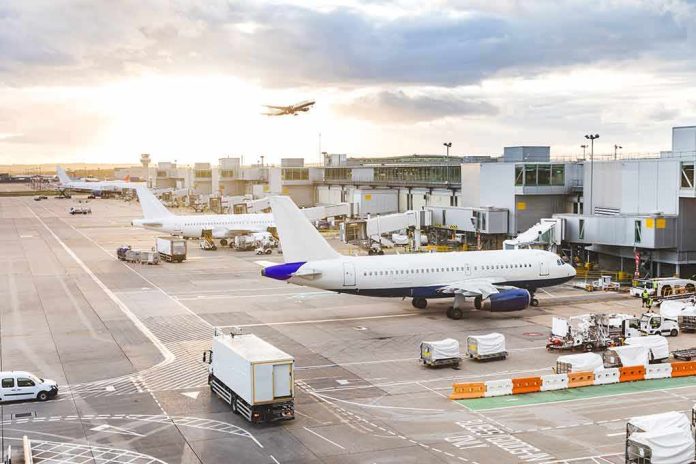
A Delta passenger slipped past a secured door at John Wayne Airport, stole a baggage tug, crashed it, and then tried for a second truck before officers stopped him.
Story Snapshot
- Airport officials say the breach began near Gate 12 around 5:30 p.m..
- The man stole an Alaska Airlines tug and crashed near Gate 7, then targeted another truck.
- Operations paused in the immediate area while police detained the suspect.
- The case joins a broader pattern of rare but recurring airport perimeter breaches.
How a Passenger Reached the Tarmac and Grabbed a Tug
Airport officials said the man exited the terminal near Gate 12 at about 5:30 p.m., reached the airfield, and took an Alaska Airlines tug used to move baggage carts. He drove across the ramp and hit another service vehicle near Gate 7, drawing a fast response from airport police and ground crews. After the crash, he tried to take a second vehicle, described as a service truck, but officers intervened and detained him without reported injuries to travelers or flight crews.
Air traffic control audio captured the ripple effect on the ramp as pilots asked why police were racing behind parked jets. A controller told a flight crew that someone had “stolen a tug,” and the airport paused ground movements in that sector while responders cleared the scene. Officials said any disruption was brief and contained to the immediate gate area as crews checked vehicles and reopened the taxi lane. The tight window matters; rapid ramp control often prevents a spectacle from becoming a crisis.
What the Charges Signal About Security and Accountability
Orange County authorities booked the suspect on counts that included vehicle theft, trespassing, and vandalism, matching the core acts reported by airport staff and seen on the field. Those charges send a simple message that aligns with common-sense law and order: secure areas are not suggestions. When someone crosses a restricted line and takes heavy equipment, police and prosecutors move fast. The tug is not a toy; it can shove a jet, injure workers, or damage key ground gear during pushback and fueling.
Airlines also face a checklist after any equipment incident. Mechanics inspect the tug for frame and steering damage. Ground managers review keys, kill-switches, and parking procedures. Airport operations teams audit badge access and door alarms. The result often looks dull on paper—memos, retraining, logs—but that boring rigor is how the system resets and next-day flights go out on time. Most readers never see those playbooks; travelers benefit from them every day.
Why “Rare but Repeating” Breaches Keep Showing Up
This kind of breach is unusual at any one airport, yet it is not a unicorn across the national system. An Associated Press review found hundreds of perimeter intrusions at major airports across a decade, with dozens reaching runways, taxiways, and gates. Another review of airport fence intrusions estimated a cadence of days, not months, between events when you sum activity across large hubs. The pattern holds: a person finds a weak link, gains access, triggers a quick police surge, and operations resume.
Most passengers waiting for their flight to Seattle find a bar or sit at the gate. One Delta passenger at John Wayne Airport allegedly decided to take a slightly different route.
Airport officials say the man slipped into the restricted ramp area at around 5:30pm Tuesday before… pic.twitter.com/z27jOOltze
— Flightdrama (@flightdrama) October 7, 2026
Experts and front-line crews will argue over the same three levers after this one: doors, people, and culture. Doors need alarms that get a fast response. People—both workers and passengers—need a clear sense that airfield lines are hard lines. Culture matters most: managers must close small gaps, not just big ones. That view tracks with conservative instincts about responsibility. Lock the gate. Empower the cop on the corner. Fix what failed, then measure if it stays fixed.
Sources:
upi.com, ground.news, edition.cnn.com, newser.com, us.headtopics.com, viewfromthewing.com, nypost.com