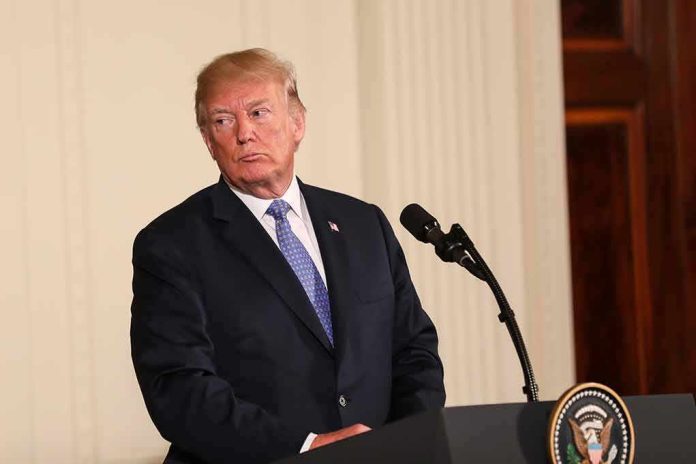
President Trump called a Reuters reporter “sick” and “way out of shape” after being asked a simple question: why did he cancel his Kansas rally just one day before it was set to happen?
Quick Take
- Trump scrapped his October 30 Salina, Kansas rally on October 29 with no reason given at first.
- Reuters reporter Jacob Bogage asked if the cancellation meant Trump was “sick of traveling.”
- Trump fired back, calling the reporter “sick,” “disgusting,” and “way out of shape.”
- Trump said he felt “perfect” and planned a tele-rally instead because Senator Roger Marshall was “doing very well.”
A Last-Minute Cancellation Raises Eyebrows
Trump had been scheduled to appear in person at a rally in Salina, Kansas, on October 30, backing Senator Roger Marshall ahead of the midterms. One day before the event, the trip was scrapped. No explanation came with the announcement at first, leaving reporters and Kansas Republicans to wonder what changed so close to the date.
The Kansas Republican Party confirmed the rally was off, and airport staff in Salina backed that up too. With five days left before election day, skipping one of the final planned campaign stops was bound to draw questions, especially from a press corps trained to spot sudden schedule changes.
The Question That Set Off The Exchange
Reuters reporter Jacob Bogage asked Trump directly whether skipping Kansas had anything to do with him being “sick of traveling.” It was a fair question given the packed campaign schedule Trump had kept in the weeks before. Reporters are supposed to ask about unexplained changes to a president’s public plans, and this one was unexplained at the time it was asked.
Trump did not take the question well. He snapped back, “Oh, you’re sick to ask that question. You are sick,” before turning the insult personal. He told the reporter he looked “like hell,” called him “disgusting,” and said he was “way out of shape.” The exchange was caught on camera and spread fast online.
Trump’s Own Explanation Undercuts The Fatigue Theory
Trump did not dodge the underlying question, he answered it, just not the way the reporter framed it. He said he felt “perfect” and that the real reason was political, not physical. “I don’t feel I have to go to Kansas,” he said, adding that Marshall was “doing very well” without him there. He said a tele-rally would fill the gap instead.
This is a header
That explanation lines up with what the White House told reporters separately: Trump planned a tele-rally for Marshall and other Republican candidates rather than flying to Kansas in person. A person familiar with the plans described the Salina stop as converted into a virtual event, and the Salina Airport Authority director called it a scheduling matter, not a health issue.
None of the available reporting shows a medical record, doctor’s statement, or staff account tying the cancellation to illness. The reporter’s question was reasonable to ask given the abrupt timing, but Trump’s answer, paired with the White House’s tele-rally explanation, gives a specific, on-the-record alternative that the public record does not contradict.
Why The Insult Became The Story
Trump calling a reporter “sick” and “out of shape” is the kind of moment that travels fast on social media, often faster than the actual news it came from. That is a familiar pattern with this president. He has a long history of meeting tough questions with personal attacks on the person asking rather than a plain answer to the question itself.
Trump Savages Reuters Reporter for Suggesting Kansas Rally Was Canceled Due to Health
"You are disgusting. Put yourself in shape. You look like hell!"
Reporter 🔽 pic.twitter.com/jmCdtnKGsQ
— .*Funkytown™*. (@01Funkytown) October 30, 2026
Common sense says a sitting president should expect scrutiny when he cancels a campaign stop five days before an election, especially one tied to a Senate race Republicans want to win. Answering the question, as Trump eventually did, serves voters better than name-calling. The insult may have grabbed headlines, but the tele-rally explanation is the part worth remembering.