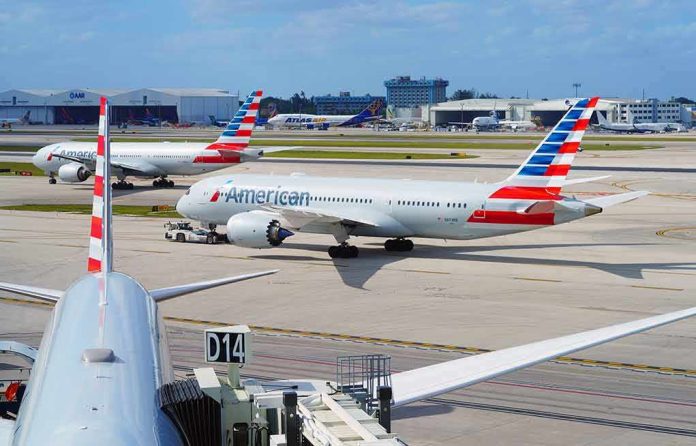
A Mayday call, a shut-down left engine, and 178 people counting seconds to a safe runway.
Story Snapshot
- American Airlines Flight 496 from Tampa to Washington diverted to Orlando after an engine problem.
- The crew declared an emergency, reported issues on the left engine, and landed safely around 3 p.m..
- Senator Ashley Moody’s office said the flight had an engine failure and made an emergency landing.
- Moody later reached Washington on another flight but missed scheduled Senate votes.
The Emergency: What Happened In The Air
American Airlines Flight 496 left Tampa bound for Washington, D.C., then turned toward Orlando after the crew reported an engine problem. Air traffic control audio, as described in news reports, captured a Mayday call and the shutdown of the number-one engine on the left wing. Orlando International offered long runways and American Airlines maintenance, so the pilots aimed for it. The jet landed safely, and the Federal Aviation Administration said it would review the incident.
Senator Ashley Moody of Florida was on board. Her office said the aircraft had an engine failure and made an emergency landing in Orlando. Media reports cited about 178 passengers and described a calm, controlled diversion rather than a chaotic event. The decision to shut down the affected engine, declare an emergency, and head for a nearby major airport matched airline playbooks taught for twin-engine jets.
On The Ground: Safety, Schedule, And Next Steps
The Federal Aviation Administration confirmed the plane landed safely at Orlando International Airport near mid-afternoon and that an investigation would follow. American Airlines routed passengers onward. Moody took the next available flight to Washington but arrived after Senate votes had closed, according to her office and outlet summaries. No official injury report appeared in the initial coverage, and outlets emphasized the safe landing while technical findings remained pending.
One descriptive gap remains normal at this stage. Early reports used different terms—engine issue, left-engine shutdown, engine failure—while the technical cause stayed unknown. That difference reflects timing, not spin: pilots report symptoms, airlines inspect hardware, and federal investigators later say what failed and why. That sequence protects safety and avoids guesswork while facts harden into findings.
Why A One-Engine Diversion Often Looks Uneventful
Modern airliners are built to fly safely on one engine. Pilots train to handle an engine problem by trimming thrust, securing the affected engine, and landing at an airport with long runways, robust fire and rescue coverage, and maintenance. That is what reports describe here. The approach echoes past events where crews shut down an engine and diverted without injuries, reinforcing that design and training reduce risk even when something serious breaks.
Republican Senator Ashley Moody (R-FL) was aboard an American Airlines flight on Monday that was forced to make an emergency landing in Orlando, following a reported midair engine failure.https://t.co/yT1gpFs2Nq
— Katie Liane (@TheKaterPotater) November 17, 2026
The crew’s reported choices also aligned with a clear priority: land soon, not somewhere remote. Orlando offers long concrete, skilled responders, and the operator’s mechanics. That reduces exposure time with one engine and speeds inspections. The public often sees “Mayday” and thinks catastrophe. In practice, “Mayday” signals that pilots want every tool—priority routing, ready trucks, and a clean path to a long runway—so abnormal turns routine at touchdown.
Politics, Perception, And A Straight Look At Facts
Coverage highlighted that a Republican senator was aboard, which guaranteed attention. That framing risks turning an aviation event into a partisan flash when the real story is standard airmanship under pressure. The facts are simple and solid: a declared emergency, a shut-down left engine, a safe landing, and missed votes because of the diversion. That aligns with common sense and conservative instincts: praise the crew’s skill, gather facts, then fix what needs fixing without drama.
Sources:
snntv.com, wisn.com, aerocorner.com, thedailybeast.com, flipboard.com, foxnews.com