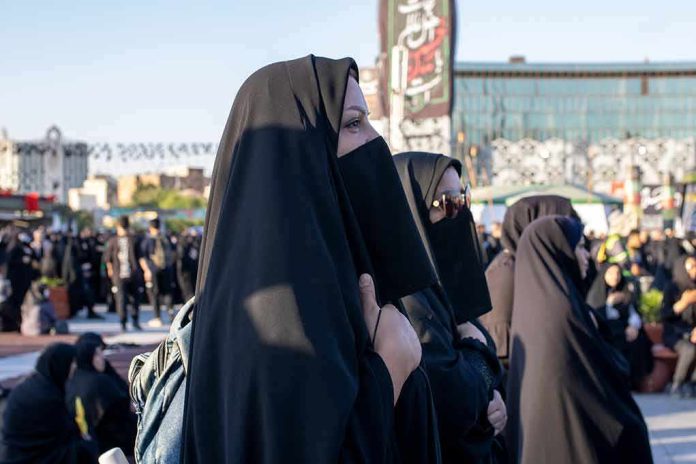
An Iranian court ordered 74 lashes for a woman whose only crime was singing on camera with her hair uncovered.
Quick Take
- Singer Parastoo Ahmadi posted a December 2024 performance online, filmed without a hijab and alongside male musicians.
- A Qom court convicted her and eight others of public indecency for publishing the video, and an appeals court upheld the ruling.
- Ahmadi and four bandmates each received 74 lashes on November 23, 2026, according to her lawyer.
- Iran Human Rights called the punishment cruel and said singing should never be a crime.
What Actually Happened At The Caravanserai
Ahmadi performed at the Deyr-e Gachin Caravanserai in Qom Province in December 2024. No live audience watched. She sang without the mandatory hijab, backed by male musicians, and later posted the footage to YouTube, where it spread fast and drew millions of views. That single decision to publish set off a legal process that would take nearly two years to run its course.
https://www.youtube.com/watch?v=s1qSkzr8t5k
Iranian authorities did not simply cite her for a dress-code violation. Prosecutors in Qom pursued a broader charge tied to publishing what they called obscene and immoral content online. That distinction matters. It let the state treat a missing headscarf and a shared video as one combined offense against public morals, rather than two separate, lesser issues.
From Conviction To The Lash
A Qom criminal court convicted Ahmadi and eight others in June 2026 of offending public decency through the publication of obscene and indecent material. Her lawyers appealed. At the end of September 2026, a Qom appeals court rejected that appeal and confirmed the sentence, according to attorney Mostafa Nili. The legal path had closed, and enforcement was simply a matter of scheduling.
That scheduling came on November 23, 2026. Nili said Ahmadi, Soheil Faghih-Nasiri, Amin Taheri, Amirali Pirnia, and Mohsen Lashkari each received 74 lashes at the sentence-enforcement unit of the Qom Prosecutor’s Office. Reports also mention two-year bans on artistic activity and on travel, stacking punishment well beyond the beating itself. For a 29-year-old whose offense was a song, that is a staggering price.
How Human Rights Groups And Ahmadi Herself Responded
Ahmadi did not frame the video as rebellion. In her own posted message, she called it an imaginary concert and said she simply wanted to sing for the people and the homeland she loved. That framing is thin as a legal defense, but it matters morally. She was not staging a political protest. She was making music and sharing it, which is exactly the kind of ordinary human act that should never invite a whip.
Iran Human Rights Documentation Center said flatly that no one should be punished for singing or for what they choose to wear, calling the flogging cruel, inhuman, and degrading. The Center for Human Rights in Iran went further, calling the sentence a flagrant violation of fundamental rights and a deliberate effort to suppress women’s freedoms. Those are strong words, but the facts here back them up.
Why This Case Keeps Repeating In Iran
This is not an isolated incident. Iran has long banned women from singing solo in public where men are present, and enforcement has swung between harsh crackdowns and quieter tolerance since the 1979 revolution. After the 2022 Woman, Life, Freedom protests, many Iranian women kept appearing uncovered in public despite arrests and business closures, showing a real gap between the law on paper and daily life on the street.
Iranian singer Parastoo Ahmadi and four members of her team were given 74 lashes each in Qom on Monday, November 23, 2026, after an appeals court upheld their convictions for her December 2024 livestreamed concert without a mandatory hijab…
In December 2024, Iranian singer… pic.twitter.com/otLQHJ8kEQ
— ArchaeoHistories (@histories_arch) November 24, 2026
Officials rarely release full court judgments or prosecution evidence in these cases, leaving reporters to rely on defense lawyers and advocacy groups for the facts. That pattern repeated with Ahmadi. The public record mostly comes from one lawyer and rights organizations, not from the state’s own courtroom documents, yet the core facts of the performance, conviction, and flogging are not seriously in dispute. For an American audience watching from a country where women choose their own clothes without fear of a whip, this case is a stark reminder of what the absence of basic freedom actually looks like.
Sources:
al.com, tvnz-1-news-prod.cdn.arcpublishing.com, nashaniva.com, al-monitor.com, bbc.com, cbsnews.com, cwibc.co.id, euronews.com, theweek.in, timesofisrael.com