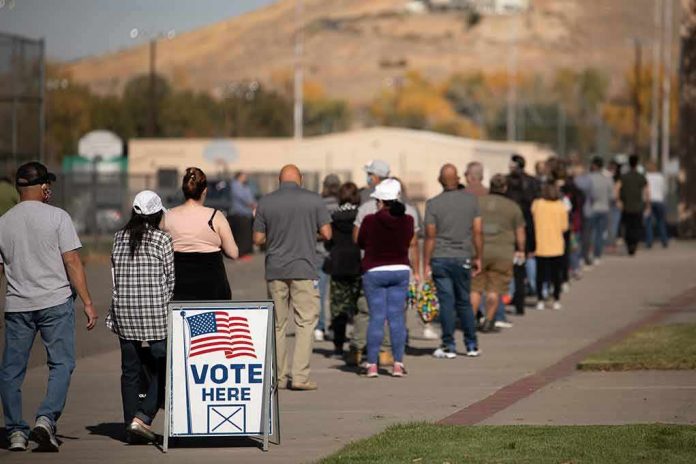
The Republican National Committee chair warned that Democrats are banking a clear early-vote lead, pressing Republicans to show up on Election Day.
Story Snapshot
- Republican National Committee chair Joe Gruters said Republicans have a turnout problem and must vote on Election Day.
- Associated Press data showed Democrats leading Republicans in early ballots in states that report party registration.
- Reporters counted more than 43 million early votes nationwide ahead of Election Day, up from 2022.
- Analysts stressed early-vote numbers show participation timing, not final candidate choices.
RNC Chair Flags Risk And Urges Election Day Surge
On November 1, Republican National Committee chair Joe Gruters said Republicans face a turnout problem and cannot assume victory if they do not vote. He told NewsNation’s The Hill Sunday that Democrats tend to vote early while Republicans show up on Election Day. He added, “If our voters turn out, we win,” and urged the base to plan now and cast ballots when polls open on Tuesday. Coverage summarized his warning as a call to action, not surrender.
Gruters’ message matched public concern among Republican officials watching early numbers. Reporters noted many Republicans feared low turnout compared with Democrats’ head start in early voting. Estimates placed Democratic early voters at about forty-three percent of early ballots and Republicans at about thirty-two percent in preliminary reads, with the rest from unaffiliated voters. The frame was simple: the clock is ticking, and every missed Republican vote could cost close races.
Early Voting Data Shows Democratic Lead In States Reporting Party
An Associated Press analysis published by PBS reported that Democrats had cast about 6.8 million early ballots in states that disclose party registration, compared to about 5.2 million for Republicans. Nationwide, more than 43 million people had already voted early, which is almost ten million more than the same time in 2022. The analysis underscored a measurable participation gap in early returns where data exists and highlighted a faster early pace this cycle.
The Associated Press also cautioned that party registration does not reveal which candidates those voters chose. Early-vote counts track participation, not preferences, and totals vary by state rules. That means a Democratic registration edge in early ballots shows a timing advantage, not a verdict. Republicans can still overcome the gap with strong Election Day turnout if they vote in force, as the party chair emphasized in his interview.
What The Numbers Mean For Strategy Under President Trump
Republicans have long leaned on Election Day voting while Democrats build early banks of ballots. That pattern appears again in 2026. The strategic risk is simple: when one side spreads voting across weeks and the other compresses it into one day, any Election Day disruption can hit harder. Weather, long lines, or local glitches can cost real votes. Gruters’ push aims to reduce that risk by moving some votes earlier where possible and by driving disciplined turnout plans.
Practical steps are clear for readers who back conservative goals. Confirm your polling place hours. Arrange a ride for family or neighbors. Bring a valid identification if your state requires it. Vote early in person if your state is still open, or show up early on Tuesday to avoid lines. Democrats are banking votes now; Republicans must answer with turnout that matches their goals on the border, energy, spending, schools, and constitutional rights. If Republicans show up, the map looks different.