The most shocking part of the Highway 99 fireball is that two men walked away from an 8,600-gallon explosion that could have killed dozens.
Story Snapshot
- A fuel tanker carrying 8,600 gallons slammed into a disabled box truck and erupted into a towering fireball.
- Southbound Highway 99 near Selma shut down for hours as crews fought flames and protected drivers from a second disaster.
- Both truck drivers survived with minor injuries, a rare outcome when that much fuel turns a freeway into a blast furnace.
- The crash exposes how one shoulder stop and one impact can test every rule of highway safety and personal responsibility at once.
A quiet shoulder stop turns into a highway firestorm
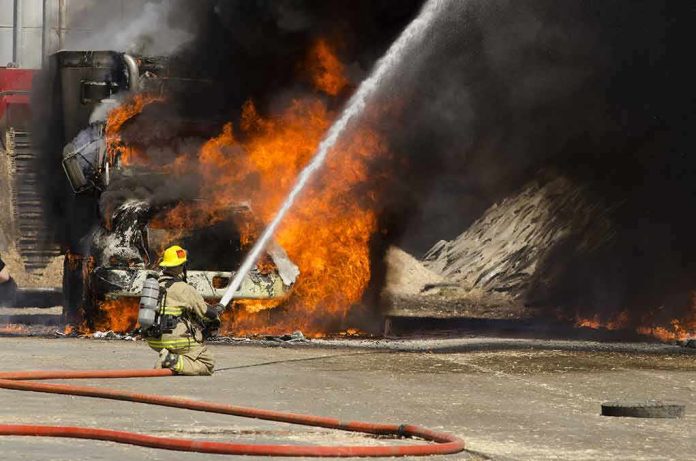
Southbound drivers on Highway 99 near Selma saw something strange before the blast. A box truck had pulled onto the right shoulder, disabled by a flat tire and waiting for help. Ten minutes later, a Peterbilt fuel tanker hauling about 8,600 gallons of gasoline came through the same stretch. The tanker struck the box truck, and in seconds the freeway turned into an orange wall of flame that towered above the overpass.
Witness video shows the tanker fully engulfed, flames shooting high as a dark column of smoke marks the crash for miles. Local outlets describe the impact as so intense that it forced officials to shut down southbound Highway 99 and divert traffic onto surface streets, effectively cutting a major vein of California’s central valley. Drivers who were seconds behind the crash stopped on the shoulder and watched a normal Saturday turn into a scene that looked closer to a war zone than a commute.
Two drivers survive a blast that should have been fatal
The most surprising fact is simple: both truck drivers lived. The Fresno Bee reports minor injuries to both. A later account notes one person treated for minor burns. In the world of large-truck crashes, that outcome is rare. Federal research shows that fuel-heavy collisions often lead to severe burns, rollovers, or mass casualty events when impact ruptures a tank at speed. This time, timing and angle spared lives even while fuel fed the fire.
Early chatter claimed the tanker driver was in critical condition, but that narrative faded as more specific reporting from the California Highway Patrol made clear both drivers walked away. That swing from “critical” to “minor” is a reminder for any conservative who values truth over clickbait. Fast social posts reward drama more than accuracy. Responsible reporting waits for real injury data, not guesswork shouted into a feed.
Confusion over what really caused the crash
One detail still raises hard questions. Some reports echo a line that an unsafe lane change caused the crash. Later accounts, based on California Highway Patrol briefings, focus instead on the disabled box truck parked on the shoulder, waiting for assistance when the tanker hit it. The public has not yet seen the full collision report. That file would spell out the primary collision factor officers chose and the facts they used to justify it.
The California Highway Patrol collision manual shows that an officer must link the official cause to specific, “articulable facts.” That means the cause cannot be a hunch or political spin. It has to tie back to lane position, speed, lighting, and driver actions. Until that document appears, common sense says we should hold off on declaring the tanker driver guilty of reckless lane changing or the box truck driver reckless for stopping on the shoulder. Americans who believe in due process should want the evidence, not an instant villain.
How one crash exposes the fragile safety of shoulders
Highway shoulders look safe. They are not. Federal highway studies show that trucks that leave the lane onto narrow or uneven shoulders face higher risk of loss of control, rollover, or collision. A disabled truck on a shoulder depends on every passing driver noticing and steering wide. A loaded fuel tanker depends on the roadway design itself, including slope breaks, visibility, and shoulder width, to give the driver enough margin to recover if anything goes wrong.
In this crash, the box truck followed what highway patrol guidance tells drivers to do: move the disabled vehicle to the shoulder and wait there to meet obligations safely. The tanker driver, for reasons still not spelled out in public, ended up striking that parked truck. Somewhere in that chain we will likely find a blend of human error and road design limits. For readers who value personal responsibility, the lesson is sharp: a legal shoulder stop is not the same as a safe shoulder stop, and large trucks magnify every choice by several tons.
Why this fireball matters beyond one scary video
Video of the Selma blast burned through social media faster than the fuel itself. Clips and headlines pushed the dramatic image of the explosion, often in just a few seconds of footage and a line about 8,600 gallons erupting on Highway 99. What many of those posts skipped was the harder part of the story: how preliminary officer summaries can lock in a narrative before the deep investigation is finished.
Highway 99 in Selma shut down Saturday after a fuel tanker crashed into a box truck, sparking a massive fire. Both drivers suffered minor injuries. pic.twitter.com/r4zEEMjU1Y
— Breaking911 (@Breaking911) August 9, 2026
California crash reports distinguish between a preliminary file and a completed investigation. The first must at least list people involved, injuries, and a basic scene description. The final report has to go further. It must identify who was at fault, name a primary collision factor, and tie that factor to detailed evidence. For citizens who want limited government yet strong rule of law, this system matters. It protects drivers from trial by rumor and stresses that official blame requires real proof.
Sources:
thegatewaypundit.com, fresnobee.com, abc7news.com, yahoo.com, kmph.com, youtube.com, facebook.com, x.com, instagram.com, nypost.com, chp.ca.gov, nhtsa.gov, sandiego.gov, scribd.com, accident-report.org