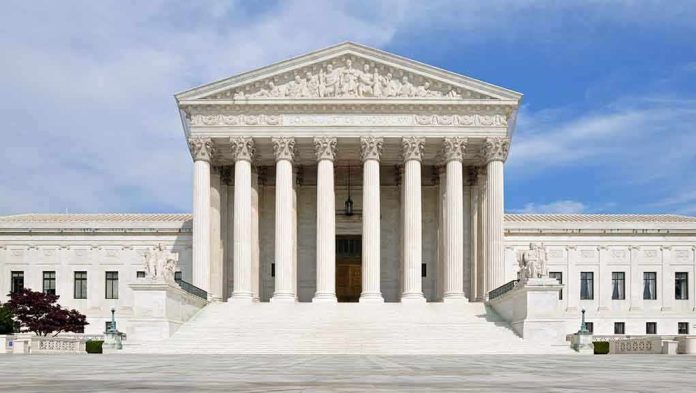
Trump’s pledge to accept the 2026 election results lands amid a renewed fight over courts, Congress, and the basic rules of power.
Story Snapshot
- Trump says he will accept the results and “doesn’t view it as a hit on me.”
- Democrats previously pushed bills to expand the Supreme Court from 9 to 13 justices.
- House Democrats passed a bill to make Washington, D.C., the 51st state in 2021.
- Backers framed both moves as pro-democracy reforms; critics see a power grab.
What Trump Said And Why It Matters Now
President Trump said he will accept the election results and added, “I don’t view it as a hit on me.” That line does two things. It cools talk of chaos. It also shifts focus to the rules that decide who governs next. The fight is not just about votes; it is about the guardrails around them. That is why old Democratic pushes to expand the Supreme Court and to grant Washington, D.C., statehood feel very current again.
Campaigns end. Institutions last. When Trump signals he will accept the count, he is saying the process still carries weight. Voters should then ask who is trying to change that process and how. Democrats have said court expansion and D.C. statehood would strengthen democracy. Conservatives hear an attempt to lock in control. Both readings cannot be true at the same time, and the record is the tiebreaker.
The Record On Supreme Court Expansion
House Democrats introduced the Judiciary Act of 2021 to add four justices, raising the Court from nine to thirteen. Sponsors said this would “restore balance, integrity, and independence” after Republican moves they called norm-breaking. Representative Mondaire Jones argued expansion was needed to counter “subversion of democracy” and to “restore balance and integrity”. Supporters also noted there are thirteen federal appellate circuits, so thirteen justices would match that structure.
As a matter of law, Congress can change the Court’s size, and it has done so in the past. Legal scholars have said the Court’s makeup has always been partly political, which is true in a narrow sense. But the practical effect of adding four seats is obvious in today’s climate. The party that passes such a bill would try to fill them and tilt rulings on elections, speech, guns, and life. That is not neutral. That is power. When sponsors frame expansion as “restoring balance,” they admit outcomes are the goal, not mere plumbing.
D.C. Statehood And The Two-Senator Question
In April 2021, the House passed the Washington, D.C., Admission Act. The Senate received the bill the same day. Backers said 700,000 residents deserve full representation. They cast it as a fairness issue grounded in simple math: no taxation without representation. The bill cleared the House Oversight Committee before the floor vote, showing organized support, not a message stunt. The bill did not become law, but the intent and the votes are clear in the record.
Fairness claims deserve respect, but statehood also comes with two senators and a voting representative. In a fifty-fifty nation, that is a big shift. Nonpartisan research arms of Congress note the Constitution raises hard questions when carving a state from the seat of federal power. Courts have not settled it. Even so, the political effect is plain. If a party adds a likely safe House seat and two likely safe Senate seats, that party gains durable leverage over judges, budgets, and war powers. Voters can like that or not, but they should call it what it is.
How These Fights Collide With Trump’s Pledge
Trump’s acceptance stance lowers the temperature around the count. It also throws light on the bigger project: who sets the rules next time. Democrats say court expansion and D.C. statehood protect democracy from a Supreme Court they view as hostile and from underrepresentation in the capital. That is their stated case. The counter is simple and strong: reforms that yield pre-set winners stop being reforms and start looking like entrenchment. Stability needs rules both sides can live under when they lose.
Common sense says we guard referees from the teams. That means we do not change the Court to fix a week’s rulings. It also means we do not add states to fix a month’s Senate math. If Congress ever touches these levers, it should do so with overwhelming, cross-party buy-in and clear constitutional footing. Trump can accept results. The rest of us should accept a harder task: demand reforms that outlast our side’s wins and bind our side’s losses.
Sources:
youtube.com, statehood.dc.gov, congress.gov, reuters.com, politifact.com, beaconjournal.com