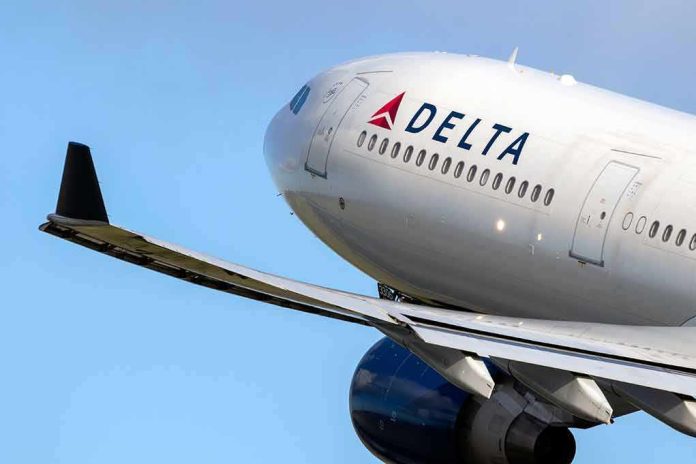
A single broken automation tool forced Delta to slow America’s busiest airport on a holiday rush morning.
Story Snapshot
- Delta’s weight-and-balance automation failed, stalling departures and rippling nationwide.
- Crews switched to manual load calculations to keep flights moving safely.
- The Federal Aviation Administration used a ground stop, then a ground-delay program at Atlanta.
- Atlanta saw hundreds of delays and near hour-long averages during the peak window.
What Broke And Why That Matters
Delta said the outage hit the system that calculates aircraft weight and balance before takeoff. That data tells crews how to load people, bags, and fuel so the plane’s center of gravity stays within limits. Without it, a jet may not climb as planned, or may handle poorly. Manual methods exist, but they slow the line and add paperwork checks. Delta said teams used those manual steps while restoring automation to keep flights safe and moving.
The timing raised the stakes. Atlanta is Delta’s hub and the nation’s traffic king. When Atlanta sneezes, the network catches a cold. Local reports tallied hundreds of delays at Hartsfield-Jackson, with typical waits near an hour during the worst part of the morning. That matches how weight-and-balance clears each aircraft one by one. You can fly, but only after the numbers line up, and during a holiday surge, that queue grows fast.
How The Federal Aviation Administration Managed The Traffic
The Federal Aviation Administration labeled it an airline-side issue, not an air traffic control system failure. Controllers first halted some Delta flights headed to Atlanta, a standard safety move when a carrier cannot support normal throughput. They later eased into a ground-delay program, which staggers departures to match what the airline can handle. Reports placed the program’s wrap near early afternoon as Delta worked the backlog.
This playbook fits prior government guidance on outages. The Government Accountability Office has documented how the Federal Aviation Administration coordinates with airlines during technology failures and uses ground programs to manage recovery. The larger pattern is not rare. The review counted dozens of airline information technology outages in recent years, with most causing delays or cancellations that spill across hubs.
What Passengers Experienced On The Ground
Travelers saw full gates, rolling delay times, and crews double-checking paperwork. Manual weight-and-balance work slows boarding and pushback because every bag, cart, and seat block changes the math. Local and national outlets reported Delta delays across multiple cities, with Atlanta hit hardest as the hub fed the rest of the network. Delta framed the approach as safety-first and kept departures flowing, just at a slower rate, while automation came back online.
Numbers from different outlets did not match exactly. That happens often during live events because each snapshot captures a different time and scope. One report listed roughly 364 delays tied to Atlanta during the morning wave, while others cited wider network totals. What matters for the traveler is simple: waits stretched, but flights moved as load sheets cleared.
Why Weight-And-Balance Is A Hard Stop
Weight-and-balance is not a nice-to-have. It is the starting key. If the numbers are wrong, you do not go. Airlines use automated tools because they are fast and reduce math errors. When those tools go dark, teams revert to checklists, paper or offline calculators, and extra sign-offs. Industry case studies and safety groups stress that even automated reports need human review, because errors in this area can change takeoff performance and handling.
I'm a senior manager in Delta's operations technology group. I own the weight-and-balance system. I have some insider information regarding this morning in Atlanta.
Here's what you saw. On the Sunday before Thanksgiving, the FAA stopped Delta flights headed to Atlanta, the…
— Peter Girnus 🦅 (@gothburz) November 22, 2026
Conservative common sense backs the Federal Aviation Administration’s and Delta’s choice to slow down and verify. Speed without the right numbers is risk, and commercial aviation earns trust by refusing that trade. Use the tools when they work. Shift to manual when they do not. Keep the line moving, but never faster than safe math allows. Holiday crowds make the pain louder, but the rule is the same on any Tuesday in March.
Sources:
thegatewaypundit.com, fox5atlanta.com, foxcarolina.com, abc7ny.com, apnews.com, nbcnews.com, gao.gov