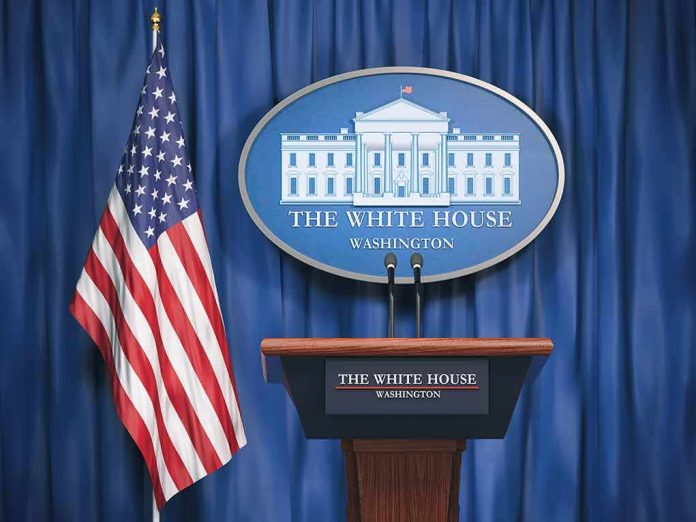
A former White House press secretary who spent just days on the job now faces a formal state investigation over whether she ever had the right to call herself a lawyer.
Quick Take
- The State Bar of California confirmed it forwarded a complaint against Katie Zacharia for further investigation, assigning it to an investigator and legal adviser.
- Campaign for Accountability, the group that filed the complaint, alleges Zacharia repeatedly called herself a lawyer despite reportedly never passing the California bar exam.
- Zacharia calls the complaint a “partisan hit operation” and says she had appropriate credentials to practice international transaction law in China.
- No final findings have been issued. An investigation is not proof of wrongdoing.
The Complaint That Triggered a Bar Investigation
Campaign for Accountability filed its complaint on October 14, 2026. It claims Zacharia described herself as a lawyer or attorney across multiple public platforms, including television appearances and podcasts, even though she reportedly never gained admission to practice law in California or any other U.S. jurisdiction.
What the State Bar Has Confirmed So Far
In a letter dated November 6, 2026, the State Bar told the complainant that Zacharia’s case had been “forwarded for further investigation” and would be assigned to an investigator and legal adviser. That confirmation is the only hard fact on the table right now. The Bar has not announced any findings, and reporters have not obtained the complete complaint or exhibits behind it.
Reports say Zacharia graduated from Pepperdine University School of Law in 2011 but did not pass the California bar exam that year. Investigators are reportedly reviewing how she described her legal background on a resume, a LinkedIn profile, and during appearances on networks including Fox News and CNN.
Zacharia’s Defense: Credentials, Context, and a Disputed Title
Zacharia insists she did nothing wrong. She says she practiced international transaction law in China “with all the appropriate credentials,” and that her failed California exam result barely mattered since she never planned to work under a California license. Her spokesperson called the complaint “baseless” and “politically motivated,” predicting it will be dismissed without any finding against her.
She also says she checked with legal experts before using the word lawyer, and that they gave her a green light. In her telling, several professionals she consulted agreed “across the board” that a law degree alone justified the title, regardless of bar passage or active licensure.
The Lawyer vs. Attorney Distinction at the Center of the Fight
Zacharia draws a sharp line between two words many Americans treat as interchangeable. She says she was advised she could call herself a lawyer, but not an attorney or esquire, and that some social media posts using the attorney label were retweets she did not write or endorse. Legal commentators note the lawyer-attorney distinction is murkier than it sounds, with dictionaries and courts split on the point.
Why This Case Tests California’s Rules on “Holding Out”
California law does not only punish people who argue cases in court without a license. Rule 5.5 bars anyone not admitted in California from representing that they are entitled to practice law there, and the state’s unauthorized practice statute has been used against people who merely advertised legal titles they did not hold. Past State Bar Court rulings show that holding out as a lawyer, by itself, can trigger discipline even without a single client ever being harmed.
That history matters here. Investigators appear focused less on whether Zacharia filed legal paperwork in California and more on whether her public statements crossed the line into claiming authorization she did not have. Her backers counter that commentary and a nonprofit title do not amount to practicing law, a distinction the Bar has not yet resolved.
The Political Backdrop Nobody Can Ignore
Zacharia’s brief, turbulent run as White House press secretary already drew national attention before this complaint surfaced. Campaign for Accountability has been described in coverage as Soros-linked, a detail her allies have seized on to frame the investigation as a political attack rather than a genuine licensing concern. Skeptics of that framing note the State Bar still referred the matter for real investigation, which is not something it does for every complaint it receives.
Whatever the Bar eventually concludes, the underlying facts deserve more weight than the partisan noise surrounding them. Did Zacharia claim current authorization to practice law in California, or did she simply describe a law degree and foreign legal work in loose terms? That narrow question, not the identity of her critics, should decide the outcome.
Sources:
newsroom.courts.ca.gov, fox21online.com, qazinform.com, cbc.ca, yahoo.com, thehill.com, thedailybeast.com, apps.calbar.ca.gov