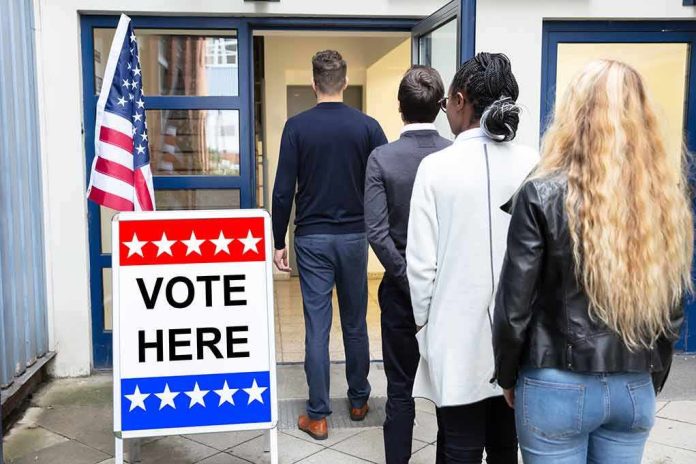
The fight over ICE near polling places is not about illegal voters sneaking into the booth—it is about how far government power can go before it scares lawful Americans away from the ballot box.
Story Snapshot
- Noncitizens cannot legally vote, but Immigration and Customs Enforcement (ICE) still shadows many communities.
- Representative Ro Khanna calls ICE a “rogue” agency and wants its funding rolled back and its structure torn down.
- Khanna links ICE abuses, harsh detention conditions, and voter suppression as part of one deeper problem.
- Conservatives see his warnings as ideology, while he frames them as a fight for constitutional rights.
Khanna’s war on ICE goes far beyond one election talking point
Representative Ro Khanna has built a full political brand around confronting Immigration and Customs Enforcement, and it is not a minor side issue. He has pushed a “10-point plan” to end ICE abuse that calls the agency “rogue” and says Congress must rein it in to restore trust in democracy. That plan includes repealing a multi‑year seventy‑five billion dollar ICE funding increase, blocking any new money, and even dismantling ICE and replacing it with a new agency inside the Department of Justice.
Khanna is not just speaking in vague moral terms; he lays out hard tools of punishment. His blueprint demands ending qualified immunity for ICE agents, directing outside prosecutors to pursue every agent who breaks the law, and banning tactics he compares to aggressive “stop and frisk.” He wants body cameras, no masks, and clear identification on officers. In his view, immigration enforcement must look less like a secret police force and more like regular law enforcement bound by civil‑rights rules.
From detention cells to Super Bowl protests, he paints ICE as a civil rights threat
Khanna’s anger toward ICE sharpened after he walked into the California City detention center and said he saw blood in a detainee’s urine, rocks in the food, and people shivering without clothes. He described the scene as a human rights crisis and argued that enforcing immigration law under those conditions crosses a moral line. In his retelling, these are not isolated mistakes; they show a culture of abuse that makes ICE unfit to hold unchecked power in any public space, including airports and voting sites.
He takes that message onto big stages. Khanna joined a protest against ICE outside the Super Bowl, demanding “no new funding” for the agency while fans streamed past the stadium. He also signed letters opposing armed ICE agents at airports, warning that visible immigration enforcement where families move and travel can cause “chaos” and fear. When he goes on podcasts, he links ICE abuses directly with voter suppression and says a “culture of impunity” threatens up to one hundred forty million Americans.
Noncitizens cannot vote, but fear can reach lawful voters too
Critics look at this and ask the blunt question: if noncitizens cannot legally vote, why worry about ICE at the polls at all? That challenge sounds simple, and for talk radio it is perfect. But it skips over how real households live. Many American citizens share homes with relatives who lack legal status. Others are naturalized citizens who still fear any contact with immigration officers after years of paperwork and interviews. Fear does not stop at the citizenship line.
Khanna’s argument fits a long history in American election law. States and Congress have often had to deal with “chilling effects,” where the visible presence of police or federal agents near polling places can quietly reduce turnout even without a direct threat. In that tradition, lawmakers like Nikema Williams have proposed laws to ban immigration agents near polls, warning that ICE activity around voting sites can intimidate communities, not just illegal immigrants. Khanna’s larger record makes clear he sees ICE as one more arm of government power that can chill participation when it shows up where people vote.
Defund, tear down, and start over: what that says about his motives
Conservatives and many swing voters hear all this and see something else: a man who simply wants to defund immigration enforcement. Khanna goes on national television to say “no additional funding for ICE” and calls for repealing the seventy‑five billion dollars already approved for the agency. He accuses ICE and the broader federal government of violating the First, Second, and Fourth Amendments at the same time and says the government is “killing American citizens.”
He does not hide the endgame. Khanna says ICE “has been corrupted,” “tainted,” and is “an agency that is rogue… killing American citizens,” followed by the simple command: “Tear it down.” From a conservative, law‑and‑order perspective, that sounds less like reform and more like abolition, dressed up in rights language. It is easy for opponents to argue that his worries about ICE near polling places are just another tool in that larger push to strip immigration enforcement of money and power.
The tension between safety, sovereignty, and trust at the ballot box
American conservative values hold two strong ideas at once: the nation has the right to control its borders, and citizens should never fear their government at the ballot box. Khanna leans hard into the second idea and uses horror stories from detention centers and hard talk about constitutional rights to claim ICE has crossed the line. He sees the same culture behind bloody urine in a detention cell and a uniform at a polling place: unchecked power that can scare people into silence.
His critics focus on the first idea. They argue that strong immigration enforcement is part of national sovereignty and that warnings about ICE near polling places distract from the simple truth that only citizens can vote. They also point to Khanna’s “tear down ICE” rhetoric to say his election concerns are not neutral, but part of an agenda to weaken enforcement across the board. The public record does not yet show clear data that ICE presence has lowered turnout, but it does show a deep battle over what kind of government people should see when they walk in to cast a ballot.
Sources:
youtube.com, pbs.org, thetonymichaels.substack.com, npr.org, ktvu.com, congress.gov