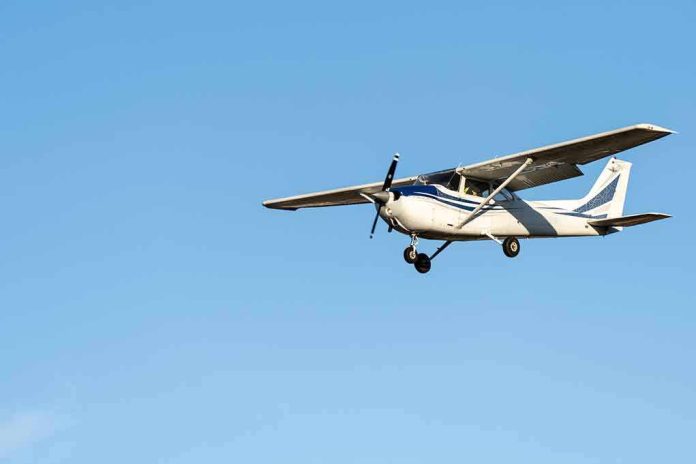
Four relatives vanished between islands and home, and the clock on survival is unforgiving.
Story Snapshot
- A Piper PA-34 with four aboard lost contact west of Andros Island, Bahamas.
- Bahamian and U.S. teams are running a joint air-sea search.
- The flight departed Great Harbour Cay bound for South Florida.
- Families are pleading for help as officials expand the search grid.
Contact lost over a narrow stretch of ocean
Bahamian authorities said a PA-34 Piper aircraft, tail number N212ML, departed Great Harbour Cay late Monday morning with four people on board, including two grandparents and their grandchildren, and then went dark over water about 13 miles west of Andros Island. The route to Miami crosses a shallow bank and then deep water. That geography matters for search crews. Shallow seas yield debris sooner; deep trenches can hide it for days.
The Royal Bahamas Defence Force and the United States Coast Guard launched aircraft and boats soon after a distress report and loss of radar contact, coordinating search patterns and asset handoffs by sector. Local police on Andros focused near Red Bays, where early reports pointed crews toward likely impact zones. Family members in Miami asked the public for tips and urged boaters to scan the waterline for debris that could drift fast with the prevailing currents.
What the timeline signals to rescuers
Officials placed the last known position west of Andros, indicating the aircraft had crossed the first leg from Great Harbour Cay and was aiming toward the Florida Straits corridor when contact dropped. That timing sends searchers to a corridor where winds can push floating items north within hours. Crews typically start with a datum based on winds, waves, and currents, then widen out. That discipline matters when minutes decide whether a life raft or small oil sheen is found.
Search teams often split the job. Fixed-wing aircraft fly parallel sweeps at altitude to spot patterns. Helicopters move low and slow to verify targets and drop swimmers. Cutters or patrol boats then close in. This is standard playbook for the Bahamas and the United States in shared waters. The goal is simple: find anything that floats, tag it, and backtrack it to the point of origin before the trail scatters.
Why small-plane searches feel personal and urgent
General aviation carries families, not anonymous crowds, which makes each case feel close to home. The Federal Aviation Administration has tracked steady improvements in fatal accident rates since 2009, and reports 2024 as the lowest rate since it began that record, yet hundreds of accidents still occur each year across a vast fleet. When a small plane vanishes over water, the absence of wreckage can outlast hope, which is why search leaders push hard in the first 24 to 48 hours.
Past cases shape decisions today. Investigators look for repeat factors: weather shifts, fuel stops, and equipment like emergency beacons. International Civil Aviation Organization guidance defines how authorities collect facts, preserve evidence, and coordinate across borders once wreckage is found. That structure keeps everyone aligned. Families deserve speed and accuracy. Taxpayers deserve competent coordination. Both are possible with tight command and clear roles.
What officials have and have not said
Authorities confirmed the aircraft type, tail number, departure point, destination, and last known area, and that four family members were on board. They have not stated a cause. That restraint aligns with good practice. Mechanical failure, spatial disorientation, fuel planning, and sudden weather can each turn a routine hop into an emergency. Declaring a cause before divers, sonar, or debris tell the story invites error and distracts crews from the search.
A South Florida family is asking for help finding their loved ones after a plane carrying four relatives went missing while flying from the Bahamas to the Miami area, prompting a multi-agency search effort involving the US Coast Guard. https://t.co/Ml8BQKzYKl
— ANI (@adickson1975) September 8, 2026
The next decisive moment comes when searchers find a confirmed item from N212ML or a data source that narrows the grid. That could be a seat cushion, a logbook, or a personal item. It could be a radar return matched to time and altitude. Any one of those can shift the operation from wide-area search to focused recovery. Until then, crews will fly and sail the lines. Families will hold vigil. Neighbors can help by sharing the official updates, not rumors, and by giving space to those in shock.
Sources:
nypost.com, miamiherald.com, nbcmiami.com, tampabay.com, faa.gov