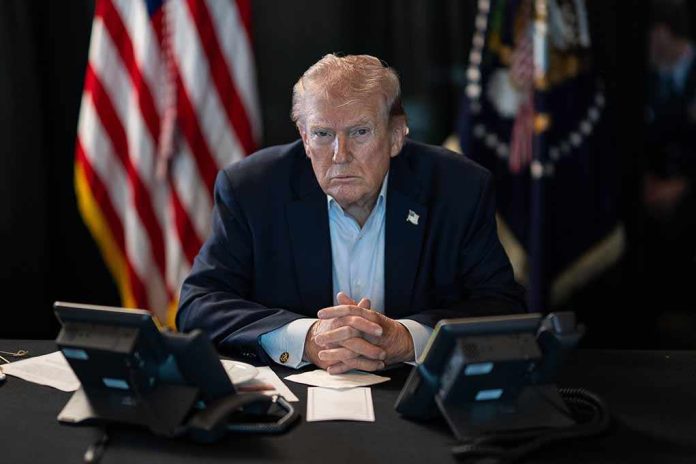
Trump told rally-goers that paying more for gas is a small price to stop a hostile regime from getting nuclear weapons, and the fallout hit fast.
Story Snapshot
- Trump framed higher gas prices as a tradeoff for national security and said they would fall soon.
- Average gas prices hovered above $4 per gallon in early September, with some states far higher.
- Polls show most voters blame Trump for the surge, citing war-related shocks.
- Energy agencies link price jumps to supply risks and Middle East disruptions.
What Trump Said And Why It Landed Like A Brick
Trump told supporters they might pay “a tiny little bit more” at the pump because the United States is stopping a terror state from getting a nuclear weapon. He called it “the right thing” and said prices would come “tumbling down” soon. That message set a clear tradeoff: national security first, wallet second. It also created a timer. If prices drop soon, he banks credit. If they do not, the line becomes a liability that opponents will replay on loop.
National average gas prices stood at about $4.22 per gallon on September 9, up sharply from a year earlier, with California near $5.87. Some regions saw even higher posted prices. The jump tracked with a tight global oil market and war risk premia. Consumers feel that every week. Household budgets flex little for a cost that visible. The more people see $80 fill-ups, the less patience they have for promises that rely on “soon.”
The Blame Game Meets The Family Budget
A Reuters/Ipsos survey found 77 percent of registered voters say Trump bears at least some responsibility for the rise in gas prices, linking it to the war with Iran and Israel. Another poll reported more than eight in ten Americans say gas prices strain their budgets, and a clear majority blame Trump for the current increase. That is not a niche complaint. That is the middle class, independents, and many 2024 Trump voters deciding what hurts most this week.
Price pain changes voting faster than any speech. Voters do not buy futures curves; they buy regular. If the president says the pain is a “small price,” he must match it with a clear plan to lower costs. Conservative common sense says peace through strength and energy abundance go together. The message works only if supply grows, shipping lanes stay safe, and refining runs high enough to pull prices down in weeks, not quarters.
What Actually Drives The Price On The Sign
The Energy Information Administration explains that oil and fuel prices jump when conflict threatens supply or creates uncertainty. Disruptions and fears about future flows move crude and product markets fast. When the Middle East turns unstable, traders price in risk. That lifts crude benchmarks, which later ripple into retail gasoline and diesel. The gap between crude and the pump is not a mystery; it is a lag with taxes, transport, and refining stacked in.
Agency outlooks flagged that global stockpiles fell and that supply routes near the Strait of Hormuz faced stress, pushing expected oil prices higher. That backdrop can overpower even aggressive domestic drilling headlines. Presidents can release reserves, ease rules, or push pipeline fixes. They cannot conjure spare capacity abroad or reopen chokepoints overnight. That does not absolve choices that raise risk, but it sets the physics that policy must beat.
The Political Math: Tradeoffs Need Timelines
Trump argued the price spike is temporary and tied to a larger win against a nuclear threat. That claim now competes with receipts from American Automobile Association averages that remain elevated and recent weekly increases. The window for “temporary” narrows with every paycheck. If the White House delivers visible drops by late fall, voters might accept the bargain. If not, they will call it a wash and punish the party in reach.
A last-minute effort by House GOP hardliners to get a floor vote on a bill to suspend the gas tax wound up coming up empty.
Members are skipping town this evening — and won't be back until mid-November.
w/@AnthonyCruznews and @NicoPortuondo https://t.co/XvrLwUMqeC
— Pavan Acharya (@pavanmacharya) September 17, 2026
Practical steps line up with bedrock conservative aims. Secure shipping lanes to calm risk premia. Fast-track refinery maintenance clearances. Expand waivers that boost seasonal gasoline supply in tight regions. Speed permits for pipelines and gas processing. Announce steady, rules-based releases from the Strategic Petroleum Reserve tied to clear thresholds, then refill on dips. Pair that with a public timeline for results. Voters do not need poetry. They need lower numbers on the marquee.
Sources:
mediaite.com, rev.com, huffpost.com, presidency.ucsb.edu, independent.co.uk