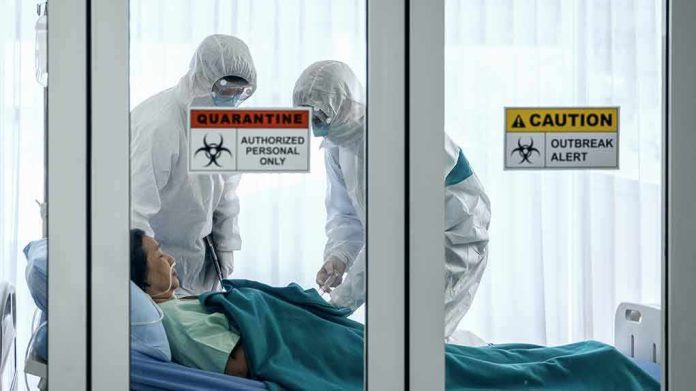
Nearly 200 people in Siberia were put under tight medical watch after a 28-year-old plague institute worker died with sudden pneumonia.
Story Snapshot
- Russian authorities activated anti-epidemic protocols in Irkutsk and Shelekhov.
- Officials said the region’s sanitary situation remains stable.
- Nearly 200 contacts entered observation or quarantine, according to multiple reports.
- Tests reportedly found no organisms tied to the worker’s lab duties.
What Happened And Where The Response Stood
Rospotrebnadzor, Russia’s public health watchdog, said a female employee at the Irkutsk Anti-Plague Research Institute died after developing pneumonia of unknown cause. The institute sits in Shelekhov, near Irkutsk in Siberia. The agency reported that “specialized protocols” and anti-epidemic steps were put in place in the area. Authorities emphasized that the broader sanitary and epidemiological situation remained stable and under control. They framed the actions as rapid containment and routine protection for the public.
Officials also said laboratory testing on patient samples did not show microorganisms linked to the employee’s professional work. That statement directly addressed public worry about an exposure to plague bacteria. The institute handles high-risk pathogens as part of Russia’s anti-plague system. Reports identified the deceased as a 28-year-old researcher or lab technician who worked at that facility. The geography and the institute’s mission raised alarm, but the agency’s lab note sought to cool that fear.
Quarantine, Observation, And Why The Numbers Matter
Local and international outlets reported that nearly 200 people connected to the case were placed under strict observation or quarantine. Some reports cited “around 200,” while others listed 197. The exact count varied by outlet, which is common in fast-moving public health responses. The three-week observation window matches standard practice for high-risk respiratory exposures. Such steps look severe to the public, but they are containment 101 for possible pneumonic transmission risk.
Containment details included contact tracing, medical checks, and limits on potential exposure points. These measures protect hospitals and emergency rooms from clusters that can seed wider spread. They also buy time for lab confirmation and clinical review. Based on the reports, authorities kept businesses and transit operating while focusing on the case circle. That targeted model aligns with proven outbreak playbooks and signals confidence that spread, if any, could be boxed in.
Why The Institute’s Identity Fuels Attention
The Irkutsk Anti-Plague Research Institute has long handled plague surveillance and other serious infections across Siberia and the Russian Far East. Its work includes research and field monitoring. When any sudden death occurs near a lab that studies dangerous pathogens, the public jumps to the worst-case scenario. Media coverage reflected that reflex. Russian officials, for their part, pointed to negative organism findings and a stable regional status to keep focus on measured steps rather than panic.
Mystery death at Russian plague lab triggers sweeping precautions as US watches closely https://t.co/jZolyxpRZa #FoxNews
— Detonics (@DetonicsMKV) October 5, 2026
The communications pattern mirrors other high-sensitivity incidents worldwide. Authorities tend to use careful language early, such as “unknown etiology,” while moving fast on containment. Outside observers read the context—plague lab, strict observation, young worker—and draw a tighter link to a feared pathogen. The responsible path for readers is to weigh the official actions and the lab’s statement together: strong containment can be both a prudent default and a sign that systems worked as designed.
How To Read The Claims Through A Common-Sense Lens
The facts carry two clear signals. First, the state treated the incident as serious, with contact observation and hospital protections. That is the right call when a respiratory threat is on the table. Second, the lab’s reported testing did not tie the death to organisms handled on the job. That claim pushes against a direct lab-acquired plague conclusion. Given those signals, a practical view favors vigilance without hype. Protect people first; let test results, not rumors, drive the labels.
What Matters Next For Public Health And Trust
Public health agencies earn trust when they move quickly and talk plainly. The reported steps in Irkutsk check the first box: rapid contact management and calm assurances. Further clarity would come from formal publication of the investigation, including test methods and timelines. That level of detail helps outside experts assess exposure risk and lab findings. Until then, the observable facts point to a contained event, strict oversight of contacts, and no confirmed spread beyond the case circle.
Sources:
newscientist.com, bostonglobe.com, euronews.com, newsweek.com, ndtv.com