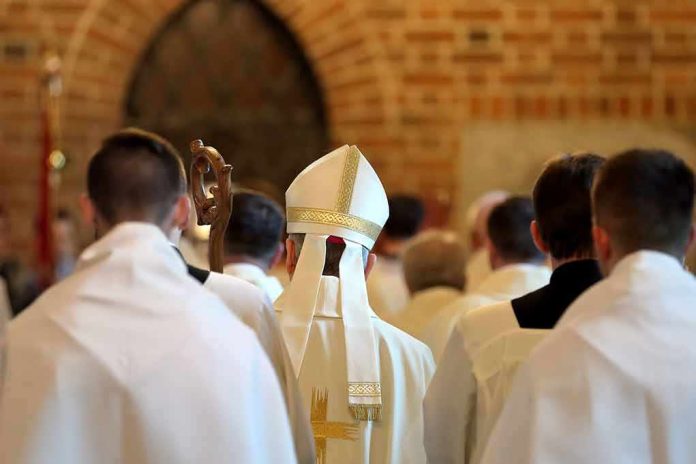
A Quranic chant echoed inside a Catholic university Mass while the archbishop sat in the front row, and that single moment now tests the line between dialogue and dilution.
At a Glance
- A Quran passage was chanted during KU Leuven’s opening Mass at St. Peter’s Church with Archbishop Luc Terlinden present.
- Reports place the date at 16 September 2026, tied to the start of the academic year.
- A student group recorded the event and framed it as incompatible with Catholic identity.
- Vatican norms forbid swapping Bible readings for non-biblical texts during Mass.
What Happened Inside St. Peter’s
Reports say a reader chanted in Arabic during the opening Mass for KU Leuven’s academic year inside St. Peter’s Church. The text was identified as a passage from the Quran, Surah 26:69–70, which asks, “What do you worship?” Archbishop Luc Terlinden attended the liturgy and, according to witnesses cited by one outlet, sat in the front row with other clergy. Hungarian Conservative fixed the date as 16 September 2026 and linked the act to the university’s ceremony to open the year.
The student group KVHV-Leuven said it recorded the moment and argued it clashed with the school’s Christian roots. The group’s public statement accused the university of blending religions in a Catholic Mass and claimed that a similar event happened the prior year under the banner of interreligious dialogue. Apollo News quoted the group’s message that Islam persecutes Christians worldwide, which is why it viewed the chant as out of bounds for a Catholic liturgy.
Where Liturgy Draws a Bright Red Line
The Catholic Church sets clear rules for what belongs at Mass. The Vatican’s instruction Redemptionis Sacramentum states that no one may replace the prescribed biblical readings with other texts, and it singles out non-biblical texts as off-limits during the readings and Psalm. That norm explains why a Quranic chant inside a Mass sparks immediate pushback. The dispute often turns on placement: whether the act landed within the formal readings or as an add-on outside the liturgical core. That detail remains unclear in current reports.
Critics say the uncertainty does not erase the problem. A non-Christian prayer inside a Catholic Mass confuses the faithful about what the Church teaches and celebrates. American conservatives look at first principles: worship should honor truth without blurring it. Inviting a text that denies core claims of the faith into the church’s central act risks trading clarity for courtesy. Unity cannot rest on mixed signals at the altar, no matter how polite the intent.
How KU Leuven’s “Dialogue” Frame Collides with Catholic Practice
Coverage links the act to a broader policy at KU Leuven that seeks openness to “other worldviews.” A report attributes to a former rector a claim that the Eucharist was adapted to reflect the university’s mission while remaining Catholic, and that Protestant, Anglican, and Muslim groups could deliver intercessions at such ceremonies. That posture helps explain how planners might have justified a Quranic moment inside a Catholic setting. But “intercessions” are not a free-form lane to import non-Christian worship into Mass.
"A passage from the Quran asking 'What do you worship?' was chanted during the opening Mass at Catholic KU Leuven attended by Archbishop Luc Terlinden" – https://t.co/AoW4kmsQIX
— Novus Ordo Watch (@NovusOrdoWatch) September 21, 2026
Common sense aligns with the Church’s rules here. A university can host interfaith dialogue before or after Mass, or in a separate event. It should not ask worshipers to parse the difference mid-liturgy. If the chant substituted for a reading, it would breach Vatican norms directly. If it sat outside the readings yet inside the liturgy, it still risks confusing the rite’s meaning. If it occurred before or after Mass, planners should have made that boundary plain. Ambiguity serves no one.
What We Still Need to Know
Open questions remain. Reports do not include KU Leuven’s official order of worship, an on-the-record statement from event planners, or a transcript that pins the exact timing and wording. The archdiocese has not publicly detailed whether it approved the inclusion or how it views the incident. A full video would settle placement, which is the key to whether this was a liturgical violation or an ill-judged but non-liturgical gesture. Until then, the facts already support a sober warning.
Sources:
lifesitenews.com, advaticanum.com, hungarianconservative.com, pal.be