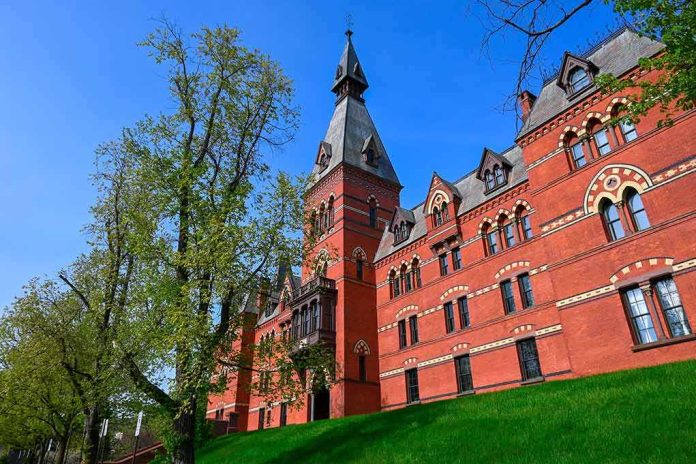
Cornell University has shut down every fraternity party on campus for the rest of the school year after a former student accused seven Chi Phi members of drugging and gang-raping her in 2024.
Quick Take
- A 101-page lawsuit filed in September 2026 accuses seven Chi Phi fraternity members of drugging and sexually assaulting the plaintiff and says a group chat was used to invite others to join.
- Cornell ran its own Title IX investigation and hearing, then banned all Interfraternity Council social events for the remainder of the academic year.
- Tompkins County District Attorney Matthew Van Houten reopened the criminal case but flagged that the lawsuit’s account differs sharply from the woman’s original police statement.
- All seven accused men deny wrongdoing, with some saying the sexual contact was consensual and others denying any sexual encounter happened at all.
What The Civil Complaint Alleges
The lawsuit, filed September 16, 2026, names Cornell, the Chi Phi fraternity, and seven individual students as defendants. It claims the plaintiff was drugged and sexually assaulted during a 2024 incident, and that fraternity members used a group chat to invite other men to take part. The complaint runs 101 pages and lays out a detailed timeline built partly on alleged screenshots and messages tied to that night.
None of those claims have been proven in court. The seven named men have all denied the allegations, with some saying any sexual contact was consensual and others denying they were involved in a sexual encounter at all. One attorney representing a defendant called the incident described in the complaint something that simply “did not happen”.
Cornell’s Response Separate From Any Criminal Case
Cornell says its Title IX office investigated the allegations for several months and then sent the case to a hearing before a trained panel of faculty and staff. The university has been careful to say this internal process is separate from any criminal proceeding. Cornell also confirmed the Chi Phi chapter was barred from campus following the alleged incident.
That internal process led to a much broader step. Cornell suspended all parties and social events at every Interfraternity Council fraternity house for the rest of the 2026-27 academic year, a decision that affects dozens of chapters with no connection to the Chi Phi allegations. The move drew heavy national attention, with outlets from Fox News to local affiliates covering the ban within hours of the announcement.
A Reopened Criminal Investigation With A Catch
District Attorney Matthew Van Houten announced his office reopened the case and plans to take it before a grand jury if the accuser cooperates. That decision gives the allegations fresh legal weight. But Van Houten also said the account in the civil complaint was “dramatically different” from the statement the woman gave police two years earlier, a discrepancy that raises real questions about which version holds up under scrutiny.
The Defense Pushes Back Hard
Scott Kretzschmar’s attorney, Jeremy Saland, said his client never touched or sexually assaulted the plaintiff and that documents, witness statements, and scientific evidence contradict her account entirely. Another defendant, Scott Norris, denied having sex or using drugs that night, though he admitted sending a message later cited in the complaint. Four of the seven men acknowledged sexual contact but described it as consensual; the rest said they weren’t involved in any sexual activity at all.
Cornell has suspended all parties and social events at Interfraternity Council fraternity houses for the rest of the academic year amid scrutiny of its handling of Jane Doe’s sexual assault case. The university says it will use that time to review whether and how fraternity life…
— Change.org (@Change) October 14, 2026
These are not minor disagreements over details. They go straight to the heart of whether a crime occurred, and no court has ruled on any of it. Treating a civil complaint’s allegations as settled fact before a trial or grand jury finishing its work would be getting ahead of the evidence, not following it.
Why This Fits A Bigger Pattern On Campus
Research on fraternity culture has long found higher rates of reported sexual assault among Greek-affiliated students compared to the broader student body. But researchers caution that fraternity membership alone doesn’t prove cause; alcohol use, social isolation, and campus-wide drinking culture all play a role too. Cornell’s decision to punish every fraternity for the alleged conduct of one chapter raises a fair question about whether the response matches the actual risk documented campus-wide.
Parents, students, and alumni now wait for two separate processes to play out: Cornell’s internal review and the district attorney’s grand jury decision. Both carry real consequences, but neither has reached a final conclusion. Fairness demands letting the evidence, not the headlines, decide what actually happened that night.
Sources:
youtube.com, us.cnn.com, statements.cornell.edu, cnn.com, apnews.com