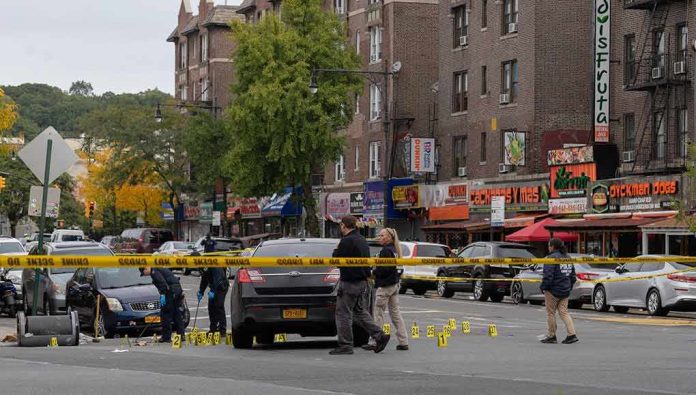
A young man in Butler County, Pennsylvania, allegedly sought a rifle to carry out an ISIS-backed mass shooting—and the FBI moved before he could pull a trigger.
Story Snapshot
- Federal prosecutors charged Jonathan Hunter Kramer with receiving a gun and ammo tied to a planned terror act.
- The Justice Department says he plotted a violent attack in support of the Islamic State.
- Agents recovered a semiautomatic rifle, five magazines, and about 190 rounds, among other gear.
- The FBI had flagged Kramer since 2023 after a juvenile case tied to a mass-casualty plot.
What The FBI And DOJ Say Happened
The U.S. Department of Justice charged Kramer by federal complaint with receiving a firearm and ammunition knowing they would be used to commit a federal crime of terrorism. Prosecutors say he engaged with Islamic State propaganda, built attack ideas, and voiced extremist goals while working to obtain weapons. ABC News reports the complaint identifies him using the alias “Hamza Al Rashid,” claiming ties to the Islamic State, and saying he was missing a “weapon” to complete his “mission”.
Agents arrested Kramer in Butler County, the same county where a gunman tried to assassinate President Trump months earlier. The complaint, according to local reporting, tracks concrete steps: leaving home with a backpack, taking an Uber to a Walmart in Gibsonia, obtaining a rifle, buying a burner phone, paying cash for a hotel, and visiting a gun store. Federal officials say his online posts, combined with those movements, established probable cause for the terrorism-linked firearm charge.
What Investigators Found And Why It Mattered
ABC News reports agents recovered a semiautomatic rifle, five rifle magazines, a bipod, a scope, about 190 rounds of rifle ammunition, an entrenchment tool, pepper spray, a prayer rug, and roughly 30 knives from Kramer and his hotel room. The gear paints a picture of a person preparing for sustained violence rather than casual possession. Prosecutors framed the arrest as a preemptive stop of a lone-actor attack inspired by a foreign terrorist group, a playbook refined over two decades of counterterror work.
The Justice Department said the subject was plotting a violent attack in support of the Islamic State while acquiring weapons thought to be preparation for the strike. That description fits the model the Federal Bureau of Investigation and partner agencies emphasize: identify a mix of online statements, steps to obtain weapons, and movement patterns that, together, show intent to act. This approach is designed to disrupt before victims exist and before a date and target turn into headlines.
Butler County’s New Place In The Security Map
Butler County now sits at the center of two major public-safety moments in one year: the Trump assassination attempt and this alleged Islamic State plot. Residents do not care about legal nuance; they want safety when they go to church, a store, or a rally. Federal agents cannot bet lives on waiting for a final target list. They act when the pattern is clear enough to meet the law’s probable-cause standard, and they take the heat for moving fast if needed.
The FBI had known Kramer since 2023, when, as a minor, he was adjudicated delinquent in Pennsylvania for his role in a mass-casualty plot and for possessing child sexual abuse material, according to the Justice Department. That history, viewed through a common-sense lens, raises the stakes when similar warning signs reappear. Federal agents are paid to connect those dots early, and this case shows the consequence of that posture.
Why The Case Fits A Larger National Pattern
The broader trend line points in one direction: more cases opened sooner. Government Accountability Office reviews document a large rise in Federal Bureau of Investigation domestic-terrorism-related cases over the last decade, underscoring the scale of modern threat hunting. The Department of Justice inspector general reported that United States Attorney’s Offices filed over one thousand domestic-terrorism cases from fiscal year 2017 through fiscal year 2022, which shows how routine these disruptions have become in federal court.
The FBI says it broke up an ISIS inspired terror plot in Pennsylvania before it could be carried out. Jonathan Hunter Kramer, 21, is charged. Attorney General Todd Blanche said the arrest came as the country marked 25 years since September 11.
FBI Director Kash Patel said the…
— Commentary Trump Daily Posts (@TrumpDailyPosts) September 16, 2026
Courts will now test the evidence. A complaint is an allegation, not a conviction. Yet conservative common sense says this: when a young man adopts an Islamic State persona, asks for a “weapon” to finish a “mission,” and gathers a rifle and hundreds of rounds, you do not wait and hope. You move, you seize, and you ask questions in court later. That is not fear. That is prudence shaped by hard lessons.
Sources:
redstate.com, justice.gov, abcnews.com, law.justia.com, abc7.com