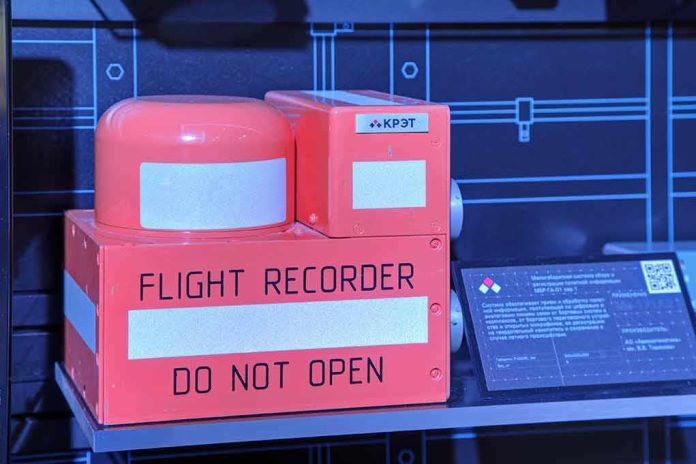
Federal investigators have pulled the cockpit voice recorder from the wreckage of a Learjet 60 that crashed near Greenacres, Florida, killing all nine people aboard.
Quick Take
- The National Transportation Safety Board (NTSB) recovered the cockpit voice recorder at the site where the jet first hit the ground.
- The device is now being examined at the NTSB Vehicle Recorders Laboratory in Washington, D.C.
- The crash happened November 1 near South Military Trail in Greenacres, Florida, killing all nine people on board.
- Investigators have finished digging at the crash site, but the recorder’s condition and contents are still unknown.
What Investigators Found At The Crash Site
The NTSB confirmed it recovered the cockpit voice recorder from the Learjet 60 that went down November 1 near Greenacres, Florida. The agency said the device turned up right at the spot where the plane first struck the ground, tying it directly to the crash scene investigators have been combing through for days. Aviation Week independently confirmed the recovery and the device’s transfer for testing.
Local outlets placed the crash site along South Military Trail between Cresthaven Boulevard and 10th Avenue North, a stretch residents in the area know well. The recorder’s recovery came only after investigators finished excavating the impact site, a sign that crews had worked carefully through the wreckage rather than rushing to grab evidence. All nine people aboard the jet died in the crash.
Why A Recovered Recorder Is Not The Same As An Answer
Finding the device is a real step forward, but it does not mean investigators already know what happened. The recorder now sits at the NTSB’s Vehicle Recorders Laboratory in Washington, D.C., where technicians will try to pull usable audio off it. Investigators have not yet said whether the recorder was damaged in the crash or whether it even captured intelligible sound in its final moments.
This gap between recovery and readout is normal in air crash investigations. Federal rules require recorders to go straight to NTSB headquarters after a crash, where specialized computer and audio equipment extracts whatever data survived. Sometimes that process produces a clean, usable recording. Other times, the data comes back overwritten, partial, or too damaged to use at all, as happened in a 2024 Alaska Airlines accident where investigators could not recover audio because the information had been recorded over.
What The Law Says About Releasing The Tape
Even if the lab pulls clean audio, the public will not hear it. Federal law bars the NTSB from releasing the actual cockpit voice recorder tape to anyone outside the investigation. What the agency can release, once the investigation reaches a public stage, is a written transcript of the recording, edited to remove material the law protects. That transcript, not the raw audio, becomes part of the public case file.
That legal limit matters for managing expectations. Families, reporters, and the flying public understandably want to know what was said in the cockpit before the crash. But the process moves on a fixed track: recovery, laboratory evaluation, internal review, and then, eventually, a factual report that may include a transcript once the docket opens. Nothing about the current recovery changes that timeline.
What Comes Next In The Investigation
Investigators will now work to match whatever the recorder yields against other evidence already pulled from the wreckage, including engine parts, wing sections, and flight-deck components. Comparing cockpit sounds, if any survive, against air traffic control recordings and radar data gives investigators a fuller timeline of the jet’s final minutes. That cross-checking process, not the recorder alone, is what typically produces a credible explanation for a crash like this one.
The NTSB has not given a timeline for when laboratory results will be ready or whether preliminary findings will surface before a final report. Other investigations show the range of outcomes is wide. In one case, a damaged recorder still yielded a full readout after a chip-level recovery effort, producing hours of usable audio despite physical damage to the unit. Whether this Learjet’s recorder holds anything close to that remains to be seen.
The National Transportation Safety Board (NTSB) announced on Monday that it has recovered the cockpit voice recorder of the Learjet 60 that crashed last week near Greenacres, Florida, killing all nine people on board. https://t.co/oF1k8Jh5Gb pic.twitter.com/d4UN4nbQiC
— Yahoo News (@YahooNews) November 10, 2026
For now, the confirmed facts are straightforward. Investigators found the recorder at the impact site, sent it to Washington for testing, and finished their on-site excavation work. Everything beyond that, including what the recorder actually captured in the final moments before nine lives were lost, waits on the laboratory.
Sources:
washingtontimes.com, ntsb.gov, patch.com, cbsnews.com, cbs12.com, wtxl.com, data.ntsb.gov, ecfr.gov