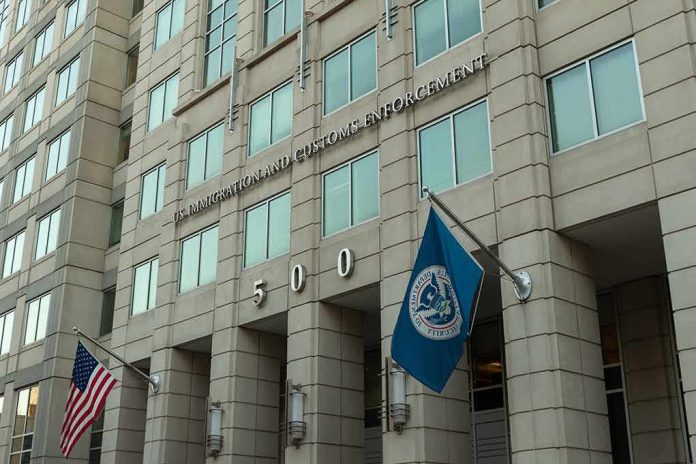
The firebomb did not clear the fence—yet it was aimed at a federal immigration hub in the heart of Atlanta.
Story Snapshot
- Federal agents say a man threw an incendiary device at the Atlanta immigration complex around 9:30 p.m. on Oct. 20, 2026.
- The device failed to ignite the building; no injuries were reported.
- An Atlanta officer chased the suspect, who escaped; the search continues.
- The same complex suffered a damaging arson assault in 2020, raising security concerns.
A failed firebomb at a busy federal complex
Federal Bureau of Investigation (FBI) officials said someone threw an incendiary device at the U.S. Immigration and Customs Enforcement building in downtown Atlanta at about 9:30 p.m. on October 20, 2026. The target sits at 180 Ted Turner Drive and houses both the field office and the immigration court. The device did not trigger a fire. No injuries were reported. Evidence technicians processed the scene while agents urged calm and said there was no known threat to the public.
Local reporting and a Department of Homeland Security summary say an Atlanta police officer saw the suspect and gave chase, but the man got away in the immediate aftermath. Authorities did not publicly name the suspect. No group claimed responsibility. The timeline, location, and basic details match across federal and local statements. The case remains active, and investigators are collecting video, physical samples, and witness accounts to identify and locate the attacker.
The site’s recent history of targeted violence
Reporters highlighted a clear precedent at the same address: a coordinated attack in 2020 that damaged the complex and led to ongoing federal pursuit of a remaining fugitive. That earlier assault, which involved fire and projectiles, left tens of thousands of dollars in damage and forced a security review. The 2026 attempt does not prove a direct link to 2020, but it shows the location remains a known target. Federal facilities that handle immigration enforcement draw repeat attention from hostile actors.
Readers may ask what “incendiary device” means in plain terms. The phrase often covers a breakable container filled with flammable liquid with an ignition source, like a cloth wick—what most call a Molotov cocktail. These crude weapons rely on simple physics: break the container, spread fuel, and ignite. Many fail for basic reasons—bad throw, poor ignition, wrong angle, or barriers like fencing. That appears to be what saved the building this time, according to accounts that the device failed to clear the fence line.
Why this matters to security and public order
Attacks on immigration sites strain local police, federal agents, and court operations. An attempt that fails still forces lockdowns, evacuations, and long nights for investigators. It also teaches would-be copycats what went wrong and what to try next. That is why speed matters now: gather evidence, release a clear suspect description, and make an arrest. Order and deterrence come from swift consequences under settled law and from visible hardening of obvious weak spots like exterior perimeters.
NEW: A suspect accused of trying to firebomb an ICE facility in downtown Atlanta fled and remains at large according to @DHSgov—The @FBI is offering a reward of up to $20,000 for information.
DHS says the man threw a bottle identified as an improvised incendiary device toward… pic.twitter.com/A5LvPC43ZC
— Ali Bradley (@AliBradleyTV) October 22, 2026
The broader pattern deserves attention without spin. Federal and independent tallies since 2025 show a surge in assaults and threats against U.S. Immigration and Customs Enforcement personnel and facilities, tracked by the Department of Homeland Security and discussed by national outlets across the spectrum. Critics may argue about root causes, but common sense says rhetoric that paints officers as fair game invites trouble. A civil society cannot excuse firebombs at courthouses and field offices. Policies can be debated loudly; violence cannot be normalized.
What effective next steps look like
Agencies should tighten lighting, camera coverage, and fence standoff zones at the Atlanta complex. Regular joint drills between the FBI, Department of Homeland Security components, and Atlanta police can trim response times and improve evidence capture. Public tips often break cases like this; a direct tip line and clear still frames can help. Prosecutors should charge attempted arson and use federal statutes for attacks on government property. That mix—prevention, speed, and firm prosecution—protects both workers and the public.
Sources:
washingtontimes.com, abcnews.com, upi.com, yahoo.com, ijr.com