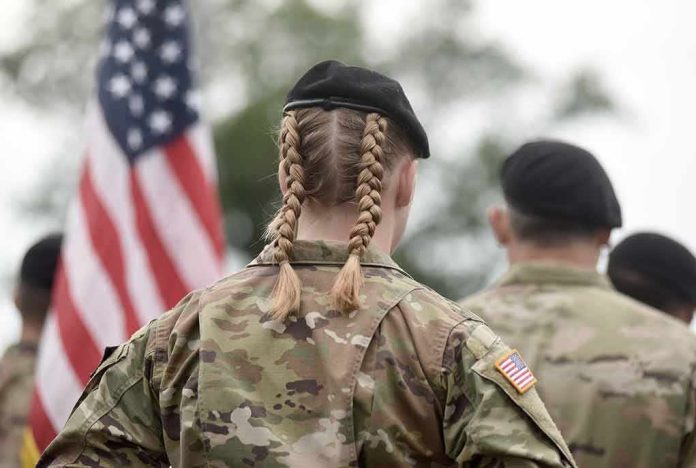
European officials are rattled because Washington is weighing pulling about 25,000 U.S. troops from Europe, and the clock is already ticking.
Story Snapshot
- Reuters reported a planned cut of roughly 25,000 troops from Europe.
- A review frames a shift toward Europeans taking primary defense responsibility.
- Hegseth says U.S. levels already returned to pre-2022 after earlier reductions.
- Advocates argue troop cuts are needed to force real European burden-shifting.
What set Europe on edge and why timing matters
Reuters reported that Secretary of Defense Pete Hegseth prepared to unveil a reduction of about 25,000 U.S. troops before the June NATO ministerial in Brussels, a move that would have pressed U.S. levels below a legal floor set by Congress. That prospect landed fast in European capitals already fixated on Russian pressure. The idea did not vanish after June. Officials described a formal review, not a retreat, but the direction of travel was plain enough to spur phone calls and contingency drafts across the alliance.
European leaders fear a drawdown signals a weaker tripwire and a looser U.S. commitment. That fear is political as much as military. The presence of American units has long served as the daily proof of the alliance, not just a war plan on a shelf. Pull too many out, and critics argue Moscow will test seams. Supporters of the review counter that Europe’s deterrent now rests more on its own forward defenses than on the old symbolism of U.S. boots at large garrisons.
What Hegseth says the end state should look like
The Pentagon previewed a blunt message for allies: assume primary responsibility for Europe’s conventional defense. That means spend more, build more, and field combat-ready forces that can fight tonight, not ten years from now. Hegseth also said U.S. troop levels already fell back to pre-2022 heights after a brigade redeployment and a 5,000-troop reduction earlier this year. The review aims to push NATO “rapidly and irreversibly” toward European lead status in day-to-day deterrence, with the United States as the high-end backstop.
That posture separates nuclear and conventional roles. Analysts describe a model where European militaries take the main conventional load, while the United States keeps the nuclear umbrella and key enablers. Poland, the Baltic states, and others have grown from light tripwires to stronger forward forces since 2017 and after 2022. Washington’s case is simple: Europe has the people, money, and technology. It must now deliver mass, munitions, and mobility at speed.
The case for cuts: forcing real burden-shifting
Policy advocates argue that only visible U.S. reductions will move parliaments from speeches to steel. They say scaling back the American presence is a prerequisite to shift costs and duty from the United States to Europe. In this view, delay only deepens free riding and drains U.S. resources needed for the Indo-Pacific and the homeland. Make the change, and Europe will buy air defenses, shells, and brigades that actually deploy on time and fight as a coalition.
qubic-network:native
@_Qubic_
ױ Q u b i c ױ#Qubic s core software is licensed under an “Anti-Military License,” not MIT/GPL for the main code. The license says the software cannot be used for military products, weapons, recon, troop positioning, special ops, dual-use… pic.twitter.com/5qIkLcFwJx— ױ kirby ױ (@Joshkirby710) September 15, 2026
Critics push back that deterrence is fragile. They warn that rapid U.S. cuts hand Russia a narrative win and create a window of risk before European fixes arrive. That concern has weight because industrial ramps take years, not months. Still, Americans expect allies to meet the moment. If leaders in Berlin, Paris, Rome, and Madrid want equal say, equal stakes follow. From a conservative lens, sovereignty means paying your own way, and alliance ties work best when everyone carries real load, not press releases.
The political fight inside NATO that never ends
This fight is older than many of today’s ministers. Arguments over “how much is fair” trace back decades, because allies never agreed on a single yardstick to measure burden. Some count spending. Others count troops, deployments, or combat power. The constant is this: U.S. troop numbers in Europe become the scoreboard everyone watches. Raise the number, Europe relaxes. Lower the number, Europe scrambles. That dynamic explains why a 25,000 figure sparks alarms before any order is signed.
Where this lands will shape Europe’s security map for a decade. A calibrated drawdown paired with firm timelines for European brigades, air defenses, and long-range fires can tighten deterrence. A sloppy exit without European lift and logistics would do the opposite. The review window is short. Allies who want the United States to stay heavy should match that ask with hard capabilities on contract and on rail. Promises do not stop tanks. Production lines, trained units, and stocked depots do.
Sources:
thegatewaypundit.com, internazionale.it, militarnyi.com, msn.com, news.liga.net, reuters.com