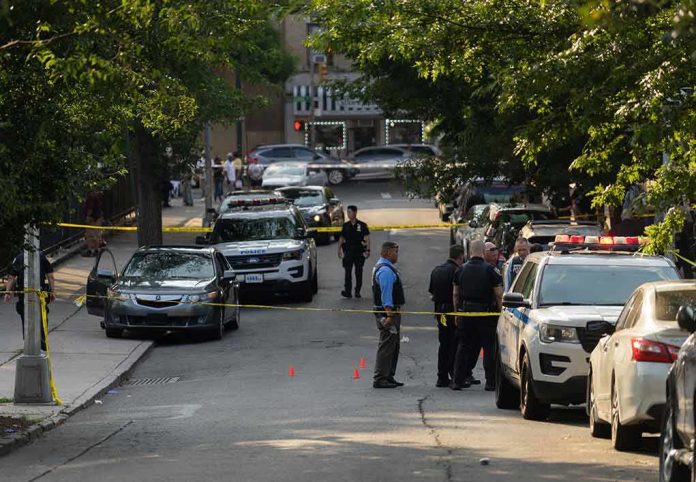
Police say a 27-year-old woman was found beaten to death on a Brooklyn kitchen floor while a young child was nearby, and the hunt for answers is on.
Story Snapshot
- Officers found the victim in a Kensington home around 5 a.m., with severe trauma.
- Medics pronounced her dead at the scene; detectives are investigating.
- A young child was present or nearby, heightening the urgency of the case.
- New York City data show child-adjacent scenes are not rare in domestic homicides.
What Police Found And When
New York City police officers arrived at a Minna Street residence near Martense Lane in Kensington around dawn. They found a 27-year-old woman on the kitchen floor, face up, unconscious, and showing clear trauma across her body. Medics declared her dead on scene. Sources said a young child was present or nearby, which triggered added support protocols. Detectives sealed the home, collected video and physical evidence, and began canvassing for witnesses as the investigation moved fast.
Detectives are now piecing together a tight overnight timeline. They are reviewing calls to police, any prior visits to the address, and whether the victim had a protective order. Investigators will rely on the Office of Chief Medical Examiner for the formal cause and manner of death. That medical ruling often trails early reports by days but usually confirms the broad scene details that police share at first contact with the public.
The Child Factor Changes Everything
Responders treat scenes with children differently. Police call in child welfare partners and trauma-informed advocates right away. New York City’s Domestic Violence Fatality Review Committee has reported for years that child presence is common at family homicide scenes. The committee’s recent reports show that about one-fifth of domestic violence homicides involve a child age ten or younger, either as a victim or present at the scene. That grim pattern explains the intense focus on child safety here.
Those same reports stress that early police facts and later medical facts arrive on different clocks. Police can fix the where and when within hours. The medical examiner nails the how and why after labs, imaging, and autopsy. That lag does not weaken the core police account; it fills in precision on injuries, timing, and possible weapons. In this case, the visual trauma reported by officers will be matched against autopsy results to guide charges, if and when police name a suspect.
How Detectives Build A Case Like This
Homicide teams start with the circle nearest the victim. They look at recent partners, roommates, and anyone with a key. They mine cameras from doorbells, bodegas, and buses. They pull phone records for pings and texts. They audit 911 calls and any prior domestic incidents at the address. They speak with neighbors about noise, arguments, or visitors in the hours before the attack. Each step tightens the timeline and either clears or focuses persons of interest.
Public safety also depends on simple, sturdy norms. Neighbors who hear violence should call 911 and stay on the line. Landlords should maintain entry cameras and lights. Courts must enforce protective orders with speed and bite. These basics align with common sense and the conservative belief that law, order, and family safety go together. When a young child is near a brutal scene, the system must move even faster. That urgency is not politics; it is duty.
Sources:
nypost.com, abc7ny.com, nydailynews.com, people.com, gothamist.com