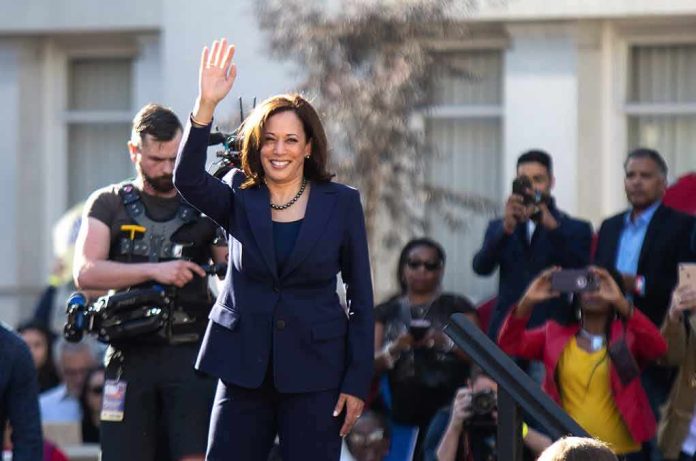
Multiple Democrats in red and swing states are telling Kamala Harris to keep her distance this fall, revealing a deep split over whether national figures help or hurt local races.
Story Snapshot
- Several Democratic candidates in tough states are declining Harris’s help, citing local political risks.
- Harris is pressing ahead with endorsements and a new political group to aid Democrats in 2026.
- Some Democrats still welcome Harris’s backing in friendlier terrain, showing a mixed reception.
- Research says surrogates can help a little, but backlash can erase gains in polarized places.
Red-State Pushback to a High-Profile Surrogate
ABC News reported that Iowa Senate nominee Josh Turek said “No” when asked if Kamala Harris should campaign for him, while Iowa gubernatorial nominee Rob Sand also signaled he did not want her help. The Guardian said Alaska Senate candidate Mary Peltola rejected Harris’s unsolicited fundraising appeal, fearing it would be a drag in a Republican-leaning state. These moves show local Democrats worrying that a national figure can fire up opposition and distract from bread-and-butter issues that decide close races.
Politico detailed Harris’s renewed push into 2026 races, including endorsements in New Hampshire and several House contests, even one in a strongly Republican Tennessee district. Harris’s team is also planning travel in competitive states, aiming to rally donors and volunteers where Democrats have a path. The split response is clear: some campaigns say “not here,” while others in friendlier districts lean in, hoping her profile boosts turnout and fundraising without triggering a backlash they cannot absorb.
Harris’s Strategy: Press On, but Let Locals Decide
Harris has launched a political action committee called “Fight for the People” to support candidates and fund travel, signaling she will stay active through the midterms. She has said candidates should do what they need to win, even if that means keeping her at arm’s length, an approach that leaves room for local judgment while keeping national support flowing. That stance lowers friction with cautious campaigns and avoids a public party feud, but it also underscores a basic tension inside the party about brand risk in red terrain.
Even with the pushback, there are Democrats who openly welcome her help. Politico reported that New Hampshire’s Chris Pappas received her public backing in a must-hold Senate race, and at least some leaders have embraced her involvement where the party’s footing is stronger. That uneven map matters. Where Democrats have demographic or organizational strength, a Harris visit can be a net plus. Where the ground is hostile, campaigns fear her presence could make their race a referendum on national figures instead of local needs like jobs, prices, and safety.
Do Surrogates Help or Hurt? What Research and History Say
Political studies suggest surrogate visits can lift a candidate’s vote share by a small amount on average, roughly in the one to two point range, while direct candidate visits do a bit more. Another line of research finds that the effects are uneven and can flip negative if the endorser is polarizing or if the race is already nationalized in a hostile environment. In plain terms, surrogates can help at the margins, but the wrong fit can wake up the other side and cancel out gains.
The 2026 map raises the stakes. The Washington Post outlined that many of the seats Democrats target sit in states where President Trump won big in 2024, making national labels even riskier for them. Voters across the spectrum also share a broader frustration: national leaders fly in, give speeches, then leave, while problems like high prices, health costs, border stress, and community safety linger. That trust gap fuels the red-state “thanks, but no thanks” posture, and it explains why some Democrats prefer to run as local fixers instead of national warriors.
Sources:
townhall.com, politico.com, silive.com, theepochtimes.com, newsmax.com, politicalwire.com, nypost.com, theguardian.com