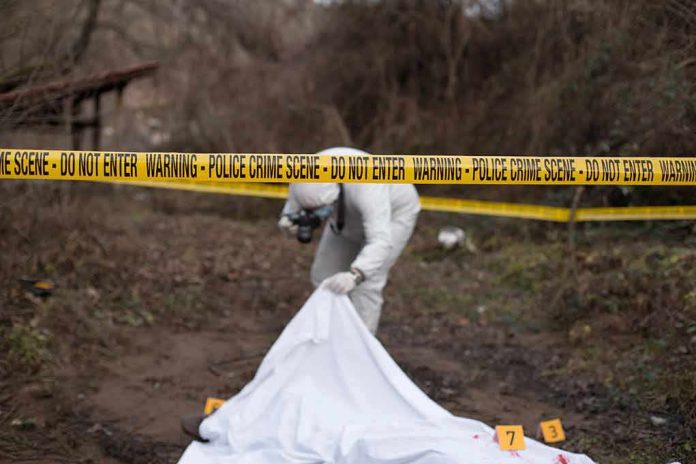
Police arrested a man after the medical examiner ruled Tasia Fortune’s hanging death a homicide, and more arrests could follow.
Story Snapshot
- Jackson police made the first arrest tied to 29-year-old Tasia Fortune’s killing.
- The state medical examiner ruled the death a homicide, shifting the case decisively.
- Detectives secured search and arrest warrants before taking the suspect into custody.
- Officials signaled additional arrests are possible as evidence develops.
Homicide Ruling Turns a Community’s Question Into a Case
Jackson police said the state medical examiner determined that Tasia Fortune’s death was a homicide, not a suicide. That ruling followed weeks of intense attention after officers found Fortune, a 29-year-old mother of four, hanging behind a vacant home on August 3. The determination changed the pace of the investigation. Detectives shifted from uncertainty to a clear criminal path, and they moved to act on the evidence they had gathered.
Police Chief RaShall Brackney said investigators secured search and arrest warrants before they encountered the suspect walking and arrested him. The arrest came after a series of interviews, scene work, and lab checks. Police did not release every detail, but they made clear that new forensic and digital steps helped them focus. The decision to take a person into custody followed the examiner’s formal call, which provided the legal footing to press forward.
The First Arrest, and Why It Matters Now
Jackson Police Department officials described the arrest as the first in an ongoing homicide case. Reporters at the announcement pressed for motive and method; police declined to go deep, citing the active probe. They emphasized that more arrests could follow, which signals a broader scope than a single suspect. That point matters. It suggests investigators see a chain of actions around the death, not a lone event in isolation.
Mississippi Today reported the arrested man’s name and age and tied the custody to Fortune’s killing. That outlet also traced earlier steps in the case, including how the city and state handled the autopsy and timeline. The picture that emerges is deliberate: gather facts, wait for the medical ruling, then act on probable cause. That sequence matches how homicide units build durable cases that can stand up in court.
What the Timeline Shows About Process and Pressure
Police found Fortune on August 3 behind an abandoned home on Road of Remembrance. Early statements called the death “pending investigation,” which is standard while examiners study the body and the scene. National outlets covered the discovery and the family’s grief as the city waited for answers. Once the examiner ruled it a homicide, police moved from caution to action and took a man into custody. That timeline fits the record and the public briefings.
Mississippi police have arrested a man in the death of Tasia Fortune, a Black woman found hanging from a tree last month.
Polices say they discovered Fortune’s body hanging in the backyard of an abandoned home.
Jackson Police Chief RaShall Brackney says the state medical… pic.twitter.com/49HGJoXq9H— Worldwide News Network (@WorldwideNNX) September 12, 2026
Two realities ran side by side in this case. Families and neighbors saw a young Black mother found hanging and felt a chill from history. Investigators had to prove the manner of death with evidence first. Local and national coverage shows that arc: early uncertainty, high concern, then a clear ruling and an arrest. That is how strong cases get built. It is also how communities gain confidence that justice is more than a headline.
Accountability, Transparency, and What Comes Next
Police said they expect more arrests. That could mean co-conspirators, people who helped after the fact, or others linked by digital or physical evidence. The department has incentives to move carefully. A rushed case can fail. A complete case can deliver justice. For a city that has seen hard crimes and harder headlines, steady work and clear updates are not window dressing. They are the duty owed to Fortune’s children and to every neighbor who wants safer streets.
Conservative common sense says two things can be true. Demand swift action when a life is taken, and demand careful proof that can win in court. Jackson police appear to be following that line now: warrants first, custody next, and signals of a wider net if facts point that way. That is the right order. Let the evidence lead, charge what you can prove, and keep the public informed without risking the case.
Sources:
independent.co.uk, bbc.com, mississippitoday.org, wlbt.com