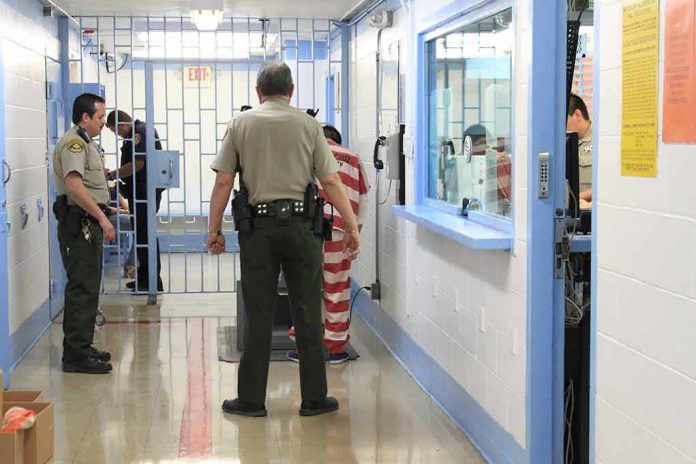
More than 43,000 people funneled into immigration detention in a single June, and the real story is how that number exposes a quiet but massive shift in how America now polices its own interior.
Story Snapshot
- Over 43,000 people were booked into immigration detention in June, the highest monthly total of this crackdown.
- Arrests inside the United States have surged, driven by White House pressure for up to 2,000 arrests a day.
- Detention capacity and daily population have climbed to record or near-record levels, reshaping interior enforcement.
- Supporters see overdue law enforcement; critics see a system growing faster than safeguards and transparency.
June’s surge shows the scale of the new enforcement reality
United States Immigration and Customs Enforcement reported more than 43,000 people booked into immigration detention in June, the highest monthly total since President Donald Trump returned to office. That figure is not a stray spike. It caps months of rising arrest numbers and reflects clear pressure from the White House for agents to hit aggressive daily targets of about 2,000 arrests. For perspective, that means more people detained in a month than many American cities even hold in their local jails.
Government data and outside analyses show this surge does not come from a sudden border crisis alone. Arrests inside the country have climbed sharply, with federal immigration agents averaging more than 1,100 arrests a day in early 2026, roughly double the pace of the prior year. One New York Times report described more than 10,000 people detained in just the last five days of June, after agency leaders ordered field offices to intensify arrest efforts. A policy choice, not random chance, drives these numbers.
Interior enforcement has expanded faster than most Americans realize
Interior immigration enforcement once focused heavily on people already in local jails. That has shifted. Researchers tracking federal immigration activity found street arrests and public-space arrests increased more than tenfold in the first year of the current administration. Agents now pick people up at traffic stops, check-ins, and even courthouse visits. For conservatives who believe the law should mean what it says, this looks like finally using the tools that Congress already gave the executive branch.
Detention capacity has grown to match this strategy. One data analysis found the number of detention beds used for people arrested inside the United States quadrupled between late 2024 and January 2026, rising from about 14,000 to around 57,000 on an average day. A separate detention trends dashboard reported that by mid-March 2026, the daily population in immigration detention was at unprecedented levels, with each day since mid-June 2025 above the previous nationwide peak from 2019. The system has been deliberately scaled up to hold more people, for longer periods, after interior arrests.
The detention machine is big, fast, and increasingly permanent
The June booking surge sits on top of a much larger enforcement machine. One analysis of government data reports that United States Immigration and Customs Enforcement booked people into detention roughly 444,900 times since the start of President Trump’s second term, with the first two and a half months of 2026 alone seeing a 61 percent increase in book-ins compared with the same period the year before. Another study found deportations following immigration arrests were five times higher in January 2026 than during an average month in the second half of 2024. This structure does not look temporary; it looks baked in.
That scale brings real tradeoffs. Supporters argue that after years of weak enforcement and mixed signals, a clear, firm approach restores deterrence and respect for the law. They also point to Congress’s funding choices and statutory framework as a democratic mandate to enforce immigration law as written. Critics, including human rights investigators, respond that growing detention headcounts and faster deportation pipelines risk sweeping in many people with no criminal convictions and leave little time to fairly present legal claims. Both views can be true in part, which is why the details of who is detained and why matter so much.
Lawful authority is clear, but data blind spots fuel distrust
The federal government clearly has legal authority to arrest and detain people who violate immigration law. That part is not in dispute. What fuels suspicion is how those powers are used at scale. The Government Accountability Office found that the agency’s public detention statistics actually undercount the number of people detained, because the agency excludes those first sent to certain temporary facilities before transfer into longer-term immigration detention. In plain terms, the true number of people locked up is higher than the headline figures admit.
🚨 America’s deportation machinery has reached record speed. Immigration authorities made 43,138 arrests in June, while 65,765 people were held in ICE detention. The stakes are public safety, due process and the limits of state power.
For anyone outside the debate: an arrest is… pic.twitter.com/zy07shLvs7
— Grandpa "Zibi" (@grandpazibi) July 22, 2026
Another layer of concern centers on outcomes inside custody. Human Rights Watch reported at least 52 deaths in United States Immigration and Customs Enforcement detention between January 2025 and early June 2026, and found that the mortality rate more than doubled compared with the prior year as the detained population grew. For Americans who want firm but fair enforcement, those numbers raise a hard question: is the government scaling up reliable due process and safe conditions as fast as it is scaling up arrests and cages?
Sources:
cbsnews.com, washingtonpost.com, hrw.org, randalolson.com, latimes.com, newsroom.ucla.edu