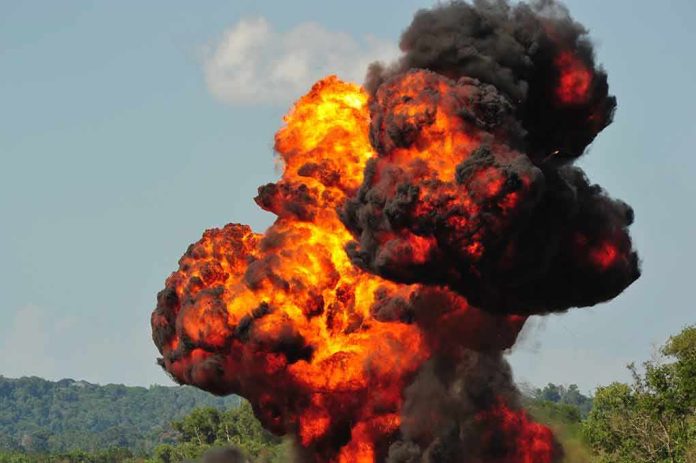
At noon Friday in Middletown, Iowa, the United States Army plans two controlled blasts to destroy 68 barrels of degraded lead azide on-site under federal authorization.
At a Glance
- Army will detonate roughly five tons of degraded lead azide at Iowa Army Ammunition Plant.
- Officials say in-place detonation is the safest option for material too unstable to move.
- United States Environmental Protection Agency (EPA) approval under hazardous waste law is in place.
- Residents were told to evacuate or shelter to limit exposure to a short-term lead-containing dust plume.
What is happening, where, and when
The Army scheduled two controlled detonations at the Iowa Army Ammunition Plant, 17571 DMC Highway 79, Middletown, around noon on November 20, 2026. The operation targets 68 barrels of degraded lead azide, totaling about five tons, that officials say became unusually sensitive with age. The public advisory sets an 8 a.m. to 2 p.m. window for safety actions, with the blast sequence at midday. This plan defines location, timing, quantity, and method, rather than an open-ended process.
Army materials describe the action as a planned, controlled safety operation to remove an immediate explosion risk from unstable stock. The site will enforce exclusion zones and weather checks before initiating shots. Officials warn of loud reports, possible ground vibration, and a brief dust plume. The notice states that the plume will contain some lead and could settle on surfaces downwind for a short period, depending on wind speed.
Why the Army chose in-place detonation
Explosive Ordnance Disposal experts determined the barrels are unsafe to relocate, due to sensitivity to movement and friction as the material dried over two decades. The Army and county notices state that detonating in place is the safest available method to remove the hazard, given the risk of accidental initiation during transport or handling. Command cites the need to end an acute explosion threat near stored materials and workers, a judgment repeated by multiple government bodies.
The Army says the United States Environmental Protection Agency Region 7 authorized the action under the Resource Conservation and Recovery Act, which governs hazardous waste treatment. Illinois public health officials report the same authorization and coordination, reflecting cross-border awareness because wind could carry the short-lived plume toward Illinois communities. EPA oversight gives the plan a legal and technical framework, with federal regulators looped into preparations.
What residents are asked to do
Guidance urges residents in the advisory area to leave between 8 a.m. and 2 p.m. If staying, people should shelter indoors, close windows, shut off outdoor air intakes if possible, and avoid outdoor activity during and shortly after the blasts. The Army warns that windows could rattle or, in rare cases near the site, break from overpressure. The notice explains that any lead in the dust plume will be short-lived aloft and may deposit on the ground downwind.
Pediatrician's take and advice on the anticipated detonation of 10000 pounds of lead azide in Iowa. https://t.co/VcnofndDn8
— Dani (@daniliz777) November 19, 2026
Basic hygiene steps reduce risk from surface dust. Officials advise waiting for dust to settle before going outside, then using damp cleaning methods on outdoor surfaces and entryways. Parents should keep children and pets off visibly dusty areas until cleaned. Gardeners can rinse produce before eating. These are standard, practical steps to cut incidental lead contact after short events that can leave trace particulates on surfaces.
How officials framed the risks and tradeoffs
Army statements admit short-term off-site effects, including noise, vibration, and potential lead particles in air. They also state the core safety goal: end the near-term risk of an unplanned explosion from unstable explosive material that may detonate if moved. Regional news reports highlight the same tradeoff: a controlled, brief release of lead-containing dust versus the persistent danger of a catastrophic blast if the material remains or is mishandled. One sentence of caution applies: an operation like this carries inherent risk, even when controlled and permitted.
Illinois public health and environmental agencies amplified the safety rationale while pushing exposure-reduction steps, which matches common sense. Government should remove immediate blast hazards to protect workers and neighbors, and it should also respect families’ health by limiting avoidable exposure. Transparent instructions empower people to act. That alignment with conservative values is clear: protect life and property now, follow the law, and keep the community informed with direct, usable guidance.
What to watch on Friday
Residents should watch official channels for last-minute weather checks and confirm the go or no-go decision close to midday. Wind speed and direction can shape the plume’s path and duration. The Army’s plan anticipates about an hour of potential airborne dust after detonation, with most activity subsiding as particles settle. Local outlets reported updated maps and timing guidance as the window approached, signaling active coordination and real-time risk management.
After the blasts, officials will reopen the area once safety checks clear. People can resume normal activity after the outdoor air clears. Those who find visible residue on patios, playsets, or vehicles can wipe it with a wet cloth and wash hands after. Property owners with concerns can track public updates about any follow-up sampling or cleanup guidance. The operational focus remains tight: finish the disposal safely, verify conditions, and return life to normal routine.
Sources:
cbsnews.com, army.mil, api.army.mil, cbs8.com, dph.illinois.gov, johnsoncountyiowa.gov, desmoinesregister.com