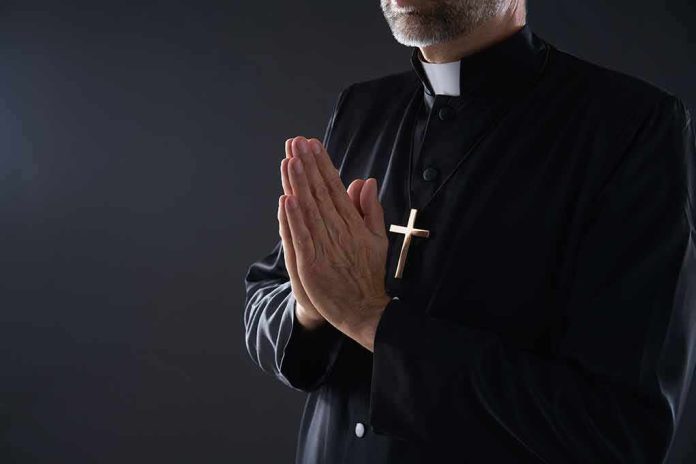
A Catholic priest vanished on a Saturday, staggered back three days later with burns and bruises, and said nothing—because his bishop had already said enough.
Story Snapshot
- The Diocese of Culiacán says Father Clemente Morales Topete was held, beaten, and burned for three days.
- The priest disappeared October 24 and returned October 27, driving himself to his parish.
- He arrived with visible injuries and went to a clinic for specialized care.
- The bishop says the attackers tried to force information from him and threatened to kill him.
A precise, grim timeline from disappearance to return
The case began Saturday, October 24, when Father Clemente Morales Topete was reported missing in Culiacán, Sinaloa. He returned on Tuesday, October 27, arriving at the Cristo Resucitado parish in La Campiña in his own truck. Local outlets reported the same sequence and emphasized the priest’s three-day captivity. The Diocese later confirmed the core details in a circular that described the deprivation of liberty and the abuse he endured over those days.
Witnesses saw the damage. Reporting from N+ stated he showed multiple blows and burns, some serious, and was moved for specialized medical care. The same account noted he remained under observation with good progress. The consistency of these details across outlets helps anchor the event in time and place, from the Saturday disappearance to the Tuesday reappearance at the parish gate with injuries that needed clinical treatment.
What church leaders say happened during captivity
Bishop Jesús José Herrera Quiñonez gave a direct account in an interview. He said a group intercepted the priest and tried to force information from him that he did not have. He described the beatings and the burns to the priest’s arms and body, and he said the assailants threatened to kill him. That picture, bleak but clear, matches the Diocese’s written confirmation and the repeated framing by separate newsrooms that reported torture over the three-day hold.
The Diocese of Culiacán publicly confirmed the abuse in a circular issued days after the return. Outlets that reviewed or quoted the circular reported beatings, burns, and death threats. They also noted the gap between the October 27 return and the November 1 date on the circular, which formalized what the faithful in La Campiña had already seen: a wounded priest who needed care and time to recover from a violent ordeal.
Patterns that explain why this story resonates
The story lands in a country where attacks on clergy are not rare. The United States Department of State reported three priest killings in one year, and the Catholic Multimedia Center counted 800 incidents of threats and extortion against priests over a recent twelve-month period. That broader pattern does not decide this case, but it explains why Mexico reacts when a priest disappears and returns battered. The facts from Culiacán echo known risks to religious leaders in some regions.
Mexican priest Father Clemente Morales Topete endured beatings, burns, and death threats after being abducted by a group of unknown individuals who held him captive for three days.
Bishop José de Jesús Herrera Quiñones of the Diocese of Culiacán in Sinaloa state reported what… pic.twitter.com/HclHd6A3Y4
— EWTN News (@EWTNews) November 4, 2026
Crime underreporting in Mexico also shapes public response. Many kidnappings and extortions never become formal cases. That silence often leaves church statements and local newsrooms to carry first accounts of violence. In this case, the bishop’s interview and the diocesan circular gave shape to events between October 24 and 27. Multiple outlets then aligned on the same core facts: captivity, beatings, burns, threats, and a return under his own power to seek care.
Accountability, prudence, and what comes next
The demand for justice is simple: identify who did this and why. The bishop’s statement about a forced search for information gives one path for investigators to follow. Conservative common sense says start with the basics: secure the medical record, the parish security footage, and the vehicle route data; get a formal case file; and match injuries to the report. That approach respects the victim, restores order, and sets a standard that violence against clergy will meet a firm legal answer.
Sources:
zenit.org, expreso.com.mx, xevt.com, editorial.aristeguinoticias.com, bishop-accountability.org