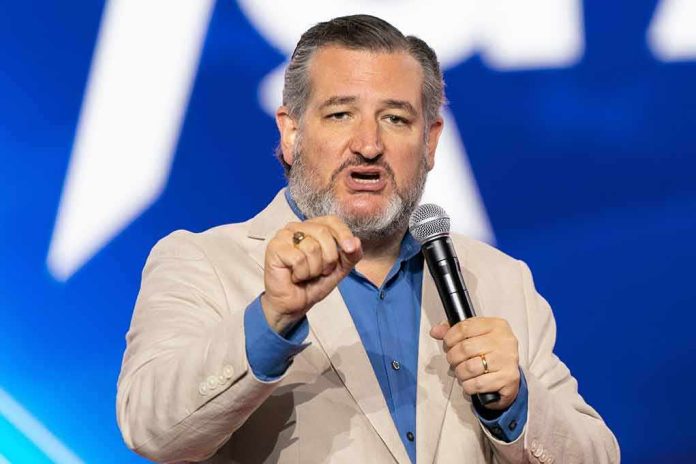
Ted Cruz said the quiet part out loud: he still wants the Oval Office, and he is not stepping aside for anyone in 2028.
Story Snapshot
- Cruz said “it’s no secret that I want to be president” on a Texas podcast.
- He refused to rule out a 2028 run and said “time will tell”.
- He argued Republicans have not crowned Vice President JD Vance as the 2028 heir.
- Reports point to moves that set up a future run and highlight friction with Trump-world.
Cruz Says the Ambition Is Alive, and 2028 Is in Play
Senator Ted Cruz of Texas said he still wants to be president and left the door open to a 2028 campaign. On Lieutenant Governor Dan Patrick’s podcast, Cruz called the drive “a bug” that rarely goes away and added, “time will tell” when pressed about another run. Local and national write-ups echoed the point. He did not shut it down on television or radio either, choosing words that keep options open while signaling seriousness to donors and activists.
Cruz also challenged the idea that Republicans have already settled on a successor to President Trump. He said the party has not coalesced around Vice President JD Vance and still must debate what it stands for after Trump leaves office. That message does two things at once. It flatters Trump’s base by focusing on ideas, and it warns would-be heirs that no one gets a coronation. For conservatives who value competition and merit, that sounds like basic fairness.
The Factional Map: Cruz, Vance, and the Post-Trump Test
Axios and others have reported that Cruz has drawn clear lines from Vance on policy and tone, including in private donor remarks about tariffs and party direction. Separate reporting described Cruz leaning into conflicts with media conservatives to define himself as a more traditional, hawkish Republican on foreign policy. These steps read like standard pre-campaign positioning. They also highlight the split inside the right: populist-nationalist on one side, Reagan-style conservative on the other. That split will shape 2028 messaging and money flows.
Cruz has also backed candidates who were not aligned with Trump’s endorsements in a few primaries, a move that shows independence but carries risk. That choice signals confidence in his own brand and a bid to court donors who want a party that blends populist energy with rule-of-law discipline, lower taxes, and peace-through-strength abroad. Voters will judge whether that mix meets the moment. The point today is simpler: Cruz wants the fight and believes he can win it on ideas.
Why “Time Will Tell” Is a Yes in Politics
Modern campaigns start long before a formal filing. Strategic hints let a would-be candidate test messages, gauge donor interest, and draw free media without a full launch. Scholars have shown how rumor coverage and framing shape early narratives by rewarding non-denial talk and sharpening factional contrasts. Cruz’s “time will tell” keeps his options open while seeding headlines that normalize him as a top-tier 2028 player. That is not coy. That is how modern pre-campaigns work.
Ted Cruz teases possible 2028 clash with JD Vance: ‘I want to be president [ I like Cruz, Vance, Trump Jr, Desantis. But I'm voting for whomever Trump endorses. ] https://t.co/JlZYMlgEln
— Inspector Clueso (@IClueso) August 27, 2026
President Trump’s circle has noticed, and coverage has logged friction as Vance’s star rises and Cruz asserts space of his own. That tension is politics, not a crisis. Competitive primaries produce better arguments and tougher nominees. From a conservative view, a real contest should ask clear questions: who can grow the economy, secure the border, rebuild deterrence, and rein in the federal bureaucracy. If Cruz runs, expect him to pitch experience, courtroom chops, and a proven ground game from his 2016 run.
What to Watch Next
Three signals will tell you if this is a true run-up or just posture. First, watch staffing: policy shop hires and a travel schedule in early primary states. Second, follow endorsements that cut against the grain; they preview coalition bets. Third, track money networks. If major donors treat Cruz as a hedge against a Vance sweep, his path widens. Until then, remember the only sentence that matters came from Cruz himself: he wants the job, and he plans to be part of the 2028 decision.
Sources:
nypost.com, texastribune.org, x.com, axios.com, cnn.com, usatoday.com, abc7amarillo.com, independent.co.uk