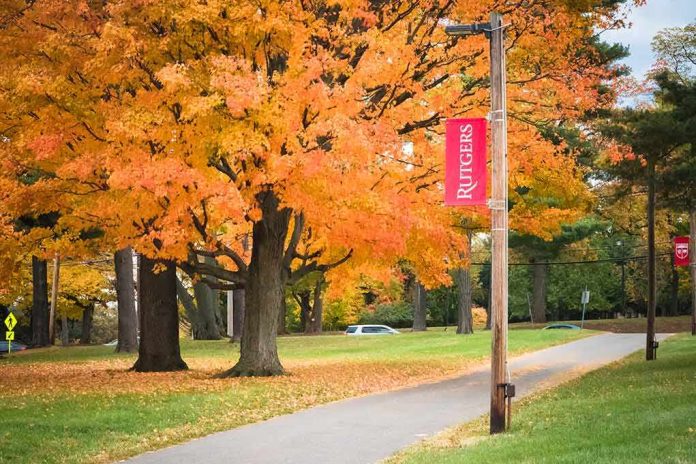
State prosecutors charged a Rutgers dean with invasion of privacy after they say he recorded “upskirt” videos on campus.
Story Snapshot
- New Jersey charged Joshua Kohut, 51, with fourth-degree invasion of privacy.
- Officials allege he filmed “upskirt” videos of a woman using a phone at Rutgers.
- Rutgers placed Kohut on leave and barred him from campus during its review.
- New Jersey courts have held “upskirting” fits invasion-of-privacy law.
Prosecutors Lay Out A Stark Allegation
New Jersey’s Attorney General announced the arrest of Joshua Kohut, dean of research at Rutgers’ School of Environmental and Biological Sciences, on a charge of fourth-degree invasion of privacy. Prosecutors say he recorded “upskirt” videos of a woman without her knowledge, using a phone on university grounds. The state’s charge centers on secret filming of intimate areas covered by clothing. Officials say investigators seized a device and found the alleged videos tied to the complaint. Kohut has the right to contest the charge in court.
Rutgers University dean caught filming ‘upskirt’ videos: ‘extremely disturbing charges’https://t.co/aTtbzn3S1S
— BREAKING NEWZ Alert (@MustReadNewz) August 26, 2026
Rutgers moved fast once informed of the charge. The university put Kohut on administrative leave and banned him from campus while it conducts an internal review. The action follows standard crisis steps at large schools: separate the accused from the workplace, secure records, and protect students and staff. The goal is simple and sound. Keep the community safe, avoid interference with the probe, and show that rules apply top to bottom.
Why “Upskirting” Is A Crime In New Jersey
New Jersey law treats “upskirting” as invasion of privacy because it targets intimate areas that a person keeps covered. The state’s appellate court made this clear in a published decision, holding that intimate parts are “exposed” for legal purposes when a camera is used to see under clothing, even if skin is not bare. That ruling closed a loophole some tried to exploit. It aligns with common sense standards: what a person hides under clothing stays private unless they choose to reveal it.
Lawmakers and courts shifted the focus in recent years. Image-based abuse is viewed as a dignity and privacy harm, not a prank. A 2023 review describes upskirting as a newer form of abuse that the law has moved to address, often after delays that left victims without clear recourse. New Jersey’s invasion-of-privacy statute and court guidance now give police and prosecutors a tested path to charge the act. That clarity sets a baseline: no one gets to steal private images in public spaces and call it harmless.
The Stakes For Rutgers And Public Trust
The case hits a raw nerve because it involves a leader tasked with upholding research ethics. Rutgers lists the dean of research as a guardian of compliance and responsible conduct across its programs. That makes the charge feel like a deeper breach for many on campus. Institutions must answer two questions at once: did the alleged act occur, and does our culture stop this before it starts? Strong policies, reporting channels, and swift discipline are the only honest replies.
Parents and staff expect schools to run on clear lines: protect privacy, enforce rules, tell the truth. Conservative values match that view. Equal justice demands due process for the accused, and firm guardrails for everyone. If evidence supports the charge, punishment should be real and public to deter copycats. If not, the system must clear the name with the same force used to accuse. Either way, the process should be fast, transparent, and fair.
What Comes Next In Court And On Campus
Fourth-degree invasion of privacy is a criminal charge that can bring penalties under state law if a court finds guilt. Prosecutors will present the device evidence and witness accounts they say tie Kohut to the recordings. Defense counsel will test the chain of custody, consent issues, and identity. The judge will apply New Jersey’s invasion-of-privacy framework, including the appellate guidance that covers “upskirting” under clothing as an invasion. The facts will drive the result.
Rutgers will likely run a parallel conduct review on policy grounds. That review can lead to discipline apart from any court outcome, based on workplace standards and safety rules. For students and staff, the takeaway should be practical. Report suspicious behavior fast. Use the university’s channels. Demand cameras and security where risks cluster, like crowded halls and transit spots. Civil society works when leaders enforce bright lines and citizens back them up with eyes open and voices raised.
Sources:
nypost.com, onnj.com, sebsnjaesnews.rutgers.edu, extension.rutgers.edu, patch.com