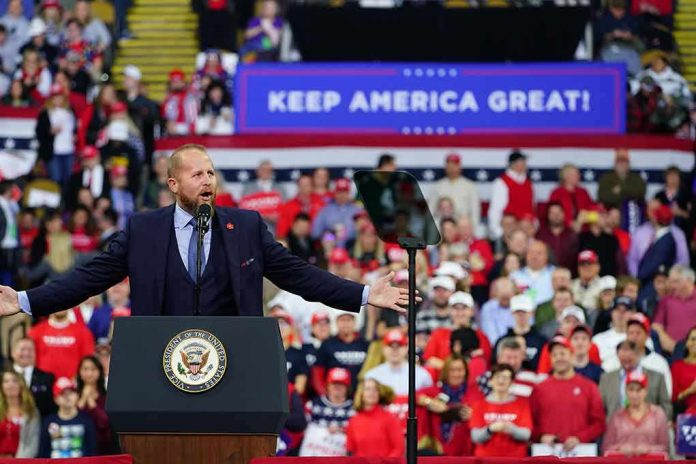
President Trump told a packed crowd in Greenville, South Carolina, that voters must show up or risk losing everything his administration has built.
Story Snapshot
- President Trump held rallies across South Carolina in August 2026, including stops in Greenville and Myrtle Beach.
- His prepared Greenville remarks, titled “Not Going Anywhere,” urged early voting and warned against reversing his record.
- The Myrtle Beach rally backed Darline Graham’s Senate campaign, tying local politics to his national message.
- Trump’s language fits a long pattern of using conflict and stakes-driven framing to drive supporter turnout.
Trump’s Greenville Message Centers On Not Losing Ground
President Trump addressed supporters in Greenville with remarks prepared under the title “Not Going Anywhere.” He told the crowd, “I’m running for president because we have a country to save,” and added he wants “to restore a country that’s strong and proud”. He reminded South Carolinians that early voting was already underway and pushed them to cast ballots before Saturday’s contest, framing turnout itself as protection for gains already made.
The speech leaned hard on a simple idea. Voters built something real over the past several years, and that progress can vanish without continued political muscle behind it. Trump didn’t just ask for support. He asked supporters to see themselves as the last line of defense against losing what they already won at the ballot box in prior elections.
Myrtle Beach Rally Ties National Stakes To A Senate Race
Days later, Trump took the stage at the Myrtle Beach Convention Center to back Darline Graham’s Senate campaign. A recorded tele-rally transcript shows him opening warmly, calling South Carolina “a very special place” and noting he has “won it so convincingly every single time” he has run for office there. That personal connection to the state gave his warnings extra weight with a crowd that has backed him repeatedly.
Coverage of the Myrtle Beach event captured Trump linking founding American ideals to present-day political fights, telling the crowd the nation faces resistance to the very principles it was built on. He framed the Senate race as part of a bigger fight, arguing that losing Republican seats in Congress would open the door to undoing his administration’s work nationwide.
A Familiar Playbook Built On Stakes And Urgency
Trump’s warning style is not new. Research comparing his 2016 campaign speeches to Hillary Clinton’s found he used conflict, blame, and negative framing far more often than his opponent. That pattern has carried into his presidency, where speeches routinely present elections as binary choices between preserving hard-won progress and losing it entirely to political rivals.
That approach carries real strategic logic. Turning policy wins into a turnout threat gives supporters a concrete reason to vote rather than assume victory is guaranteed. For a base that already trusts Trump’s economic and border security record, the message that Democrats could reverse it all taps into genuine stakes rather than manufactured fear, especially with control of Congress on the line in 2026.
Official White House Remarks Reinforce The Same Themes
The White House released multiple video statements from Trump throughout July and August 2026, each reinforcing similar themes about protecting American families and continuing his agenda. A White House release specifically credited Trump and Republicans with delivering results “for South Carolina Families,” dated the same week as his Myrtle Beach appearance. That timing suggests a coordinated push pairing rally rhetoric with formal administration messaging ahead of the state’s elections.
South Carolina holds outsized importance in Trump’s political history, having backed him in every primary and general election he’s contested there. His return trips in 2026 signal that Republicans view the state as a proving ground for whether his warnings about losing ground will translate into higher turnout. Voters heading to the polls now carry that message directly into the voting booth, framed as their own choice to make.
Sources:
rev.com, democrats.senate.gov, whitehouse.gov