A Chinese Communist Party intelligence veteran quietly bought a building about 650 feet from the White House, and Washington is now on alert.
Story Snapshot
- A reported Chinese state-security figure bought a historic building near the White House.
- The deal closed July 21, 2026, for $8.4 million, per contemporaneous reporting.
- Lawmakers have pushed bills to block Chinese Communist Party-linked real estate buys near federal sites.
- Security experts warn proximity real estate can aid surveillance even without proven misuse.
What Happened: A Strategic Address Changes Hands
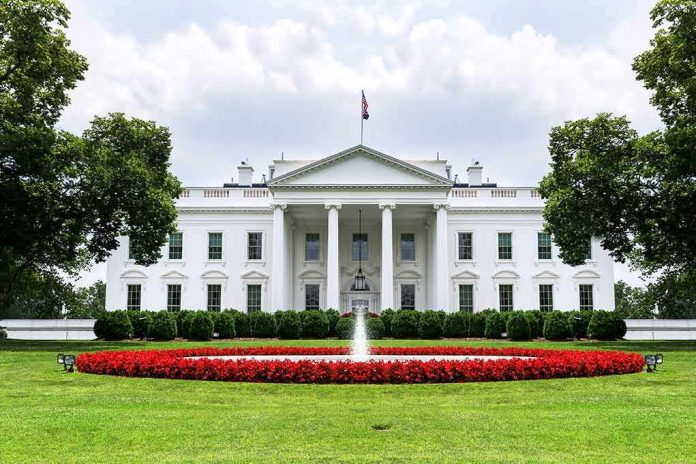
Daily Caller News Foundation reporting, republished by AOL, says the Philip Qiu and Family Foundation purchased the 100-year-old Securities Building for $8.4 million on July 21, 2026. The property sits about 650 feet northeast of the White House grounds. The reporting identifies Qiu as tied to Chinese intelligence and state security bodies. That combination—identity, location, and ownership—instantly drew attention across policy circles and conservative media because proximity can create opportunity, even before intent is shown.
Social posts amplified claims that Qiu has sniper training and advanced security expertise. Those posts used the same central facts—buyer identity and distance—to frame the purchase as a tactical foothold. The core public record that matters remains the sale, the named buyer, and the location. Those facts are enough to justify robust scrutiny from counterintelligence officials and lawmakers who treat Chinese Communist Party-linked acquisitions near sensitive facilities as a standing risk vector.
Why Proximity Matters In Counterintelligence
Analysts have warned for years that foreign-linked real estate near key United States government and defense sites can enable technical collection, human surveillance, and pattern-of-life analysis. The Center for Strategic and International Studies has documented efforts by Chinese investors to acquire land and infrastructure near bases, and the discovery of Chinese telecommunications equipment near missile fields. These are not academic fears; they are lessons learned. The White House perimeter is among the most monitored zones on earth, yet proximity still matters.
Critics often ask, “If there is no proven spying, what is the problem?” Security professionals answer with two words: access and options. Real estate gives lawful presence, plausible cover, and routine logistics. It offers rooftops, interior lines of sight, and fiber entry points. It enables devices to blend with normal building systems. None of this proves wrongdoing. All of it lowers the cost of trying. That asymmetry is exactly why conservative lawmakers call for clear red lines on adversary-linked ownership near federal property.
Capitol Hill’s Response: Draw Bright Lines, Not Hazy Hopes
House and Senate Republicans have advanced bills to block entities tied to the Chinese Communist Party from buying land next to federal property and to bar such purchases across the United States. Representative Dan Newhouse proposed restrictions aimed at property adjacent to federal land. Senator Rick Scott, with Senators Tom Cotton, Kevin Cramer, and Katie Britt, backed a nationwide stop sign on Chinese Communist Party real estate buys. Similar efforts in the Western Caucus and House bills target the same gap: proximity risk.
These proposals reflect conservative priorities: defend national assets first, do not wait for a breach, and close loopholes that invite exploitation. The logic is simple and sound. If proximity is a known risk, then make it off-limits to adversary-linked buyers. Protecting sovereignty and critical nodes is a government’s first job. Waiting for a smoking gun near the White House is not strategy; it is surrender dressed as patience.
The Policy Gap: How The System Missed This
Current review systems focus on takeovers of companies, select land near military bases, or deals tied to certain infrastructure. They often miss urban parcels where physical closeness can be as valuable as a database. The Committee on Foreign Investment in the United States excels in many areas but was not designed as a blanket proximity cop. Think tanks like the Heritage Foundation have urged reforms, including adding the Department of Agriculture to reviews and tightening proximity triggers nationwide.
Thursday August 13th 2026 [Evening News Brief]
🟥CCP intelligence official, Philip Qiu, now owns a building 650 feet northeast of the White House – @DailyCaller
🟥NATO veterans are considering forming an International Resistance Front to join the Anti-Taliban Resistance -… pic.twitter.com/qyacvskePt
— Apexguard (@apexguardhq) August 14, 2026
One response is to expand screening to include any purchase by Chinese Communist Party-linked persons within defined distances of federal facilities. Another is to mandate ongoing audits of building systems that face sensitive sites, including rooftop gear and network ingress points. Cities also play a role. Zoning, permitting, and inspection regimes can flag red-team risks before they become headaches. Security is less about chasing spies and more about denying them easy plays.
What To Watch Next: From Headline To Hardening
Expect congressional hearings and agency briefings on the building’s security profile and on any needed upgrades to federal protective measures. Watch for bipartisan energy around narrow, proximity-based rules, since the problem is specific and fixable. Track whether the District’s oversight tools evolve to require enhanced disclosure and inspection for sensitive-view parcels. The take-home is not panic; it is prudence. The United States should seal obvious doors, especially ones that open onto the White House lawn.
Sources:
townhall.com, aol.com, nytimes.com, x.com, foxnews.com, rickscott.senate.gov, westerncaucus.house.gov, columbiamonews.com, csis.org