Madison let a protest blockade swallow a key street while a homicide probe into a police shooting put the whole city on edge.
At a Glance
- Protesters shut down a major Madison intersection with cars, pallets, and furniture.
- City leaders urged calm and promised a full investigation but did not clear the road.
- Events were canceled and businesses disrupted as the blockade dragged on.
- The shooting of Corey Ruiz remains under state investigation; the family calls it unjustified.
What Happened On The Street
Protesters blockaded Williamson and South Baldwin with cars, wood planks, cones, mattresses, pallets, and furniture. The closure stretched across days, not hours, with city notices signaling no quick reopening. The intersection feeds traffic toward the state capitol and nearby neighborhoods, so the hold had outsized impact. Police did not rush a clearance. City statements centered on patience, safety, and a promise to listen, not on an order to move people and debris out of the roadway.
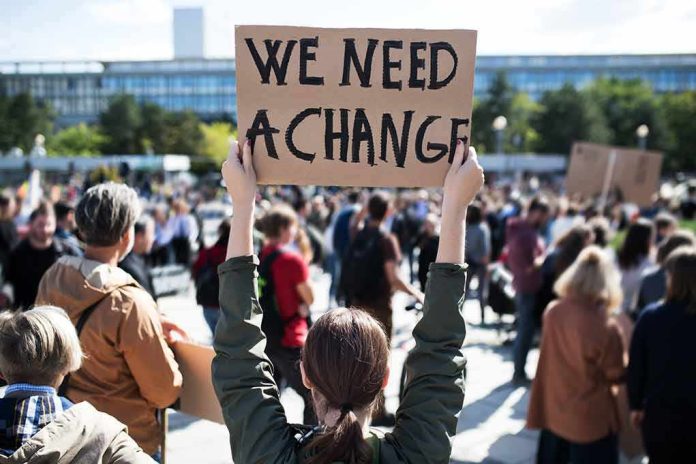
Protest crowds returned repeatedly for vigils and actions. Reporters described disruptions to a police press conference and tense exchanges with officials. Signs carried harsh language against the department. Some residents saw grief and a demand for answers. Others saw a creeping seizure of public space that government seemed to accept by default. The split hardened as each day closed without a traffic reset and as images of the barricade traveled far beyond the city.
Why The Blockade Took Root
The shooting of Corey Ruiz lit the fuse. Police say he pulled a knife during a struggle, injuring an officer, before another officer shot and killed him. The Wisconsin Department of Justice’s detectives are running a homicide investigation, which keeps many records sealed while they gather evidence. Family members and civil-rights counsel called the killing “unjustified and unconstitutional” and demanded criminal charges. Their message turned the street corner into a memorial and a rally point.
Visual analysis and bystander video fueled the dispute over tactics and timing. National outlets noted key moments in the scuffle and questioned the use of force. Those clips, not official body-camera releases, set the early narrative in public view. That is a common pattern in high-profile use-of-force cases. When the government asks for patience but offers few details, public trust often slides, and protest groups shift from march to sit-in, then to blockade.
City Signals: Accommodation Without Authorization
City messaging encouraged peaceful protests and invited a listening session with neighbors. It did not explicitly authorize a street seizure or issue a public permit for a full closure. The effect felt the same to drivers and merchants: barricades stayed, traffic did not flow, and police managed the edge rather than reclaim the lane. That is tolerance, not formal endorsement, but to many observers, the difference vanished with each canceled plan and quiet storefront.
Corey Ruiz’s Mom, Sister & Attorney Ben Crump Speak Out: “I Need Somebody to Help Me Understand Why They Felt It Was Ok to Execute My Brother”… “They Took My Baby From Me”
“His Criminal Record Does Not Define Who My Brother Was
He Was Shot Dead by Madison Police While Armed… pic.twitter.com/0JAaKUFLJi— Christina Aguayo (@ChristinaNewstv) July 30, 2026
City leaders also stressed that the state investigation must run its course. That stance aligns with due process and avoids stepping on the probe. But it clashes with a conservative reading of equal treatment under law. Madison would ticket a food truck that parked wrong for an afternoon. Letting private groups hold a public street for days sets a precedent that rewards pressure, not process. The longer it lasted, the more it looked like policy by occupation.
The Cost Of Holding A Street Hostage
The blockade’s reach spilled past the corner. The Madison Public Market delayed its grand opening. AtwoodFest was canceled. The Dane County Farmers’ Market closed early. Concerts on the Square was shut down after protesters occupied the stage. These are not fringe events. They are civic staples that knit a city together. Every cancellation was a story of wasted prep, lost sales, and families turned away. The record does not yet tally the exact dollar loss, but the pain was plain.
Public safety concerns came next. Emergency access relies on clear routes and predictable detours. A barricade built with scrap and cars turns a map into a maze. The best time to open a path for an ambulance is before someone needs it. City tolerance of a fixed blockade raises that risk. Order does not require silence or curfews. It does require a neutral line: protest on the sidewalks and public squares, not across traffic lanes for days on end.
What Accountability Should Look Like Now
The state must finish the homicide investigation and release evidence promptly. Transparency builds trust before a verdict lands. The city should draw bright rules for protests that protect speech and keep the streets open. Require permits for marches, limit lane closures by time, and set clear penalties for hard blockades. That is not anti-protest; that is pro-equal access. People deserve both the right to speak and the right to move through their city without a political checkpoint.
Sources:
nypost.com, en.wikipedia.org, cityofmadison.com, wpr.org, facebook.com, jsonline.com, reuters.com