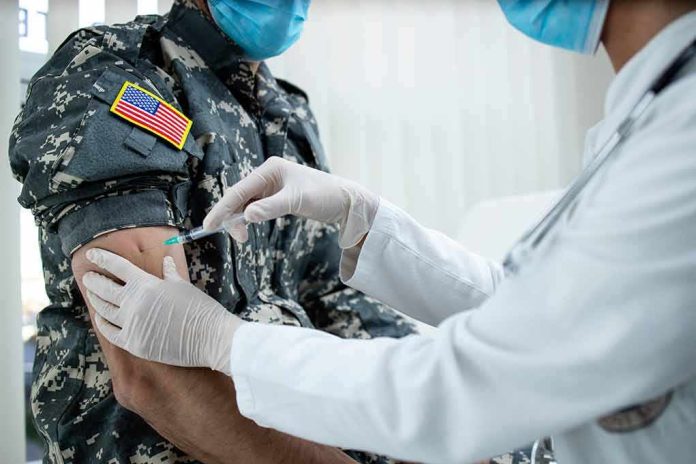
An Army flight surgeon told a federal court she is vetting 2,544 reported troop deaths filed after COVID shots—and top officials want answers fast.
Story Snapshot
- An Army doctor says she is reviewing 2,544 post-vaccine death reports tied to service members.
- The review includes 55,000 adverse-event submissions, many unverified and not proof of causation.
- Health and defense leaders tasked her to separate real signals from noise, using records and autopsies.
- Federal guidance says a report alone never proves a vaccine caused harm.
What sparked the Army review and who is in charge
Army Lt. Col. Theresa Long told a Virginia federal court she is leading a review of reported military deaths and injuries after COVID vaccination. She said she is working with Health and Human Services Secretary Robert F. Kennedy Jr. and Defense Secretary Pete Hegseth on the probe’s scope and methods. The case centers on 2,544 death entries and tens of thousands of adverse-event reports in the federal reporting system. The goal is simple: verify facts, then judge cause.
Report counts rose during the pandemic, fueled by mandates, fear, and confusion. That surge left leaders with two duties that do not clash: protect force health and protect public trust. The only way to do both is to test every serious report against hard records. That means pulling medical charts, autopsy results, duty logs, and vaccination dates. It also means interviewing families and units when timelines or symptoms do not line up with known risks.
What the reporting system can and cannot tell us
The Vaccine Adverse Event Reporting System accepts any report after a shot, from anyone. It is built to catch early safety signals, not to prove cause. Federal guidance says a report by itself does not show a vaccine caused the event. Analysts must link symptoms, timing, and medical findings to judge a real tie. The data guide is blunt: no proof is required to file a report, and many entries are incomplete or coincidental.
Public health reviews have long reached the same bottom line. Early national checks did not find a broad causal link between COVID vaccination and reported deaths, aside from a rare clotting syndrome tied to one product. Those reviews relied on the right tools: death certificates, autopsies, and expert panels. That is the same toolkit the Army will need here. The difference now is the specific military focus, the scale of the review, and a chain of command demanding clarity.
How a credible review should work inside the ranks
A credible investigation must start with case definitions and a clean ledger. Investigators should de-duplicate records, match each entry to a real person, and verify service status and vaccination date. They should sort cases by time from dose to event, medical history, and plausible mechanisms. They should flag known risks, like myocarditis clusters in young men, for closer reads. Then they must apply the same rules to all branches, grades, and duty types.
Transparency matters more than spin. Publish methods first. Share how many records lacked proof of death, how many linked to non-service members, and how many had autopsies. Explain how causality was judged. Use plain categories: confirmed, probable, possible, unlikely, and unassessable. That level of candor protects good troops and good vaccines. It also respects families who deserve precise answers, not slogans.
What this means for readiness, trust, and policy
Force health protection must serve two ends—maximum readiness and informed consent. Conservative common sense says you measure twice and cut once. A hard audit of death and injury reports is the measure-twice step. If the review finds clear causal links in a subset, adjust policy, screening, or duty restrictions. If it finds mostly coincidence, publish that too and keep the receipts. Either outcome strengthens the ranks.
Critics argue this review gives oxygen to rumors. That fear flips the burden. Sunlight, not suppression, quiets rumors. The Centers for Disease Control and Prevention’s own language warns against treating raw reports as proof, and that warning should frame every briefing. But refusing to check serious claims against medical facts would be the real breach of duty. The Army is doing what a disciplined institution should do: verify, validate, and then decide.
Where to watch for real answers next
Three markers will show if this probe is serious. First, whether investigators gain full access to death certificates, autopsies, and service medical records for every case possible. Second, whether the team posts a methods plan with predefined causality rules before releasing results. Third, whether the final report cites how many cases moved from rumor to verified, and how many were ruled out with documented reasons.
The stakes are human and strategic. Families want truth. Commanders want fit units. Taxpayers want policies that weigh benefits and risks with equal care. The federal warning about the limits of the reporting system should guide the public conversation, not end it. Let the facts—medical, chronological, and mechanical—drive the call. That is how you honor service and keep the force sharp.
Sources:
military.com, advisory.com, fakti.bg, militarybackpay.com