Twice in four months, gunfire hit the same U.S. consulate in downtown Toronto — and the second time, police had to call off a 140-kilometer-per-hour chase to keep everyone else on the road alive.
Story Snapshot
- Same U.S. consulate in Toronto shot at in March and again in late July this year
- Latest shooter fired once, left a bullet hole in the facade, and sped off in a white sedan
- Police chased the suspect at highway speeds, then suspended the pursuit for public safety
- Both incidents are treated as national security matters with multi-agency investigations
One building, two shootings, and a growing security problem
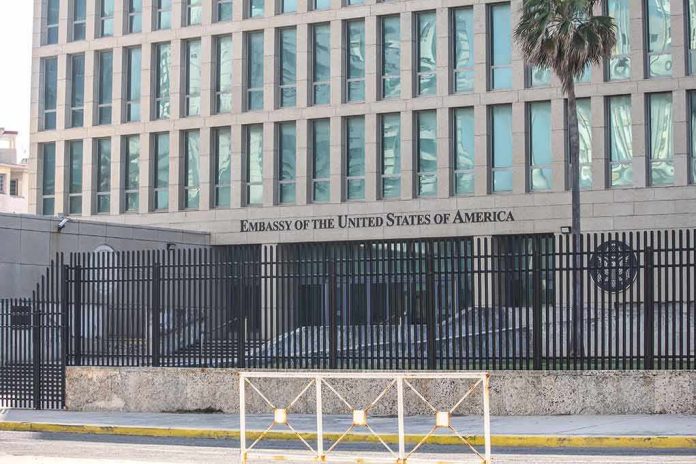
The U.S. consulate on University Avenue has now been attacked twice in one year, and that alone should make people sit up. In March, two men stepped out of a white sport utility vehicle and fired several rounds into the building before speeding away, leaving shell casings and visible damage behind but no injuries inside. Police and federal agencies labeled that first attack a national security incident, signaling they saw more than random street crime.
On July 27, it happened again. Officers on surveillance near the consulate heard a gunshot around 4:45 in the morning. They found a single shell casing and a clear bullet strike on the front facade, confirming at least one round hit the building. Cameras captured a white sedan fleeing the area. No one inside the consulate was hurt, but the message was plain enough: someone was willing to put a bullet into an American diplomatic site. Twice.
The chase that police chose to end
After the July shot, Toronto police spotted the suspect vehicle and gave chase down the Don Valley Parkway, a major highway cutting through the city. Speeds hit more than 140 kilometers per hour, a dangerous pace on public roads even before sunrise. Commanders decided to suspend the pursuit for safety reasons rather than risk a deadly crash with commuters or an oncoming family car. That choice shows the constant balance in modern policing: chase the bad guy, but do not turn one gunshot into a mass casualty pileup.
Some people will say police should have chased harder, longer, faster. That view lines up with a tough-on-crime instinct that many conservatives share. But it collides with another common sense rule: the state is supposed to protect the innocent first. When a suspect turns a city highway into a racetrack, backing off can be the most responsible action. The key question now is whether the investigation, cameras, and forensics are strong enough to catch up later without that live arrest on the roadside.
Why this is treated as a national security incident
After the March shooting, the Royal Canadian Mounted Police federal policing unit called the attack a national security incident and a national security threat. That language is not used for every drive-by shooting. Diplomatic buildings are protected sites, and attacks on them can signal foreign direction, terrorist intent, or organized crime with a political edge. That is why Canadian security services and the Federal Bureau of Investigation are involved, not just local patrol officers.
Officials have said there were people inside the consulate when shots were fired, yet the building’s heavy fortification kept them safe. That detail matters. These attacks targeted a place designed to stand up to violence, not a random storefront. When a shooter aims at an American flag on foreign soil, even one bullet can carry geopolitical weight. Later, Canadian officials told Parliament that suspects in the March case were paid and contracted by a foreign organization, and United States authorities tied an Iraqi national to a broader pattern of attacks on American interests. Those claims, if fully proved in court, push the story out of routine crime and into the realm of foreign-directed hostility.
Patterns, hired gunmen, and what comes next
Police now see the March shooting as part of a wider pattern where young men are hired to carry out attacks and film them. That is a chilling model. It mixes money, social media clout, and political messaging into one simple act: pull up, fire, post the proof, disappear. The July shot outside the Toronto consulate fits the same playbook in at least one way. It was fast, focused, and aimed at a symbol more than a person. No injuries, but a clear mark left on a high-profile target.
#NationalSecurity: Toronto Police Investigate After Shots Fired Outside U.S. Consulate In📍Toronto. Suspect(s) Fled In A White Sedan Was Seen Fleeing.🇨🇦🇺🇸
Previous Shooting At The Consulate Was A Terrorist Attack Alleged To Be Directed By Kata’ib Hezbollah Commander Mohammad… https://t.co/5djUJYQIRi pic.twitter.com/1Z8HkxcbEY
— 401_da_sarpanch (@401_da_sarpanch) July 27, 2026
From a common-sense, security-first view, the response should be just as clear. Harden the target even more. Share intelligence faster between Toronto police, federal agencies, and United States partners. Treat repeat attacks on the same diplomatic site as a red line, not background noise. Conservatives often warn about slow responses to foreign interference and soft handling of organized crime. This case touches both concerns. The building was strong enough to stop bullets, but the system still has to prove it can stop whoever is sending gunmen back, again and again.
Sources:
bbc.com, nytimes.com, youtube.com, cbc.ca, bloomberg.com, usnews.com