Within one week, three fatal encounters forced immigration traffic stops to pause—then President Trump ordered them back on, betting that aggressive roadside enforcement makes America safer despite thin proof and rising public anger.
Story Snapshot
- Trump calls immigration traffic stops one of ICE’s most “important and effective” tools and reverses a pause in less than 24 hours
- New data show most ICE arrests now involve people with no criminal convictions, raising doubts about “crime-fighting” claims
- Court settlements and legal experts say immigration agents cannot use traffic violations as excuses to pull people over without real suspicion
- Research on traffic and pedestrian stops finds little crime benefit but clear harm to trust, health, and community safety
Trump doubles down on traffic stops after deadly week
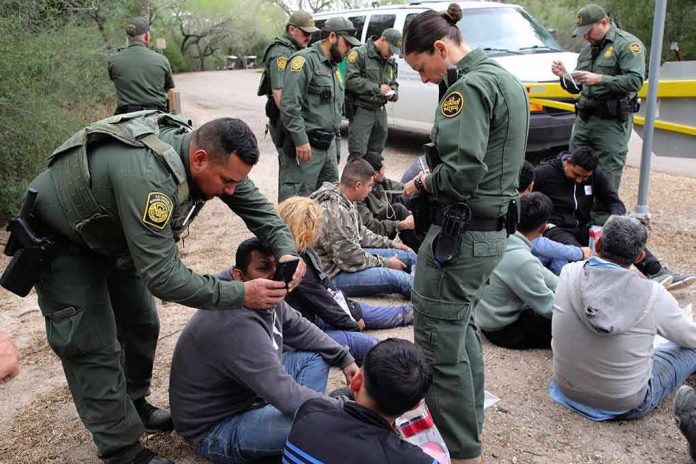
President Trump did not wait for the dust to settle after three deadly incidents tied to immigration traffic stops in Maine, Texas, and Florida. Reports say U.S. Immigration and Customs Enforcement agents were ordered to halt most vehicle stops after two shootings and one fatal crash during a single week, a major policy shift for the nation’s largest immigration enforcement agency. Within hours, Trump publicly insisted that traffic stops are one of ICE’s most “important and effective crime-fighting tools” and directed the Department of Homeland Security to resume them.
To his supporters, this looked like a firm stand against what they see as media-fueled panic and activist pressure. They argue that pulling back on stops would reward lawbreakers and weaken deterrence. From a common-sense conservative view, keeping tools that help catch dangerous people sounds right. But the controversy turns on a hard question: do these particular stops actually catch many dangerous people, or mostly easy targets who pose little threat?
What the law really allows immigration agents to do on the road
The legal ground under these stops is tighter than many realize. The American Immigration Council explains that federal immigration agents cannot stop cars for basic traffic violations; only state and local police have that authority. Immigration agents may stop a vehicle only to enforce federal criminal or immigration law, and they must have “reasonable suspicion” based on specific facts that someone in the vehicle is committing a crime or is removable under immigration law.
Race or ethnicity alone cannot legally count as reasonable suspicion, even if agents suspect a person lacks legal status. Outside of fixed checkpoints within 100 miles of the border, federal immigration officers cannot stop random cars without this kind of articulable suspicion. That legal line matters because a recent settlement in the Castañon Nava case forced ICE to issue a nationwide policy to curb unlawful “collateral arrests” through vehicle stops in several Midwestern states. Under that settlement, ICE must document the particular facts for every warrantless arrest and vehicle stop and may only stop vehicles when there is reasonable suspicion that a specific person inside lacks legal status.
Do ICE traffic stops really target serious criminals?
Trump’s defense of these stops rests on the idea that they help catch serious lawbreakers. Government and research data tell a different story. The Brennan Center reports that even with a huge budget surge, ICE arrests of immigrants with criminal convictions, especially violent crimes, have flatlined. Instead of focusing on targeted investigations, officers increasingly chase quotas by arresting easy-to-find people suspected of being immigrants, many with clean records.
Newly released ICE data analyzed by the Cato Institute show that in October 2025, 71 percent of ICE arrests involved people with no criminal convictions, and 45 percent had neither convictions nor pending charges. A separate analysis of big city crackdowns found that in cities like Los Angeles and Chicago, more than half of those detained had no prior criminal record, and fewer than 30 percent had any prior conviction, with an even smaller share involving violent offenses. To a reader who values law and order, this raises a blunt point: if a tool mostly sweeps up non-criminals while leaving violent offenders untouched, calling it “effective crime-fighting” strains belief.
What broader research says about stops, crime, and community safety
The debate over ICE traffic stops sits inside a larger body of research on police stops. A major “Stop the Stops” report finds that traffic stops show negligible impact on long-term crime trends; as stops declined between 2012 and 2017, crime rates stayed roughly flat. Short-term crime did not drop meaningfully either. The report concludes that pretextual stops—pulling drivers over for minor issues as a way to investigate other crimes—do not make communities safer and rarely uncover non-traffic crimes.
Trump reverse
DHS/ICE in under 24 hours.
After deadly shootings led to a temporary pause on most vehicle stops for immigration enforcement, President Trump directed ICE to resume traffic stops immediately. This will result in more deaths. pic.twitter.com/Olvth3VJ92— Ruben Garcia (@goRubenRuben) July 16, 2026
A separate systematic review and meta-analysis of pedestrian stops finds that stop interventions can reduce crime at the geographic level but come with serious downsides. People who are stopped report worse mental and physical health, more negative views of police, and even higher self-reported crime and delinquency, about 15 percent higher than those never stopped. For conservatives who care about stable families, churches, and neighborhoods, a tactic that erodes trust and worsens behavior over time should raise real concern, even if it offers short bursts of crime reduction.
The clash between enforcement quotas and real public safety
Trump’s second administration has pushed immigration agents to maximize arrests. Legal analysis notes that agents now have a mandate to detain as many people as possible, and pedestrian stops in places like home improvement store parking lots and construction sites have become routine. Research on ICE arrest trends shows a clear pattern: when daily arrests spike, the share of people with criminal convictions drops. That suggests the system shifts away from targeted enforcement and toward broad sweeps the moment leadership emphasizes numbers over quality.
From a common-sense conservative angle, real public safety comes from focusing scarce enforcement resources on people who actually threaten life and property, not from padding statistics with low-risk immigrants pulled over on the road. Trump’s instinct to back his agents and refuse to “cave to the mob” aligns with a strong-leadership ethos. But the facts on who gets arrested, what the law allows, and what stops do to community trust point to a tougher, quieter question: is this particular battlefield—mass immigration traffic stops—the place where serious crime is truly fought, or just where it is loudly claimed?
Sources:
nypost.com, pmc.ncbi.nlm.nih.gov, fbaum.unc.edu, nij.ojp.gov, ice.gov, marcelroman.com, cato.org, policinginstitute.org, nytimes.com, imba.missouri.edu