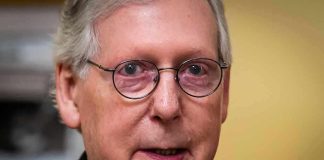
When a sitting president gets inches from a reporter’s face on Air Force One and calls him treasonous, something bigger than a bad flight is happening.
Story Snapshot
- President Trump confronted New York Times national security correspondent David Sanger aboard Air Force One, calling him “fake” and accusing him of treason over Iran war coverage.
- Trump declared the reporter’s writing “treasonous” during a press gaggle that the White House itself recorded and released.
- Sanger is a veteran White House and national security correspondent who had previously sat for an extended Oval Office interview with Trump alongside other Times reporters.
- The confrontation reflects a deliberate and escalating strategy of personalizing attacks on named journalists rather than simply disputing their organizations.
What Actually Happened on That Plane
Aboard Air Force One en route to Anchorage, Alaska, on May 15, 2026, President Trump turned a routine press gaggle into a face-to-face confrontation with David Sanger of The New York Times. Trump told Sanger directly, “I had a military victory. But the fake news, guys like you, write incorrectly.” He then escalated, calling Sanger’s reporting “treasonous” and labeling him a “fake guy” while the reporter stood there and, by multiple accounts, managed an awkward grin in response. The White House recorded and released the exchange itself.
The subject matter was Iran. Trump had been pressing his case that U.S. military action against Iran represented a decisive victory, and he clearly believed the Times coverage was undercutting that narrative. Whether you agree with Trump’s characterization or not, the setting matters: this was not a tweet, not a rally crowd, and not a campaign ad. It was a sitting president, in close physical proximity, telling a journalist to his face that his work bordered on betrayal of the country.
The Word “Treasonous” Is Not a Throwaway Line
Treason is one of only three crimes explicitly defined in the United States Constitution. Using the word against a journalist reporting on foreign policy is not a legal accusation in any formal sense, but it is a signal to the public about how that journalist’s work should be received. When Trump calls coverage “sort of treasonous,” he is not filing charges. He is filing a verdict in the court of public opinion, and his base tends to accept that verdict without deliberation. That is precisely why the word keeps appearing.
"Wow, I'm hearing this now for the first time!"
-Donald Trump, author of "Crippled America", a book about the fact that America might not be great, and in fact, could Made Great Again.
Thank you, David.
This is excellent and new information to us. pic.twitter.com/1ixoKoGLi6
— Jack Roberts (@jack226RE) May 15, 2026
David Sanger is not an anonymous blogger. He is a White House and national security correspondent with decades of sourced, on-record reporting, and he had previously participated in a formal extended interview with Trump in the Oval Office alongside other Times reporters. [1] The idea that a journalist of his standing is somehow a covert enemy of the state strains credibility, and the facts on the ground do not support the accusation. Calling a reporter treasonous for asking hard questions about Iran policy is a rhetorical move, not a factual finding.
Why Trump Does This and Why It Works
This is not impulsive behavior. Personalizing attacks on named journalists rather than simply disputing their organizations is a calculated escalation that has grown more pronounced over time. When a president singles out a specific reporter by name and calls that person dishonest or disloyal, several things happen simultaneously: the reporter becomes a target for the president’s supporters, the underlying story gets buried under coverage of the conflict itself, and every future story that reporter writes gets pre-discredited in the minds of a significant portion of the audience. It is tactically effective regardless of whether the reporting is accurate.
The uncomfortable truth for media critics on both sides is this: Trump’s strategy works in part because institutional press credibility has genuinely eroded, and some of that erosion is self-inflicted. When major outlets have published stories that required corrections or that leaned heavily on anonymous sourcing about sensitive national security matters, they handed critics the ammunition. None of that justifies calling a journalist treasonous. But it does explain why the accusation lands with so many people who might otherwise dismiss it as overreach. The press and the president are locked in a cycle each side feeds, and the American public is left sorting through the wreckage for something resembling the truth.
Sources:
[1] Web – An Interview With the President – Apple Podcasts