A Chattanooga police officer’s sprint into a burning home did more than save a mother and her children; it exposed how one ten-second choice can still cut through a country jaded by headlines and hashtags.
Story Snapshot
- Body camera video shows Officer Rogers charging into a burning two-story home to pull out a 4-year-old girl while her family flees behind him.[1]
- The May 1 nighttime blaze on Cranberry Way in Hixson, Tennessee, destroyed the family’s belongings but took no lives.[1]
- Chattanooga Police publicly credited Rogers with saving the family, reinforcing the “guardian” image many Americans still want from law enforcement.[1]
- The episode highlights both genuine courage and the way modern media turns body camera footage into instant civic mythology.[1]
Flames at the Door and a Split-Second Decision
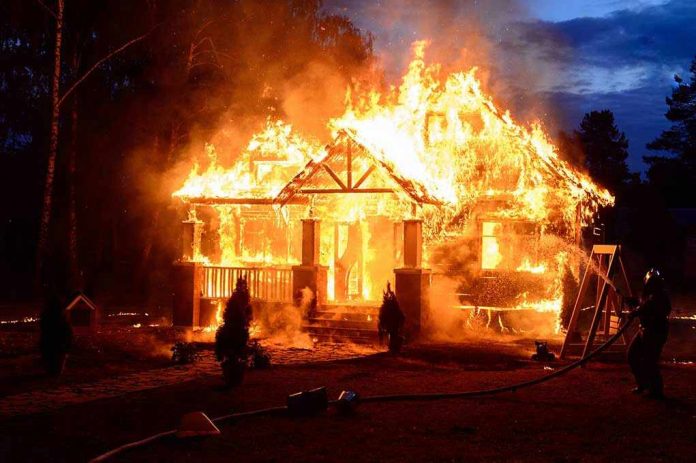
The call came in just before 10 p.m. on May 1, sending Chattanooga Police to a reported house fire on Cranberry Way in Hixson, Tennessee.[1] Officer Rogers pulled up before firefighters and saw what most of us only witness in disaster movies: flames already licking around the front door and running up the exterior and interior walls of the second floor. Neighbors shouted that people were still inside. At that point, policy manuals and training guides no longer matter; the only question is whether you step in or stand back.[1]
Rogers ran straight through the smoky doorway. Police body camera footage reportedly shows him pushing into the burning home with flames visible near the entrance, moving toward the family trapped inside.[1] According to local reporting, he emerged carrying 4-year-old Marlowe in his arms while her mother, Rachel Blaylock, followed with 10-year-old Charles.[1] The Chattanooga Police Department later said no one suffered injuries, a sentence that sounds almost casual until you remember how many fire stories end with body counts instead of gratitude.
The Human Cost Behind a “No Injuries” Headline
The Blaylock family lost nearly everything inside the home. An online fundraiser described the house as destroyed and the family’s belongings wiped out by the fire. The Chattanooga Fire Department reported that crews knocked down the blaze within about 20 minutes, fast by structural fire standards but an eternity when your children are inside and the clock is ticking in seconds instead of minutes. Material losses can be insured or rebuilt; the moment that decides whether a child wakes up the next morning cannot be rewound.
That tradeoff between things and lives sits at the center of this story. Rogers did not have a checklist item that said “sprint into fully involved structure, personal risk unknown.” Police respond to fires as part of their duty, but they usually secure the scene, keep people back, and wait for fire crews with breathing gear and hoses.[1] Charging in is not the safe option; it is the gamble that your lungs, your instincts, and a little providence will beat the fire long enough to grab whoever is inside. From a common-sense perspective, that looks a lot like heroism, even if the paperwork just calls it an “emergency response.”
Why This Rescue Resonates With a Skeptical Public
Americans older than forty have watched trust in institutions erode for decades, often for good reasons. Yet a scene like this still cuts through the cynicism. The narrative here is simple and old-fashioned: a mother, two children, a burning home, and a cop who runs toward the danger instead of away from it.[1] Body camera video, for all its controversies, becomes the modern equivalent of swearing on a Bible; people believe their own eyes long before they believe talking heads.
A police officer in Chattanooga, Tennessee is being hailed for his bravery after rushing into a burning apartment building to rescue a mother and two children before firefighters arrived.
Bodycam footage shows Officer Rogers entering the apartment to evacuate the family, then… pic.twitter.com/EUg6gplfil— CBS News (@CBSNews) May 12, 2026
This clarity explains why departments lean so hard into “hero alert” stories featuring dramatic footage.[1] They show the “guardian” side of policing that many citizens quietly hope is still the norm: local officers willing to risk real skin in the game for people they have never met. From a conservative, common-sense lens, this is what law enforcement should look like at its best—individual responsibility, courage under pressure, and protection of the innocent without a focus group or political script in sight.
The Danger of Letting Video Do All the Thinking
Video, however, does not automatically tell the whole story. The public has not seen the full body camera file, the incident report, or the fire department’s after-action review for this May 1 blaze.[1] The media accounts rely on descriptions from Chattanooga Police and brief broadcast summaries rather than archival documents.[1] That does not make the rescue any less real, but it does remind us that the story arrives already edited, framed, and packaged before we ever hit play.
Local news outlets benefit from gripping footage, and police departments benefit from positive coverage that counters every scandal and lawsuit.[1] Conservative values call for a balanced approach here: respect genuine courage, but also insist on transparency. Citizens should celebrate officers like Rogers when they risk their lives, and at the same time support open records for body camera footage and incident reports, so hero stories rest on evidence, not just emotion. That combination—gratitude plus scrutiny—is how adults handle power.
What This Night in Chattanooga Tells the Rest of Us
The Chattanooga fire on Cranberry Way will not become a national holiday or a chapter in a history book, but it offers a sharp snapshot of what still works in this country.[1] A neighbor called for help, a uniformed stranger answered, and a family that could have been a casualty report walked out alive. The house burned; the people did not. That outcome depended on training, yes, but also on one officer’s willingness to move toward the heat when it counted.
For everyone watching from a safe distance, the real question is what we choose to remember. If we only file this away as “viral police video number 7,486,” we miss the point. The better response is quieter but harder: teach our kids that duty sometimes means running into the metaphorical fire; demand accountability from our institutions without sneering at every act of service; and refuse to let endless outrage drown out the moments when someone actually does the right thing fast. That is how a brief flash of courage in Tennessee can still throw light on the rest of us.
Sources:
[1] Web – Hero alert: Bodycam shows Chattanooga officer rushing …