Portland’s latest “No Kings III” showdown ended with masked agitators testing a federal ICE gate—and learning the hard way that Washington won’t treat attempted breaches like routine street theater.
Quick Take
- Clashes outside Portland’s ICE facility followed “No Kings III” protests on March 28, 2026, with at least two arrests reported.
- Video showed masked individuals battling federal officers and attempting to force the facility gate.
- Portland Police Bureau monitored and managed safety issues but maintains a policy of not participating in immigration enforcement.
- Portland’s ICE-area protests have produced repeated arrests since June 2025, signaling a sustained cycle of escalation.
What happened outside the Portland ICE facility
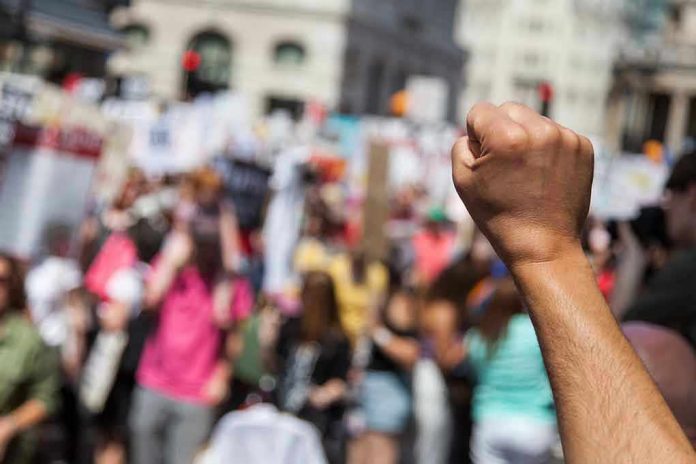
Portland-area “No Kings III” protests on March 28, 2026, shifted from daytime rallies into a nighttime confrontation outside the city’s ICE facility in the South Waterfront area. Reports described hundreds gathering as federal officers held the line at the facility. By later evening, video captured masked participants pushing into confrontations and attempting to breach the gate, and reporting confirmed at least two arrests as authorities secured the site.
The basic facts are not in serious dispute: the confrontation occurred after the broader “No Kings III” events, it centered on a federal installation, and it ended with arrests and a facility that remained secured. What remains less clear from the available reporting is the full count of injuries or the precise sequence of the gate-tampering effort beyond what appears in video coverage and incremental live updates.
How “No Kings III” protests fed a predictable escalation pattern
Organizers promoted “No Kings III” as a wide, metro-area day of action, with reporting citing more than a dozen events across the Portland region and spillover activity into nearby areas. Messaging included opposition to Trump administration policies and complaints around affordability, immigration enforcement, and public services. That mix reliably draws large crowds—but when nighttime groups pivot toward a federal facility, the risk shifts from speech to direct confrontation and criminal exposure.
Local organizers also circulated ambitious turnout claims, including estimates of “tens of thousands,” but the available coverage noted those numbers were not verified by officials. That matters because inflated crowd estimates can be used as political proof-of-mandate while downplaying the smaller subset that engages in property damage or assaults. From a law-and-order perspective, the key variable is not the biggest crowd claim; it’s the smaller group willing to cross the line into unlawful entry attempts.
Federal officers, local police, and the limits of “neutral” policing
Portland Police Bureau’s posture is shaped by long-standing local policy: PPB states it does not engage in immigration enforcement, a stance anchored in its directives and public messaging. During the South Waterfront protest activity described in prior coverage, PPB emphasized monitoring, traffic control, and medical coordination rather than direct involvement with ICE operations. That approach can reduce city liability, but it also leaves federal officers to handle facility defense when a crowd targets a federal perimeter.
In earlier ICE-area protest activity, federal agents used irritants while PPB reported no local arrests, illustrating how quickly jurisdictional boundaries and tactics can diverge in the same incident. When a protest transitions from chanting to pushing gates, the constitutional picture changes: the First Amendment protects peaceful assembly, not forced entry or vandalism. Facilities tied to federal law enforcement also trigger a faster hardening of response because the mission is protection, not negotiation.
Why this matters beyond Portland: rights, security, and accountability
Portland’s ICE-related protest history suggests this isn’t a one-off. City reporting referenced dozens of arrests tied to ICE activity since mid-2025, signaling an entrenched tactic set that returns whenever national politics heats up. That pattern pressures residents and businesses through recurring disruptions, and it normalizes the idea that “direct action” at sensitive government sites is routine. Over time, that erodes respect for lawful process—something conservatives warn eventually gets turned against ordinary citizens.
At the same time, conservatives watching this in 2026 are processing a separate frustration: national priorities feel scrambled. Americans are paying more for energy, debating the cost and scope of a war with Iran, and increasingly skeptical of open-ended conflict abroad—yet federal resources still have to secure installations at home from coordinated disorder. When political movements treat border enforcement as illegitimate, confrontations like Portland’s become a domestic tax on national cohesion and public safety.
More Craziness in Portland As Anti-ICE Mob Finds Out It's Not a Good Idea to Break Open ICE Facility Gate https://t.co/1Nuh1TchJr
— PatPeters,PhD. (@PatVPeters) March 29, 2026
For readers trying to cut through the noise, the most grounded takeaway is simple: protests are common; attempts to breach a federal facility perimeter are not protected speech and predictably trigger arrests and a stronger security posture. The public still lacks full clarity on how organizers, local authorities, and federal agencies will change tactics before the next flare-up. For now, the reporting shows the same loop: big daytime rallies, nighttime escalation at ICE, and consequences that rarely deter repeat attempts.
Sources:
https://www.opb.org/article/2026/03/28/no-kings-protest-portland-oregon-updates/
https://www.portland.gov/police/news/2026/2/1/ppb-monitors-protest-activity-no-arrests-made