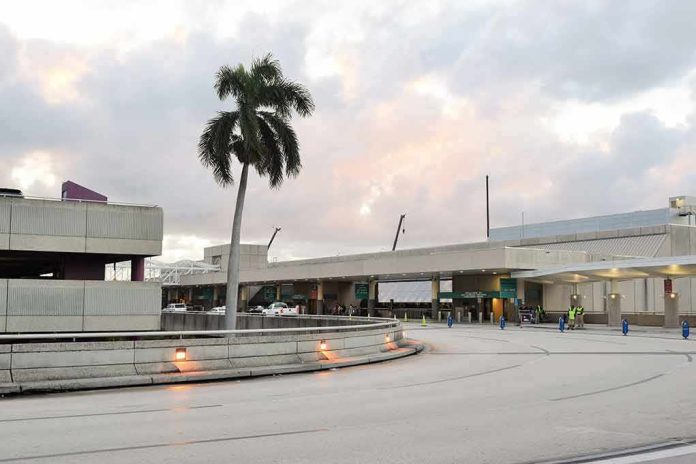
The fight to turn Palm Beach’s hometown airport into Donald J. Trump International Airport shows exactly how hard America now battles over names, symbols, and who gets to control them.
Story Snapshot
- Florida’s governor and legislature seized naming power over big airports and picked Trump
- Palm Beach County cut a narrow 4–3 deal giving the Trump Organization control of the brand
- Codes, signs, and maps now shift from PBI to DJT as lawsuits and critics circle
- The airport becomes a test case for state power, local control, and political symbolism
How Trump’s Name Landed On The Airport, By Law Not By Local Choice
Florida lawmakers did not simply ask Palm Beach County if it wanted Trump’s name on its airport. They rewrote the rules so the state, not local governments, decides the names of major commercial airports, then wrote Palm Beach International Airport directly into the bill as “President Donald J. Trump International Airport.” Governor Ron DeSantis signed the legislation on March 30, 2026, only hours after it reached his desk, with no big public event or long delay. That speed showed clear intent: lock in Trump’s name and move on.
The law does more than rename one airport. It preempts, or overrides, local authority on naming decisions for major airports statewide. Palm Beach County still owns and runs the airport, but it no longer controls what it is called, which is a sharp break from normal home rule. For many conservatives, the move looks like a rare case where state power expands at the expense of local control, raising fair questions about whether symbolism pushed aside small-government instincts.
The County’s Tight Vote And A Powerful Trademark Deal
Once the state locked in “President Donald J. Trump International Airport,” Palm Beach County still had to decide how to manage that brand. After heated debate, the County Commission approved a licensing agreement by a narrow 4–3 vote to let the Trump Organization control use of the name, image, and likeness for airport promotion. The deal gives Trump’s business an oversight role on how the brand appears on logos and marketing, and it shields the airport from trademark fights by putting the owner of the name at the table.
The trademark side matters almost as much as the law itself. The Trump Organization had already moved to secure trademark rights for airport uses of Trump’s name nationwide, saying it needed to protect the brand as Florida advanced the renaming. Supporters see that as standard business practice; critics call it a perk-packed arrangement that mixes public infrastructure with private branding power. Common sense suggests both things can be true at once: protecting trademarks is normal, but concentrating branding control in one political figure’s company is unusual for a taxpayer-funded hub.
Signs, Codes, And The Moment DJT Became Operational
For travelers, what counts is not the bill signing date but when the name and codes start to appear in the real world. The airport’s own announcement says the federal aviation location and International Civil Aviation Organization identifiers change from PBI and KPBI to DJT and KDJT effective July 9, 2026, once the Federal Aviation Administration finishes its administrative steps. That means pilots, air traffic controllers, and flight planners now work with DJT in their systems, marking the official operational shift in the aviation world.
The airport also lays out how the booking code used by passengers will lag behind. The International Air Transport Association code that appears on tickets and bags will stay PBI until mid-August 2026, then switch to DJT after a scheduled update. That gap creates a short window where the signs say Trump, the cockpit instruments say DJT, but your boarding pass still shows PBI. Operators have been warned to make sure their charts, databases, and procedures are updated to match the new designation to keep safety and logistics tight.
The Ceremony, The Boulevard, And Trump’s Personal Touch
Supporters did not treat the renaming as a dry paperwork exercise. Eric Trump piloted the first flight to land under the new name, touching down at 5:01 a.m. and calling his father’s name “more synonymous with Palm Beach than Donald Trump.” He said all five major airlines at the airport backed the change, framing it as a business-friendly rebrand rather than just a political statement. That claim has not yet drawn public written confirmation from the airlines, which leaves a gap critics can point to, but it fits the Trump family’s effort to present the move as mainstream.
Palm Beach International Airport in Florida has officially been renamed President Donald J. Trump International Airport.
The change took effect on July 9, 2026, after a state law passed earlier this year. The airport code will change from PBI to DJT on August 18.
Trump frequently…— Port Watch (@PortWatchman) July 9, 2026
The renaming did not stop at the terminal doors. Southern Boulevard, the major road in front of the airport, was retitled “President Donald J. Trump Boulevard,” tightening the geographic tie between the airport name and the routes people drive to reach it. Donald Trump himself, speaking by phone from overseas, called the honor exciting and meaningful, even though he missed the ceremony because of travel. Love him or hate him, that direct involvement underscores that this is not some distant, dusty naming; it is part of Trump’s living brand and ongoing political story.
Costs, Lawsuits, And The Battle Over Who Pays And Who Decides
Behind the new signs and codes sits a real price tag. State and local reports put the rebranding cost at about $5.5 million for new signage, uniforms, and marketing, with about half of that, $2.75 million, coming from a state appropriation. Critics, especially Democrats and some residents, argue that spending millions to rename a well-known, well-functioning airport is a waste and an unfair burden on local taxpayers. Supporters answer that presidents from Kennedy to Reagan have airports named after them and Trump, as a Florida resident and former president, fits that pattern.
Legal fights add more friction. At least two lawsuits aim to stop or unwind the change, arguing that the state law sidesteps county ownership and home rule. Opponents say the renaming turns shared public infrastructure into a partisan monument and accuse the state of regulatory capture, where political power rewrites rules to serve one figure’s brand. From a conservative values lens that favors limited government and clear local voice, those objections deserve serious weight, even if the law currently stands.
Confused Travelers, Polarized Neighbors, And What This Airport Signals
Local coverage shows some travelers confused by fresh Trump airport signs while their phones and navigation tools still search for PBI. That confusion is likely short-term; people adjust quickly once maps, apps, and tickets all line up. The deeper impact sits with residents, who now see one of their core civic assets renamed by the state after a polarizing figure over the protests of a sizable share of their neighbors. That is more than branding; it is a stress test for how America handles honors in a divided time.
Supporters view the airport as a deserved tribute to a president who made Palm Beach his home base, gave many conservatives a voice, and reshaped national debates. Opponents see it as one more example of politics pushing into every corner of public life, down to the name on the baggage claim. The facts are clear: the law is signed, the codes are changing, the signs are up. The open question is what it means when turning an airport into Donald J. Trump International Airport feels to many people less like a simple honor and more like a fresh front in the culture war.
Sources:
youtube.com, wlrn.org, pbia.org, news4jax.com, facebook.com, thehill.com, pbs.org, presidentsusa.net