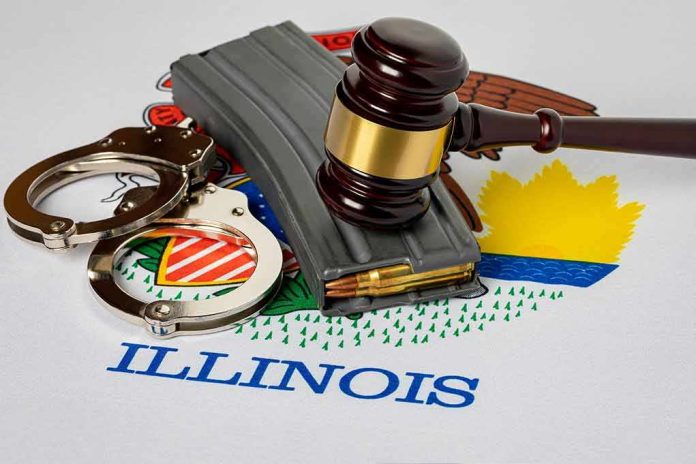
A federal court just said Illinois can ban the most popular rifle in America while admitting millions of citizens already own it.
Story Snapshot
- Seventh Circuit upheld Illinois’ AR-15 and magazine ban under the Supreme Court’s Bruen test, but only by stretching history hard.
- The court analogized AR-15s to 1800s bowie knives and “exceptionally dangerous weapons,” even while conceding lawful common use.
- A trial judge, the Department of Justice, and the Trump team all say the law flunks the Second Amendment’s common-use standard.
- The Supreme Court is now taking AR-15 cases that could wipe out bans like Illinois’ nationwide.
How Illinois Ended Up Banning the Most Common Rifle
Illinois passed the Protect Illinois Communities Act in 2023, after a high-profile mass shooting, to ban so-called assault weapons and limit magazine capacity. The law targets rifles like the AR-15 and magazines over 10 rounds for long guns and 15 rounds for handguns. That means a law-abiding owner who did nothing wrong can become a criminal for buying or selling the same rifle millions of Americans keep for home defense, sport, and competition.
Gun owners sued fast. In the Southern District of Illinois, Judge Stephen McGlynn issued a 168-page opinion blocking the law. He found these rifles and standard magazines are in common use, and he saw no founding-era tradition of banning them. Applying the Supreme Court’s Bruen test, he held that public safety fears cannot override an enumerated right that the Constitution already protects. In plain language, the state’s “we know better” argument did not survive contact with history.
What The Seventh Circuit Said To Keep The Ban Alive
The Seventh Circuit Court of Appeals stepped in and reversed course. In a 2–1 decision, it upheld Illinois’ law and put the ban back in force. The panel assumed, for the sake of argument, that AR-15s fall under the Second Amendment’s “plain text,” but then concluded Illinois met its burden under Bruen’s second step. To get there, the majority said history allows regulation of “exceptionally dangerous” arms, even when there is no carbon-copy law from 1791.
The court leaned hard on a comparison almost no gun owner would accept: it analogized modern AR-15s to 19th-century bowie knives. States once restricted these knives through taxes, penalties, and carry rules, treating them as tools of street violence. From that, the panel reasoned that Illinois can now treat AR-15s as a modern class of unusually dangerous weapons, and regulate them more like contraband than like ordinary handguns. For many conservatives, that sounds less like history and more like policy dressed up in old clothing.
The Logical Knot: Common Use Versus “Weapons Of War”
Here is where the opinion runs straight into common sense. The panel acknowledged that AR-15s are widely owned and used for lawful purposes, including self-defense. That fact matters because the Supreme Court in Heller said weapons “in common use” by law-abiding citizens sit at the heart of the Second Amendment. Yet the Seventh Circuit still treated AR-15s as “weapons of war” that the state can ban while leaving handguns alone.
That move creates a tension even non-lawyers can spot. If a firearm is covered by the plain text of “the right to keep and bear Arms,” and it is commonly owned by peaceable citizens, why can the state outlaw it outright? The court tried to solve that problem by stressing lethality. It highlighted higher muzzle velocity and the ability to fire rapidly with detachable magazines, and on that basis drew a line between AR-15s and handguns. The problem is that the Constitution does not protect only mild or polite arms; it protects arms that work.
Side B’s Rebuttal: History, Rights, And Federal Pushback
Judge McGlynn’s district court ruling pulled no punches. He found no founding-era tradition of banning common rifles or typical magazines, and he rejected Illinois’ argument that public safety alone justifies broad bans. He read Bruen to mean the government cannot outlaw firearms just because officials now label them “militaristic” or scary. That reading lines up with a core conservative value: the Constitution sets real limits that do not bend every time a politician notices a poll or a headline.
🔴 Federal appeals court upholds Illinois semiautomatic weapons ban
The U.S. Court of Appeals for the Seventh Circuit ruled 2-1 Thursday that Illinois's ban on AR-15 rifles and large-capacity magazines does not violate the Second Amendment. The decision reverses a 2024… pic.twitter.com/ytSfD1as7v
— NewsTongue (@NewsTongueX) July 10, 2026
Here is the twist that surprised many observers: the United States Department of Justice filed an amicus brief backing the injunction that struck down Illinois’ law. The brief argued that the act violates the Second Amendment to the extent it bans firearms in common lawful use by citizens. The Trump team, in its own filing, also urged courts to correct what it called the Seventh Circuit’s misreading of Bruen. When both federal lawyers and a conservative administration converge against a ban, it signals that the appellate ruling rests on shaky ground.
Why The Supreme Court’s Next Move Could Change Everything
The story does not end in Chicago. The Supreme Court has already agreed to hear challenges to AR-15 bans from Cook County and Connecticut, asking whether the Second Amendment protects possession of these rifles at all. Justice Clarence Thomas, joined by Justice Samuel Alito, has already signaled concern, criticizing lower courts that treat the right to keep and bear arms as second-class. If the Court applies its own common-use test with teeth, many state bans may not survive.
That is why Illinois’ case feels less like a local fight and more like a preview. On one side stand lawmakers, advocacy groups, and some academics who see bans as a logical answer to modern violence. On the other side are millions of owners, a district judge, and even federal lawyers who say you cannot erase a constitutional right by relabeling a common rifle as a battlefield weapon. Soon the only opinion that matters will come from nine justices, and this time, there is no higher court to stretch history any further.
Sources:
law.justia.com, justice.gov, michellawyers.com, media.ca7.uscourts.gov, reddit.com, cbsnews.com, giffords.org