The most revealing fact is not that a Coast Guard team stopped a crowded boat, but that the public record already contains two competing stories: one of a dangerous maritime interdiction, and one of a rescue that no one has yet fully audited.
Story Snapshot
- A U.S. Coast Guard-led operation intercepted a vessel carrying 240 people near Turks and Caicos, with partner agencies and local authorities involved.
- Official and media accounts describe the boat as overcrowded, taking on water, and at risk of sinking.
- The available sources do not prove an intended illegal entry into the United States; they prove an interception near Turks and Caicos.
- The case already shows how labels such as “migrants,” “aliens,” and “irregular migrants” shape public judgment before the facts are fully released.
What Happened at Sea
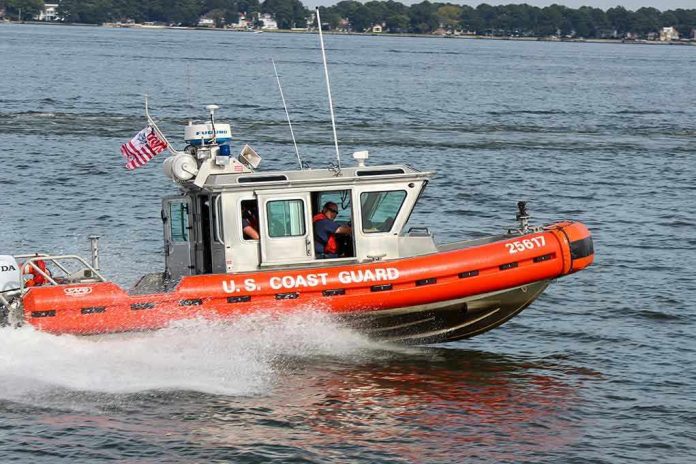
U.S. Coast Guard, Customs and Border Protection Air and Marine Operations, and Turks and Caicos authorities conducted a joint maritime operation that intercepted a vessel carrying 240 people near the islands.[3] Fox News reported that the boat was overcrowded and taking on water, while the Coast Guard’s own video framed the event as a coordinated interdiction near Turks and Caicos.[1] The Royal Turks and Caicos Islands Police said the vessel was tracked and later intercepted by the United States Coast Guard.[2]
That matters because the operation was not described as a simple patrol stop. It was a multi-agency response to a vessel already seen as unstable, which is why the language in the record leans so hard on words like “overloaded,” “unsafe,” and “dangerous.”[1] Those words are not ornamental. They are the hinge of the whole public narrative: if the boat was truly near failure, interdiction becomes rescue as much as enforcement.
Why the Language Matters So Much
The argument over this incident begins with terminology, not law. Some sources call the people aboard “migrants,” others say “aliens,” and others use “irregular migrants,” and that vocabulary steers readers toward very different conclusions about legitimacy and threat.[1] Conservative readers will notice the practical point immediately: a government that cannot defend its terms cleanly often ends up letting the loudest media frame define the event for it.
The strongest evidence in the current record supports the view that the boat was in distress and that authorities treated the situation as an urgent maritime intervention.[1][3] The Turks and Caicos government said its Regiment carried out a “tactical interception” and “immediate stabilization of the vessel,” while Fox News quoted the Coast Guard describing the removal of people from a perilous situation.[3] That language supports the safety rationale, even if it does not settle every legal question.
What the Record Does Not Prove
The available sources do not independently prove that the passengers were trying to enter the United States illegally.[1][2][3] They show an interception near Turks and Caicos, a transfer to local custody, and descriptions of migrants or passengers aboard a distressed vessel.[1][2] That is important because geographic proximity alone is not evidence of U.S. entry intent. Without route documents, passenger testimony, or operational intelligence, the leap from “intercepted near the islands” to “attempted illegal entry into the United States” remains unproven.
The record is also thin on legal authority. None of the supplied sources spells out the statute, treaty basis, or bilateral rules that governed the operation.[1][2][3] That omission does not make the interdiction improper, but it does mean the public has been asked to trust the agencies without seeing the legal scaffolding. In a serious case, that is not a minor gap; it is the difference between a persuasive account and a complete one.
The Missing Evidence That Would End the Debate
What would settle this story is not more commentary but harder proof: incident reports, cutter logs, radio traffic, passenger interviews, and medical records.[1][2][3] The sources also do not give a casualty report, detailed damage assessment, or sworn first-hand testimony from officers who saw the vessel before interception.[1][2] Until those records surface, the public is left with a familiar maritime pattern: strong visuals, fast conclusions, and far too little documentary depth.
US Coast Guard intercepts vessel with 240 migrants near Turks and Caicos Islands https://t.co/zwUaaSjEfL
— MixVale (@Mixvale) June 5, 2026
That is why the case will remain politically combustible. Enforcement-heavy outlets see a clean border-security story; critics see a rescue wrapped in rhetoric that may obscure the passengers’ actual circumstances.[1][3] Both reactions are understandable, but only one thing is certain right now: the public record proves an interception of a dangerously crowded vessel, not the full legal and factual story behind it.
Sources:
[1] Web – Coast Guard Stops 240 Illegal Immigrants on Overcrowded Vessel
[2] Web – Overcrowded boat carrying 240 Haitian migrants interdicted near …
[3] Web – Illegal vessel intercepted – Royal Turks and Caicos Island Police