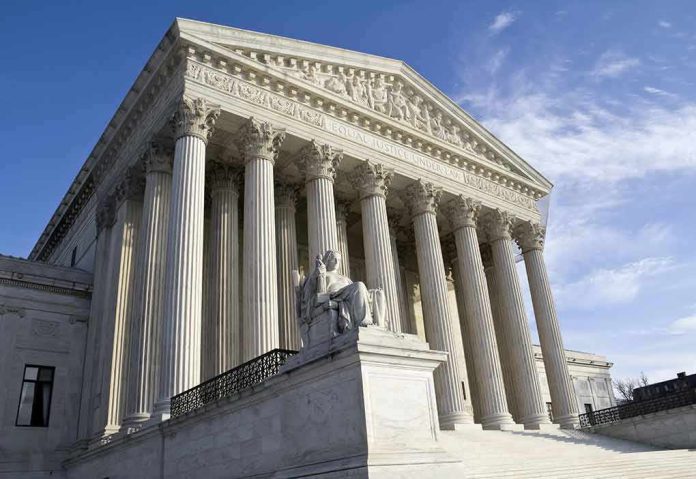
The Supreme Court just stripped away a 90-year-old shield that protected federal agency bosses from being fired at will, handing President Trump the power to clean house across Washington’s regulatory agencies.
Quick Take
- The Supreme Court ruled 6-3 in Trump v. Slaughter on June 29, 2026, that Federal Trade Commission commissioners can be removed by the president without cause.
- The case started when President Trump fired Commissioner Rebecca Kelly Slaughter in March 2025.
- The decision guts the core protection from Humphrey’s Executor, a 1935 ruling that had shielded agency leaders for nine decades.
- The ruling follows a pattern set by Seila Law in 2020 and Collins v. Yellen in 2021, both stripping job protections from other agency heads.
- Trump now has a much clearer path to replace leaders at other multimember agencies that resist his policy agenda.
The Ruling That Changes Who Runs Washington
Chief Justice John Roberts wrote the majority opinion, joined by Justices Alito, Gorsuch, Kavanaugh and Barrett, with Thomas joining most of it. The Court’s holding was blunt: the Federal Trade Commission’s for-cause removal protection is “contrary to” the Constitution. The justices wrote plainly that “subordinates who exercise the President’s power are subject to removal by him”. The case was reversed and sent back to the lower courts.
That single line reshapes how every independent agency operates. Commissioners who once believed a statute protected their jobs from presidential displeasure now know otherwise. If the president exercises executive power through them, he can remove them for any reason, not just proven misconduct or neglect of duty.
One Firing, One Lawsuit, One Supreme Court Showdown
The fight began in March 2025. Trump told Federal Trade Commission Commissioner Rebecca Kelly Slaughter he was removing her from office. The Federal Trade Commission Act only allowed removal “for inefficiency, neglect of duty, or malfeasance in office”. Slaughter sued, arguing the firing broke the law Congress wrote decades earlier.
A lower court agreed with her. It called the president’s firing “ultra vires,” meaning beyond his legal authority, and issued a permanent injunction ordering officials not to interfere “with Ms. Slaughter’s right to perform her lawful duties”. The Supreme Court took the case, heard arguments in December 2025, and reversed that ruling outright.
The Hundred-Year Tug-of-War Over the Bureaucracy
This fight stretches back a century. In Myers v. United States in 1926, the Court recognized broad presidential power to remove a postmaster. Nine years later, Humphrey’s Executor flipped that logic for the Federal Trade Commission, reasoning that commissioners performed quasi-legislative and quasi-judicial work deserving independence from the White House.
That independence started crumbling in 2020, when Seila Law stripped job protection from the Consumer Financial Protection Bureau’s director. Collins v. Yellen extended the same logic to the Federal Housing Finance Agency in 2021. Each ruling chipped away at Humphrey’s Executor’s reasoning, and Trump v. Slaughter finishes the job for the agency the 1935 case was built around.
What Trump Could Do With This Power Now
With removal authority secured, Trump can swap out agency leaders who slow-walk his deregulation push without needing to prove wrongdoing. That is a direct win for anyone who believes unelected bureaucrats should answer to a president voters actually chose, not sit protected for years regardless of performance or policy direction.
Other multimember agencies, including the Securities and Exchange Commission, the National Labor Relations Board and the Federal Communications Commission, operate under similar for-cause removal language. This ruling signals the Court is likely to side with the president in future fights over those agencies too, giving Trump leverage he did not clearly have a year ago.
The bigger story here is accountability. For ninety years, agency heads could point to statutory protection and shrug off presidential pressure. That era is closing. Whether that strengthens good government or simply hands one branch more muscle will play out agency by agency, fight by fight, for years to come.
Sources:
thegatewaypundit.com, supremecourt.gov, law.cornell.edu, constitution.congress.gov, congress.gov, paulweiss.com