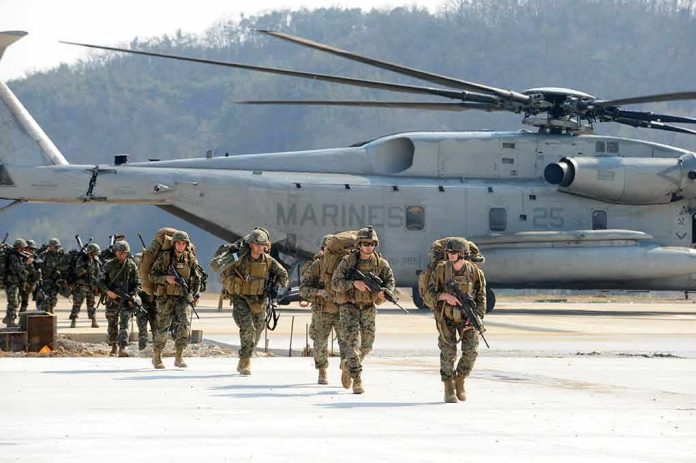
A single arrest on Okinawa triggered a month of midnight-to-dawn silence for U.S. troops and a sharp message to Tokyo and the island’s people.
Story Snapshot
- Japanese police arrested Lance Cpl. Devin Jacob Ballard on suspicion of killing Anna Yagi in Naha.
- U.S. Marines said they are cooperating with Japanese authorities and called the case serious.
- Commanders imposed a 30-day night curfew and a 48-hour alcohol ban for U.S. forces on Okinawa.
- Japan lodged strong protests and summoned the U.S. ambassador amid public outrage.
What Happened And Why It Mattered Fast
Okinawa police arrested U.S. Marine Lance Cpl. Devin Jacob Ballard, 20, on suspicion of killing 39-year-old Anna Yagi in a Naha hotel and stealing her wallet and backpack. Reports said Ballard denied the allegations as the investigation moved ahead in Japanese custody. The III Marine Expeditionary Force said it was cooperating and stressed that Marines must meet the highest standards of conduct, underscoring the gravity placed on the case by military leaders.
Commanders imposed a midnight-to-5 a.m. curfew for 30 days and ordered a 48-hour alcohol ban on and off base. Coverage linked the move to the need to ease tensions and allow time for training and accountability measures. Lt. Gen. Benjamin T. Watson, the Okinawa area coordinator and III Marine Expeditionary Force commander, was cited as the announcing authority in reporting on the restrictions. The action fit a familiar crisis playbook meant to reassure the host nation while police work proceeds.
Diplomatic Heat And Local Outrage Shaped The Response
Japan’s government lodged strong protests and summoned the U.S. ambassador after the arrest. Leaders framed the alleged killing as a grave offense that demanded visible steps to restore calm. News reports also showed protests on Okinawa and in Tokyo, where residents voiced anger and deep fatigue over repeat incidents tied to U.S. personnel. The curfew aimed to show control, reduce off-base risk at night, and meet the moment with restraint rather than denial.
Okinawa’s frustration did not begin this week. The island hosts a heavy share of American facilities under the bilateral treaty and the Status of Forces Agreement. Past high-profile crimes by U.S. service members have fueled calls for stricter discipline or structural change. Local and national leaders have argued that standard measures often come after, not before, a tragedy. That history explains why commanders reached for quick, public limits on liberty to calm the street and buy time.
What The Curfew Does And Does Not Do
The curfew restricts movement during the hours when alcohol-related and liberty incidents tend to spike. The 48-hour alcohol ban and a broader pause on some activities give leaders time to run training, check unit accountability, and meet with Japanese officials. Those steps can limit opportunities for misconduct and signal respect. The evidence available does not offer a clear metric that proves the curfew prevents future crimes, but it plainly lowers exposure during the riskiest window.
The U.S. military is imposing a monthlong curfew in Okinawa after the arrest of a marine on suspicion of murdering a local woman https://t.co/9jaKfAMCXb
— TIME (@TIME) October 7, 2026
Some will call this collective punishment. A better frame is command responsibility. Good order and discipline protect the mission and the host community. Conservatives value personal accountability and respect for law. Both apply here. The alleged crime is a matter for Japanese justice. The curfew is a matter for American command. One does not replace the other. It shows the chain of command acting early, even as the legal process runs its course and facts are tested.
The Stakes For Allies And For Every Marine On Liberty
Alliances run on trust as much as strategy. Every liberty brief and sign-out log on Okinawa now carries more weight. A single off-duty choice can ripple through diplomacy, fuel protest, and complicate missions that keep the region stable. The Marine Corps’ public tone matched that reality. It promised cooperation with Japanese authorities and held the line on standards. That is the right balance: help the host nation, respect due process, and tighten discipline until the storm passes.
Sources:
cbsnews.com, bbc.com, arabnews.jp, aljazeera.com, kuwaittimes.com