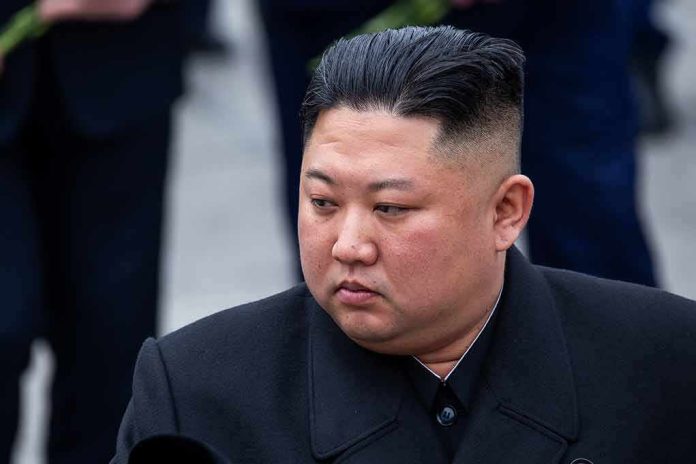
South Korea’s spy agency says Kim Jong Un is “extremely obese,” yet still sprints up ship stairs under watchful doctors—an unsettling mix of risk and resilience that raises bigger questions than it answers.
Story Snapshot
- South Korea’s National Intelligence Service estimates Kim at about 140 kilograms and high cardiovascular risk.
- Lawmakers briefed say Kim shows no clear health abnormalities during recent public inspections.
- Prior briefings linked his weight to high blood pressure and diabetes concerns, with medicine sought abroad.
- Spy-briefing “echo chamber” effects and secrecy make precise verification hard for outsiders.
NIS puts numbers to the risk—and keeps the brakes on alarm
South Korea’s National Intelligence Service told lawmakers that Kim weighs in the 140 kilogram range and falls into a high-risk category for heart disease. The same briefing stressed there were no clear signs of health abnormalities. That paired message—elevated risk without present dysfunction—tracks a pattern. The agency has long flagged weight concerns while batting down rumors of a health crisis. The signal here is not collapse. The signal is rising odds over time, watched by doctors and managed for now.
The NIS added a detail meant to calm markets and militaries alike. Kim showed no struggle with exertion during a destroyer inspection, even running up stairs. That vignette will not erase the risk label, but it does frame the clock. If he can handle bursts of activity today, the danger lies ahead, not at this hour. Conservative common sense reads this as a reminder: plan for the worst, but do not declare it before it arrives.
A long-running thread, not a sudden scare
This assessment extends a yearslong line. Past briefings traced Kim’s weight rise across the 2010s and tied it to blood pressure and diabetes concerns. In 2024, the Associated Press reported the NIS believed his aides were sourcing new medicines abroad to treat obesity-related conditions. Even then, Seoul’s message avoided crisis talk. In 2020 and 2021, South Korean officials said he had no irregular symptoms and was not seriously ill, despite weight swings and rumor cycles. This continuity matters. It suggests an analytic baseline, not a fleeting headline.
Skeptics will ask how the spies got the number. The 2026 reports do not spell out the method. Prior chatter referenced video-based estimates and artificial intelligence tools, but this briefing kept methods behind the screen. That is normal in intelligence. It is also why outside readers should separate trajectory from precision. The clearest fact is directional: the agency has moved him into an “extremely obese” bracket and linked that to heart risk. The rest is confidence bands, not lab printouts.
What the stamina clip does—and does not—prove
The staircase scene is doing heavy lifting in this narrative. It tells us he is not incapacitated. It does not tell us that all is well. A single moment cannot negate chronic risk. Think of a smoker who sprints one block. The lungs still pay a price over years. The NIS’s two-part message reflects that difference between snapshots and trends. Today looks stable. Tomorrow remains uncertain. That is why a dedicated medical team shadows him and, reportedly, hunts for medicine beyond North Korea’s borders when needed.
North Korean leader Kim Jong Un is assessed to be "extremely obese" and weighing over 140 kg, according to South Korea’s spy agency.
Despite being at high risk of cardiovascular disease, the nuclear-armed state's leader shows no signs of major health issues.📸: AFP… pic.twitter.com/SsarCZOAVb
— Channels Television (@channelstv) September 30, 2026
American conservatives will recognize the prudence here: judge by what you can see, prepare for what you cannot. There is no case for hype. There is a solid case for contingency planning. North Korea sits on nuclear weapons, missile forces, and a personality-led system. Health shocks in such systems can turn fast. A fit-looking leader can still face a sudden episode. The right response mixes vigilance with restraint, not wishful thinking or rumor-chasing.
Why the secrecy loop keeps spinning
The briefing-to-lawmaker-to-media pipeline shapes how the public hears about Kim’s health. The British Broadcasting Corporation has warned for years about the “pitfalls of spy briefings,” where facts compress, nuance thins, and estimates sound like certainties once they leave the secure room. That does not make the NIS wrong. It makes their claims easy to misread. The best practice is to anchor on the few hard pegs: the weight estimate band, the stated risk category, the observed physical activity, and the lack of diagnosed crisis in public view.
The policy stakes are larger than a number on a scale. If his health worsens, succession planning will move from whispers to actions. If he stays stable, deterrence and pressure remain the core tools to manage Pyongyang. Either way, clarity beats theater. The NIS appears to be signaling both resolve and realism: monitor closely, report soberly, and avoid feeding rumor mills that help no one—least of all citizens who would bear the cost of miscalculation.
Bottom line
Kim Jong Un is assessed as extremely obese, at roughly 140 kilograms, with elevated cardiovascular risk and no current signs of impairment under watch by a dedicated medical team. He can climb stairs today. He cannot outrun math forever. The prudent course is steady deterrence and quiet contingency planning, not glee or panic. Let the facts lead, keep the rhetoric low, and watch the trend line more than the snapshots.
Sources:
dagens.com, asiae.co.kr, abcnews.com, news.sbs.co.kr, nbcnews.com