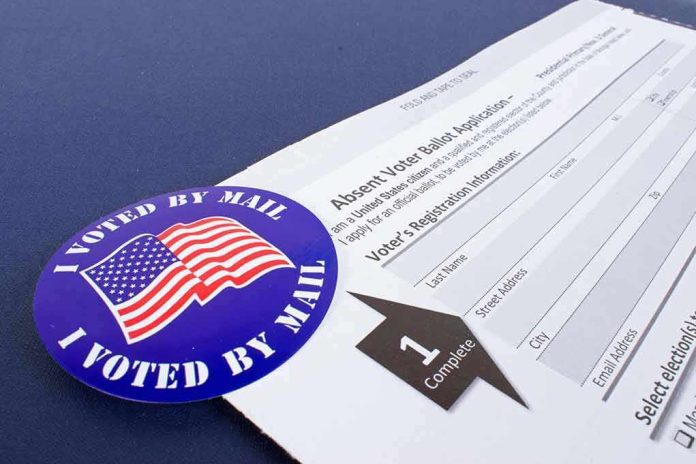
Washington scrubbed a checkbox from the overseas voter form, and the ripple hits state law, ballot access, and trust all at once.
Story Snapshot
- The August 2026 Federal Post Card Application removed the “never lived in the U.S.” checkbox.
- Officials called the checkbox “inaccurate” and said the changes reduce confusion and align with federal law.
- States still control eligibility rules; Texas blocks ballots to “never resided” applicants under current state law.
- Advocacy guides show some states treat these voters differently, which shaped how the old checkbox worked.
What Changed On The Federal Form
The government approved a revised Federal Post Card Application on August 28, 2026. The approval record says the update clarifies identification rules and removes an “inaccurate eligibility checkbox for citizens who have never lived in the U.S.” That language anchors the official view: the checkbox did not reflect how eligibility really works under federal law and caused confusion for applicants and administrators. The updated form package and listing confirm the revision and its scope without adding detail on implementation.
HUGE Development: Revised Overseas Voter Form FPCA Eliminates Checkbox “I Never Lived In U.S.” – A Blow to Birth Tourism Voters, Non-Citizens, and Democrats https://t.co/0RuPEsppVZ #gatewaypundit via @gatewaypundit
— BREAKING NEWZ Alert (@MustReadNewz) September 8, 2026
Conservative readers will ask the next hard question: did this change weaken a screen that kept ineligible ballots out? The record does not show that. A checkbox is a self-attestation, not a proof document. The federal notice labels it inaccurate, not protective. That said, form layout shapes workflow. When you remove a flag, you change how fast and where clerks look. The effect depends on state law and back-end checks, not the federal box alone.
How State Law Still Calls The Shots
States decide whether a citizen who never lived in the United States can vote and for which contests. Texas gives a clear example. Its official checklist tells local officials to deny ballots if an applicant indicates they never resided in the United States. That instruction operates regardless of the federal form’s checkbox. Texas relies on its own eligibility rules, and the clerk’s guidance is direct: do not send a ballot in those cases under current state law.
Other states take a different path. Federal Voting Assistance Program materials and long-standing guidance note that some states let United States citizens born and living abroad use a parent’s last state address as their voting residence. Those voters may get a federal-only ballot in some states or a full ballot in others, depending on local law. This patchwork shows why a single federal tick box never acted as a universal gatekeeper.
Why Advocates And Media Read The Same Edit Differently
Voting-abroad advocates have long treated “never lived in the United States” as a real category for counseling voters. Their pages explain that the Federal Post Card Application lists categories, including that one, but stress that not every state uses it the same way. They also say the government site suppresses that option for states that do not allow such voters, which hints at dynamic filtering behind the scenes. That explains why removing the static checkbox can be framed as a cleanup, not an opening.
Some commentators call the removal a blow to safeguards and link it to non-citizens or “birth tourism” voters. The official record does not support that jump. The change targets a category of United States citizens overseas, not non-citizens. The listing says the checkbox was inaccurate for eligibility purposes, not that it screened out non-citizens. Claims that the deletion invites non-citizen ballots stretch beyond the cited facts. The stronger conservative case centers on transparency and process, not conspiracy.
What Common Sense Demands Next
Election confidence comes from clear rules, repeatable checks, and a paper trail that matches the law. Congress set baseline protections for overseas voters, but states draw the tight lines on residence. The federal form should mirror that map, not blur it. The government should publish the redlines, the rationale memo, and state-impact analysis so voters and clerks see exactly what changed and why. Sunlight stops rumor mills cold and backs up administrators who follow the rules.
Three guardrails keep this clean. First, identity and citizenship proof must remain independent of any checkbox. Second, state eligibility logic must drive ballot style, every time. Third, audit logs should flag “never resided” determinations for quality control in states that restrict them. Texas shows how direct guidance works; other states should match that clarity or explain their alternative path in plain English.
Bottom Line For Voters And Officials
The form lost a box, not a law. States still decide if a citizen who never lived in the United States gets a full ballot, a federal-only ballot, or no ballot. Texas continues to block those ballots under current law. Federal officials say the change fixes confusion and aligns with statute. Voters deserve a posted playbook, not a scavenger hunt. Publish the details, keep the audits sharp, and let the rules, not rumors, run the count.
Sources:
thegatewaypundit.com, votefromabroad.org, eci.gov.in, aaro.org, reginfo.gov, sos.state.tx.us, fvap.gov