The most explosive moment in Charlie Kirk’s assassination hearing was not about bullets or DNA, but about who gets to see the truth unfold in real time.
Story Snapshot
- Judge Tony Graf refused to shut off courtroom cameras, calling electronic coverage a tool for public access and government accountability.
- Charlie Kirk’s widow Erika demanded full transparency, pushing for cameras so no one can doubt what happened to her husband.
- The defense warned that wall-to-wall coverage and leaking exhibits could poison the jury pool and wreck Tyler Robinson’s right to a fair trial.
- This clash over cameras and sealed evidence now sits at the center of a high-stakes murder case with a possible death penalty on the table.
A Utah courtroom turns into a battle over who gets to see justice
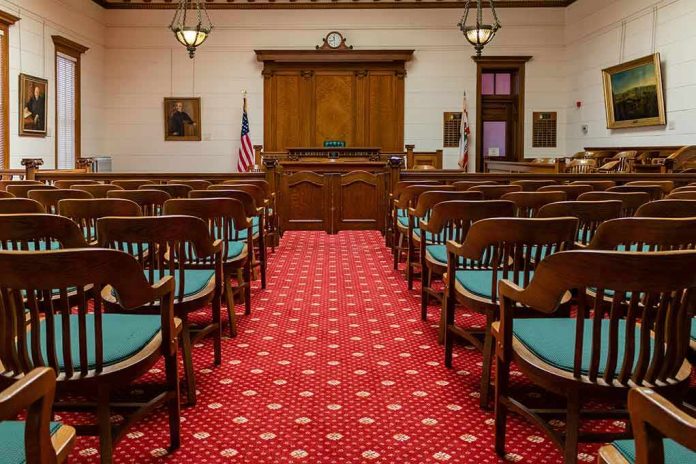
Inside a small Provo courtroom, the case against Tyler Robinson, accused of assassinating conservative activist Charlie Kirk, is no longer just about who fired a rifle on a campus roof. It is also about who gets to watch the state prove it. Judge Tony Graf faces a packed five-day preliminary hearing where prosecutors roll out surveillance video, digital records, and DNA while cameras and reporters broadcast almost every move to a national audience.
PRELIMINARY HEARING UPDATE: CHARLIE KIRK ASSASSINATION CASE EXPLAINED
We are nearing the end of day two in the multi-day preliminary hearing for Tyler Robinson, the man accused of fatally shooting conservative activist Charlie Kirk at Utah Valley University. Prosecutors… pic.twitter.com/f3HLDnsXKs
— Crime Talk with Scott Reisch (@CrimeTalkNet) July 7, 2026
Utah rules start with a clear presumption: if the main purpose is journalism, electronic media are allowed in court. Judge Graf leaned straight into that standard when Robinson’s lawyers tried to block cameras and microphones altogether. He said electronic media coverage “provides a means to facilitate the public’s right of access to court proceedings,” framing cameras not as a circus, but as a modern window into government power. In a country built on open courts, that is no small statement.
The Kirk family pushes for sunlight, not secrecy
On the other side of the room sits Erika Kirk, a widow in a front row that feels more like a pressure cooker. Prosecutors expect her and other family members to attend throughout the week as they seek the death penalty. Outside court, Erika has been blunt. She says the public “deserve to have cameras” so no one hesitates to understand what happened to Charlie that day. For many conservatives who watched Kirk speak for years, that call lands like a demand to see the receipts, not just trust the headlines.
Prosecutors echo that theme of transparency, but they do it with a strategic twist. Trial lawyer Rebecca Rose argued that daily courtroom coverage can help cut down conspiracy theories by showing the facts and evidence as they are presented. That matters in a case where Candace Owens and others have already pushed wild online theories about exploding mics and foreign plots, without offering hard alternative evidence. From the state’s view, cameras turn rumor into something testable against actual testimony and exhibits.
A defense team warns of a trial by media
Defense lawyers for Tyler Robinson see the same cameras as a threat, not a safeguard. They filed motions to seal dozens of exhibits, warning that dumping sensitive videos, texts, and forensic reports into the media stream would “infect” the jury pool long before any trial begins. Their concern is not abstract. A defense consultant, Dr. Brian Edelman, reported that almost everyone in Utah County knows about the case and a strong majority already believes Robinson is guilty after months of coverage.
That bias problem grows when officials talk too freely. The defense hammered prosecutor Jeff Gray and others for speaking to national outlets about DNA on the rifle and a supposed confession note. Judge Graf has now held a top Utah County prosecutor in contempt for violating a gag order with media comments about the case. For a defense that claims the state is trying the case on cable news first, that contempt ruling looks like proof their fear is not just spin but grounded in actual misconduct.
Evidence on screen, but not always for public replay
Even as cameras roll, the judge draws lines on what the public sees. Prosecutors told the court they would show several videos of the shooting itself, including footage of Kirk addressing thousands at Utah Valley University and the moment he was hit. Graf ordered the courtroom monitor positioned so the press videographer cannot capture those images directly on their feed, trying to balance open proceedings with limits on graphic replay outside court. That split decision shows how tricky “transparency” becomes once emotion and violence hit the screen.
Other evidence has already surfaced in public form. The Utah County Attorney’s Office posted selected documents, including charging information that mentions DNA consistent with Robinson on the trigger, casing, and cartridges, and texts about “having enough of [Kirk’s] hatred”. At the same time, prosecutors released surveillance video tracing Robinson’s movements on campus the day of the shooting, underscoring their confidence that visual and forensic proof ties him to the rifle and rooftop. The story the state wants the public to see is orderly and strong.
American conservative values pull both ways in this fight
For many right-leaning Americans, this case hits two core instincts at once. On one hand, there is a deep belief that government should be visible, accountable, and tested in the open, not behind sealed files. Judge Graf’s ruling that cameras help the public hold courts to account fits that view closely. Erika Kirk’s demand for no secrets about her husband’s killing lines up with a long tradition of citizens insisting they be allowed to see how power is used in their name.
On the other hand, conservatives also care strongly about due process, fair trials, and protection from state overreach. The defense argument that nonstop media coverage and leaked exhibits can destroy the presumption of innocence for an unpopular defendant resonates with that value. Federal studies show sealing in criminal cases is often used for reasons like protecting investigations or defendants, not just hiding embarrassment. When a prosecutor must be held in contempt for talking too much, many see a warning sign that “transparency” can slide into public relations at the expense of justice.
What this clash tells us about justice in the spotlight
This hearing proves that in a high-profile murder case, the fight is no longer just about what happened on a rooftop. It is about who controls the story between now and trial. The Kirk family and many in the public want cameras and open files so mistrust and rumors do not fill the gaps. The defense wants tight control on evidence to keep the jury’s first real exposure inside a courtroom, under rules, not on a smartphone scroll at midnight. Both claim to defend the integrity of the system.
American common sense says the right answer is not blind trust in either side, but careful, rule-based transparency that keeps courts open while respecting the presumption of innocence. Judge Graf’s refusal to shut out cameras, his discipline of a talkative prosecutor, and his decisions on what can be shown and how suggest he knows he is walking a thin line. As more video, DNA, and digital records come to light, the question is whether the public will feel more certain about justice being done, or more aware of how fragile real fairness becomes once the cameras stay on from day one.
Sources:
pjmedia.com, apnews.com, pbs.org, youtube.com, facebook.com, atty.utahcounty.gov, fox4news.com, washingtontimes.com, livenowfox.com