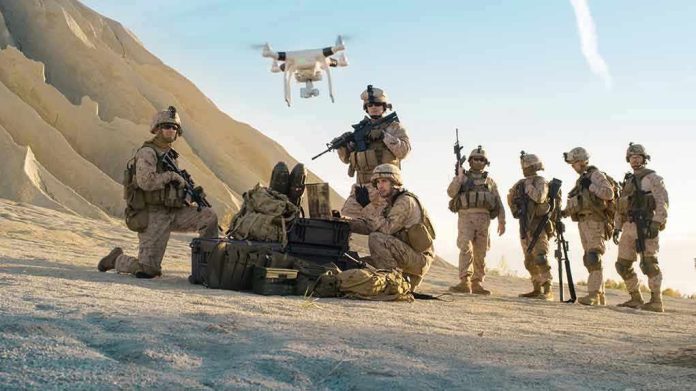
The Pentagon’s little-known drone office is demanding a staggering $54.6 billion funding surge—the largest single-year increase for any military program in history—raising serious questions about fiscal accountability and congressional oversight in an era when Americans are already drowning in federal debt.
Story Highlights
- Defense Autonomous Warfare Group seeks $54.6 billion for FY2027, a jaw-dropping 24,070% increase from its $225.9 million FY2026 budget
- Massive funding push relies heavily on partisan reconciliation process, bypassing traditional congressional scrutiny and debate
- Program absorbs Biden-era Replicator initiative, prioritizing drone swarms and AI-enabled autonomous systems across all combat domains
- Total defense budget reaches $1.5 trillion with $75 billion allocated for drones and counter-drone technology
- Taxpayers face unprecedented spending on largely untested autonomous warfare systems while struggling with inflation and economic uncertainty
Unprecedented Budget Explosion Raises Accountability Concerns
The Defense Autonomous Warfare Group received just $225.9 million in FY2026 funding when established late last year under the Trump administration. Pentagon officials now seek $54.6 billion for FY2027—a budget that exceeds the entire U.S. Marine Corps allocation of $52.8 billion. Lt. Gen. Steven Whitney, Director of Force Structure, Resources and Assessment, frames this as funding for “rapid innovation and new capabilities,” while Acting Comptroller Jules Hurst describes DAWG as a “pathfinder” for troop protection and battlefield dominance. The reliance on reconciliation funding—$53.6 billion of the total—circumvents normal appropriations processes that typically provide greater transparency.
From Replicator to DAWG: Autonomous Warfare Evolution
DAWG absorbed the Biden administration’s 2023 Replicator initiative, which aimed to field thousands of low-cost, attritable drones by 2028 for Pacific operations against peer adversaries like China. The new program operates under U.S. Special Operations Command, testing drones with commandos to evaluate systems across air, land, sea, and undersea domains. The initiative responds to lessons from Ukraine’s drone-heavy conflict, where inexpensive autonomous systems challenged traditional military platforms. DAWG emphasizes collaborative autonomy rather than human-operated drones, integrating systems like the MQ-25 Stingray and one-way attack drones. This represents a fundamental shift in military doctrine toward swarm tactics enabled by artificial intelligence.
Congressional Process Sidestepped Through Reconciliation
The Pentagon’s strategy to secure DAWG funding through the reconciliation process reveals a troubling pattern of avoiding rigorous congressional oversight. Reconciliation allows passage with a simple majority rather than the sixty votes typically required to overcome Senate filibusters, enabling partisan approval without bipartisan consensus. While Republicans control both chambers, this approach mirrors the same budget gimmicks that conservatives have long criticized Democrats for employing. The $1.5 trillion total defense request—$1.15 trillion base plus $350 billion reconciliation—represents a massive expansion during a period when national debt exceeds $35 trillion. Americans across the political spectrum increasingly question whether elected officials prioritize sound fiscal management or simply securing funding for pet projects that benefit defense contractors.
Economic Impact and Industry Windfalls
The DAWG funding surge promises enormous contracts for drone manufacturers and AI developers, creating obvious conflicts of interest as industry provides “feedback loops” to Pentagon planners. This cozy relationship between defense contractors and government decision-makers exemplifies the military-industrial complex concerns that resonate with citizens frustrated by government waste. The $54.6 billion allocation rivals the gross domestic product of small nations, funneling taxpayer dollars into largely unproven autonomous warfare systems. While proponents argue this investment protects American troops and maintains technological superiority, critics note the absence of competitive procurement processes and independent testing validating these expensive capabilities. Defense workers and manufacturers stand to benefit enormously, but ordinary Americans see their tax burden increase for programs that bypass normal accountability measures.
The Pentagon’s DAWG initiative represents either visionary preparation for future conflicts or reckless spending on untested technology, depending on one’s perspective. What remains indisputable is the unprecedented scale of funding increase and concerning lack of transparent oversight. As Congress considers this proposal, Americans deserve answers about how $54.6 billion in autonomous warfare spending serves national security interests versus contractor profits. The broader issue transcends partisan politics—it reflects fundamental questions about fiscal responsibility, government accountability, and whether the defense establishment operates in citizens’ interests or its own institutional priorities. Both conservatives and liberals should demand rigorous justification before approving history’s largest single-program military funding surge.
Sources:
Pentagon officials broadly detail $55 billion drone plan under DAWG
Pentagon’s little-known drone office just claimed largest single military funding surge ever
Pentagon’s Bet on Autonomous Warfare
Debrief: Pentagon’s Little-Known DAWG Fetches $54.6B Spending Plan