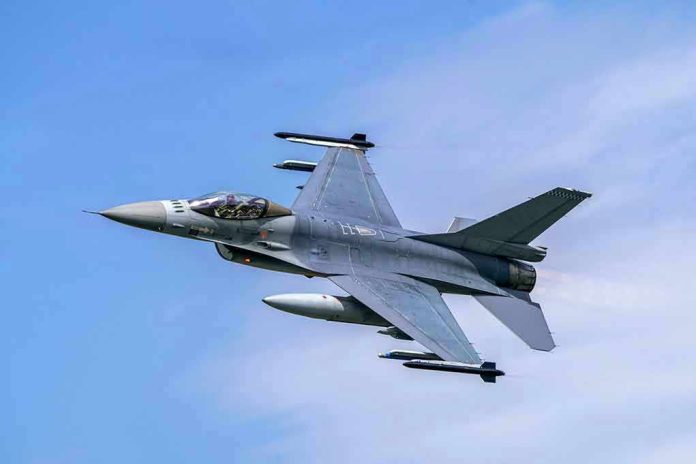
Kuwaiti defenses shot down three American F-15E Strike Eagles in a shocking friendly fire blunder amid war with Iran—yet every pilot walked away unscathed, begging the question: how did billion-dollar jets vanish in allied skies?
Story Snapshot
- Three U.S. F-15E Strike Eagles crashed over Kuwait on March 1-2, 2026, hit by Kuwaiti air defenses in confirmed friendly fire during Operation Epic Fury against Iran.
- All six aircrew ejected safely, recovered by locals and authorities, and remain stable with no serious injuries.
- Incident unfolded at 11:03 p.m. ET March 1 amid Iranian aircraft, missiles, and drone attacks flooding the battlespace.
- Loss totals over $300 million in aircraft; rapid U.S.-Kuwait coordination preserved alliance strength.
- Ongoing investigation targets Patriot system flaws in chaotic multi-threat combat.
Incident Timeline in Kuwaiti Airspace
Three F-15E Strike Eagles from the U.S. Air Force plummeted over Kuwait near Al Jahra at 11:03 p.m. ET on March 1, 2026, equivalent to early March 2 local time. Kuwaiti air defenses mistook them for threats during intense combat. Pilots and weapons systems officers ejected immediately. Local civilians and Kuwaiti forces recovered all six within hours. CENTCOM confirmed the friendly fire nature swiftly.
Operation Epic Fury Ignites the Chaos
Operation Epic Fury launched at 1:15 a.m. ET March 1 with U.S.-Israeli strikes hammering Iranian targets. Forces hit IRGC command centers, air defenses, missile sites, and airfields. Israeli officials and President Trump confirmed Ayatollah Ali Khamenei’s death in a strike on his compound. Iran retaliated fiercely, killing three U.S. troops and wounding five before the F-15 losses. Kuwait hosted U.S. bases actively backing the campaign.
Stakeholders Respond with Transparency
CENTCOM stated Kuwaiti defenses erroneously downed the jets amid Iranian aircraft, ballistic missiles, and drones overwhelming radars. Kuwait’s Ministry of Defense verified crew safety and hospital transport. Gratitude flowed both ways: U.S. thanked Kuwaiti recovery efforts; Kuwait condemned Iranian strikes. Regional allies like Saudi Arabia and UAE stood firm in the anti-Iran coalition. This swift honesty aligns with conservative values of accountability in alliances.
Aircrew families breathed relief as all six pilots and WSOs evaded serious harm. U.S. forces now scrutinize procedures while crews await return to base.
Technical Breakdown of the Friendly Fire Failure
Patriot missiles likely misidentified the F-15Es when radar screens saturated with threats. These systems use radar tracks and IFF encryption, but chaos from simultaneous Iranian jets, missiles, and drones caused errors. Heightened alerts amplified risks. A prior 2024 USS Gettysburg incident downed an F/A-18F under similar stress, pointing to systemic issues over operator fault. Common sense demands better tech resilience in multi-threat wars.
Immediate and Lasting Repercussions
Short-term, Operation Epic Fury loses airpower punch from the $300 million aircraft hit. Investigations divert resources to fix IFF and protocols. Long-term, expect Patriot upgrades, refined training, and tighter U.S.-Kuwait coordination. The zero-casualty outcome reassures families and troops. Politically, it bolsters alliances without derailing the Iran campaign. Broader lessons sharpen defenses against friendly losses in high-stakes skies.
Sources:
US confirms three US F-15 fighter jets crashed in Kuwait in friendly fire incident, crews OK
F-15 Crashing in Flames Middle East
US F-15 fighter jet crashes in Kuwait
Kuwait says several US warplanes crashed in the country, all crew survived
Three US F-15s involved in friendly fire incident in Kuwait pilots safe
3 F-15s shot down by Kuwait in friendly fire incident pilots safe US says