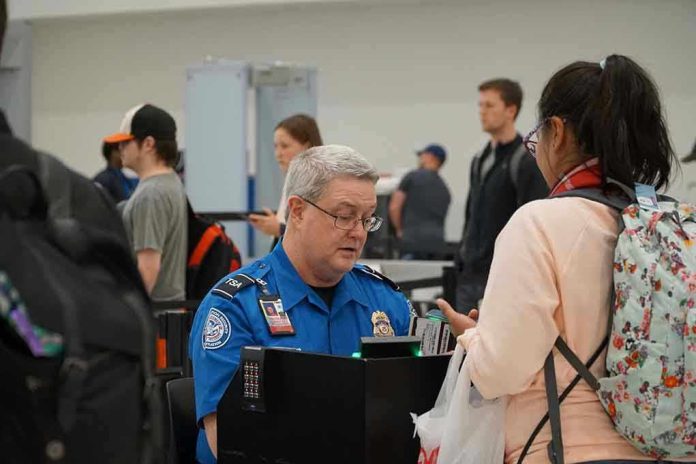
A funding fight in Washington turned into a three-hour penalty box for ordinary Americans standing in airport security lines.
Quick Take
- A partial DHS shutdown that began February 14, 2026, hit airports hardest during spring break travel.
- DHS and TSA leaders publicly blamed Senate Democrats for a funding lapse that left TSA officers working without pay.
- TSA reported unscheduled absences doubling as pay disruptions and assaults on officers increased at checkpoints.
- Senate Democrats tied DHS funding to ICE/CBP policy reforms; Republicans demanded full funding without enforcement limits.
- Airports from Houston to Atlanta reported hour-plus waits, with some lines approaching three hours.
Spring Break Chaos Exposed the One Agency You Can’t “Pause”
DHS put the blame on Democrats as security lines at major U.S. airports stretched from annoying to unworkable, including reports of nearly three-hour waits at Houston’s William P. Hobby Airport. The immediate mechanism wasn’t mysterious: the DHS funding lapse forced TSA officers to keep screening passengers without reliable pay, and TSA leadership said unscheduled absences doubled. Travelers saw the result in real time: missed flights, frayed tempers, and a system designed for volume suddenly running thin.
Air travel functions on tight tolerances. A small staffing drop ripples quickly because checkpoints can’t “catch up” later the way a back office can. When a checkpoint slows, the line grows, then grows faster because flights keep departing at scheduled times. That’s why shutdowns don’t feel like abstract budget disputes; they feel like standing still while the clock punishes you. DHS messaging leaned into that reality, framing the episode as preventable and politically manufactured.
What Actually Broke: Pay, Attendance, and the Human Limits of “Essential”
TSA officers fall into the category Washington calls “essential,” which often translates to “required to work during a shutdown.” TSA leadership described partial paychecks in early March, followed by worse conditions as the lapse continued. When families can’t count on the next deposit, “unscheduled absence” stops being a statistic and becomes a coping strategy: second jobs, child care conflicts, skipped commutes, and a basic question of whether showing up costs more than it earns.
TSA also reported an increase in assaults on officers during this period, echoing dynamics seen in the 2018–2019 shutdown. Pressure at checkpoints concentrates conflict. A delayed passenger sees an officer as the obstacle, not the exhausted person implementing rules written far above their pay grade. TSA has emphasized screening integrity remained intact, but the trendline matters: chronic understaffing plus rising hostility is how a functioning operation drifts toward failure without any single dramatic incident.
The Senate Standoff: ICE/CBP Reforms Versus “No Kneecapping” Enforcement
Senate Democrats argued DHS funding should come with reforms to immigration enforcement, including limits and requirements they say protect civil liberties. Republicans argued the opposite: fund DHS cleanly and fully, without constraints that weaken ICE and CBP. The result became a familiar Washington deadlock with a twist: instead of a broad federal shutdown, this one pinched DHS specifically, dragging frontline security and disaster-response components into a political struggle centered on the border.
From a conservative, common-sense viewpoint, holding TSA pay hostage to win leverage over ICE/CBP looks like governing backward. Congress can debate warrants, sensitive locations, and enforcement boundaries without turning airports into stress tests for working families. At the same time, Republicans blocking piecemeal fixes invites its own criticism: if lawmakers know TSA and Coast Guard operations are taking the hit, refusing targeted relief can look like choosing political symmetry over public order.
Why TSA Becomes the Punching Bag in Every Shutdown
TSA sits at the intersection of federal authority and everyday life. Most agencies can quietly degrade for weeks before the public notices. TSA fails loudly within hours. That visibility makes TSA useful to both parties: a vivid example to shame the other side. During this lapse, TSA even rolled out airport-facing video messaging warning travelers of long waits and urging patience for unpaid officers—communication that doubles as a public pressure campaign, whether intended or not.
The deeper problem is structural. Shutdown politics rewards maximum leverage, and leverage requires pain. Airports produce measurable pain—line length, missed flights, viral videos—so they become the preferred theater. If lawmakers wanted to stop this cycle, they’d treat aviation security like critical infrastructure funding: automatic continuity appropriations, no lapses, no bargaining with payroll. Washington resists that because it would remove a reliable hostage from the negotiating table.
What Happens Next if the Lapse Drags On
As of mid-March, reports showed persistent long lines in places like Houston, New Orleans, and Atlanta. TSA leadership said screening remained safe, but safety isn’t binary; it’s a capacity game. When absences double, overtime climbs, and burnout spikes, performance risk rises even if no one can point to a single “failure.” The public also recalibrates expectations: travelers start arriving earlier, snapping at staff sooner, and trusting institutions less.
The practical fix is simple and unglamorous: restore full DHS funding and sort out immigration policy in normal order. A government that can’t keep paychecks flowing to the people checking boarding passes and bags can’t claim competence with a straight face. If lawmakers want voters over 40 to believe in stability again, they should start by proving they can keep the lights on at the nation’s airports.
Until then, the most revealing detail isn’t the partisan talking point. It’s the quiet admission embedded in every warning about lines: the system works only when ordinary workers believe the country will keep its promises to them.
Sources:
DHS Hammers Dems Over Airport Security Lines Amid Funding Lapse
TSA rolls out video warning travelers of long wait times
Lawmakers vent frustration over DHS shutdown as lines grow at nation’s airports