A passport is supposed to be a boring proof-of-citizenship booklet, until the government decides to turn it into a political Rorschach test.
Story Snapshot
- The State Department says it will issue a limited-edition commemorative passport tied to the America250 anniversary.
- The interior artwork includes President Donald Trump’s portrait and a gold-style signature alongside Declaration of Independence text and an image of the 1776 signing.
- Applicants can get it at no extra cost, but only by applying in person at the Washington Passport Agency starting in July 2026.
- Officials emphasize security remains unchanged; the real dispute is symbolism, precedent, and who “owns” national imagery.
What the “Patriot Passport” Actually Is, and Where You Can Get One
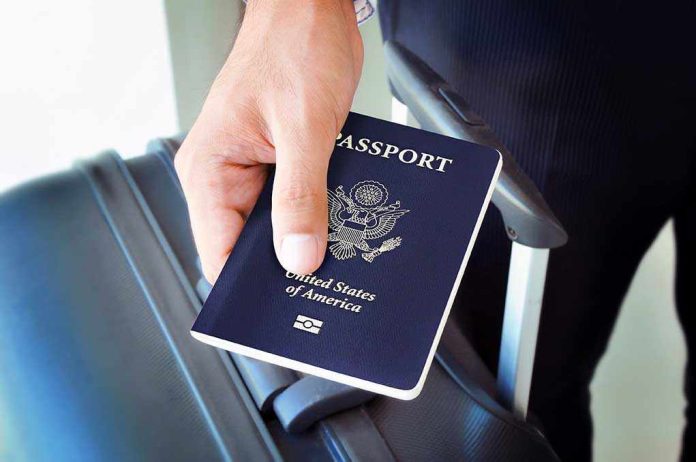
The State Department’s plan centers on a commemorative edition timed for July 2026, when America’s 250th birthday celebrations hit full volume. The limited-run passport keeps the standard security features used in modern U.S. passports, but adds customized interior art: Trump’s portrait and signature placed amid Declaration of Independence text, paired with a scene of the Declaration’s signing. Availability matters as much as design: only in-person applicants at the Washington Passport Agency qualify.
That narrow distribution is the first quiet plot twist. This isn’t a nationwide switch, not a website checkbox, not a mail-in surprise for families renewing before a cruise. It’s a D.C.-only, supply-limited offering that effectively turns a federal document into a destination item. For a certain kind of traveler, that’s collector catnip; for critics, it looks like the government flirting with personality branding on a document meant to be politically neutral.
Why This Breaks the Unwritten Rules of Passport Design
Most Americans don’t track passport aesthetics, but there’s a long-standing norm: official travel documents showcase national symbols, landscapes, and shared history—not living political figures. The “Next Generation” passport introduced in 2021 leaned into that tradition with iconic scenes and security-driven artwork choices. The America250 edition changes the emotional temperature by putting a sitting president’s likeness inside the book. No statute forbids the idea in the reporting, but tradition is its own form of guardrail.
The State Department spokesperson’s public posture focuses on art and security, not the political lightning rod in the renderings. That choice reads strategic. Agencies usually try to avoid becoming campaign props because passports cross borders and outlast news cycles. If the point is a patriotic commemoration, critics ask why the Founders and flags aren’t enough. If the point is legacy, supporters ask why Washington and Lincoln get monuments but modern leaders can’t be part of the story.
America250: A Celebration, a Brand, and a Political Multiplier
The passport sits inside a broader America250 initiative, a government-backed anniversary push that has already leaned into high-profile, made-for-TV events. Commemorations can unify, but they can also become a megaphone for whichever administration holds the controls at the time. That’s the central tension: the same machinery that prints secure documents and stages national celebrations also chooses the imagery. When that imagery includes the president, the celebration stops feeling generic and starts feeling owned.
From a conservative, common-sense standpoint, the fairest test is simple: does the design serve the country, or does it serve a personality? If the content truly elevates founding principles, it can reinforce civic pride without demanding ideological agreement. If it reads like forced loyalty—especially if applicants can’t opt out when applying in person—then the government invites the very backlash it claims it doesn’t want. The reporting suggests no opt-out mechanism for those who receive the commemorative version at that office.
The Practical Fallout: Scarcity, Confusion, and the Secondary Market
Limited supply plus a single pickup pipeline produces predictable consequences. Expect lines, appointment scarcity, and a cottage industry of “help” services that hover around high-demand government paperwork. Reporting also shows uncertainty around how many will exist; one widely circulated number was publicly challenged. That matters because scarcity drives behavior: people travel for “limited edition” items, resellers sniff opportunity, and ordinary applicants risk getting swept into a circus they never asked for.
The most grounded concern isn’t that the passport will stop working; officials stress it maintains the same security features as other U.S. passports. The concern is institutional drift. Once an agency proves it can attach current political branding to a core identity document without immediate consequences, future administrations can do the same. Today it’s Trump with Declaration text; tomorrow it’s another president, another cause, another “limited run.” The precedent becomes the product.
How This Plays Overseas: The Passport as a Message You Don’t Control
Americans often forget that a passport is also an ambassador. Foreign border officers don’t care about U.S. cable-news feuds, but they do recognize when a document broadcasts internal politics. A commemorative interior page won’t change entry rules, yet it can change the vibe: a traveler suddenly has to explain a design choice they didn’t make, or they have to own it proudly in a tense moment. That’s not catastrophic, but it’s friction—exactly what a passport should reduce.
Supporters will argue, with some justification, that foreign governments print leaders on currency and commemorate politics all the time, and America shouldn’t act allergic to its own elected leadership. Critics will respond that U.S. strength comes from institutions that outlast leaders, and that identity documents should underscore continuity, not partisan mood. Both arguments contain truth; the deciding factor is whether the State Department can keep commemoration from turning into a revolving billboard.
What to Watch Before July 2026
The unanswered questions will shape whether this stays a quirky footnote or becomes a genuine institutional controversy: Will the Washington Passport Agency clearly disclose the commemorative version before payment and processing? Will an applicant be able to request a standard design instead? Will the department publish firm production numbers to prevent rumor-driven chaos? Those are process questions, not ideology questions—and process is where government earns trust.
Cue the Meltdown: State Dept to Issue Commemorative 'Patriot Passport' Featuring Trump's Imagehttps://t.co/D2bHuSy5oq
— RedState (@RedState) April 29, 2026
Americans can handle patriotic art, even bold patriotic art, when it feels like it belongs to everyone. The moment a passport’s symbolism feels assigned—especially by bureaucratic default—people stop debating design and start debating power. That’s the real story behind the “Patriot Passport”: not whether Trump belongs on an interior page, but whether the country wants its most basic proof of citizenship to double as a statement piece.
Sources:
New passports featuring Trump’s image unveiled by State Department
State Department passport design includes Trump portrait
US to issue commemorative passports bearing Trump’s image
Trump passports: State Department unveils new commemorative design