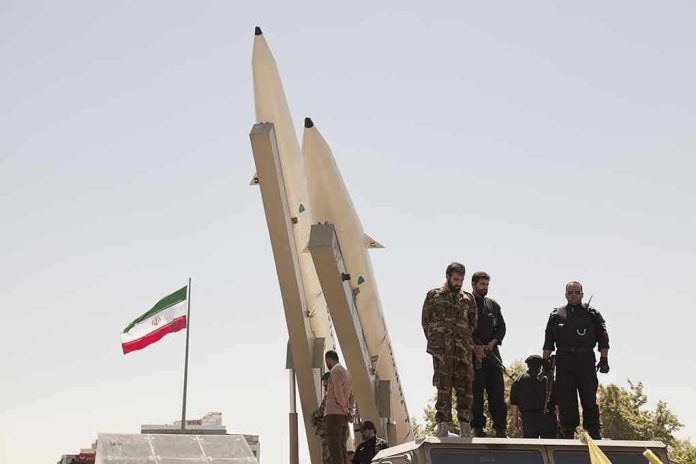
The collapse of American-led ceasefire talks has triggered Israeli warnings of devastating military escalation against Iran, pushing the Middle East to the brink of a wider regional war that could reshape global energy markets and international security for decades.
Story Snapshot
- Iran rejected a 15-point U.S. ceasefire proposal demanding nuclear dismantlement, prompting Israeli threats of intensified strikes
- Twenty-one hours of negotiations in Pakistan ended without agreement, with U.S. Vice President JD Vance leading talks opposite Iranian Parliament Speaker Mohammad Bagher Ghalibaf
- Iran countered with its own 5-point plan demanding war reparations, security guarantees, and sovereignty over the Strait of Hormuz
- Recent Iranian attacks on Kuwait International Airport and continued Israeli strikes near Isfahan signal military operations continue unabated
- No additional diplomatic talks scheduled as hardline elements within Iran’s Revolutionary Guard Corps reportedly block negotiating flexibility
The Diplomatic Breakdown in Pakistan
Vice President JD Vance spent 21 hours in Pakistan attempting to broker peace between the United States and Iran, only to watch negotiations crumble amid irreconcilable demands. The American proposal required Iran to dismantle its nuclear program and halt all uranium enrichment in exchange for full sanctions relief, civilian nuclear energy assistance, and removal of automatic UN sanctions mechanisms. Iranian officials walked away, with their Foreign Minister Abbas Araghchi flatly declaring that no negotiations with the enemy had occurred and none were planned. The stark contradiction between White House claims of productive ongoing talks and Iran’s outright denial reveals the chasm separating these adversaries.
Iran’s Counterdemands and Military Response
Tehran issued its own proposal through state television, a 5-point plan that reads like a victor’s terms rather than a negotiated settlement. Iran demands an end to assassinations of its officials, security guarantees against future wars, war reparations for damages sustained, complete cessation of hostilities, and Iranian sovereignty over the Strait of Hormuz. That final demand strikes at the heart of global energy security, as roughly one-fifth of the world’s oil normally passes through that waterway. Iran’s rejection came with military punctuation: attacks on Israel and Gulf Arab countries, including an assault on Kuwait International Airport that broadened the conflict beyond the two primary antagonists.
Israel’s Escalation Threat and Strategic Calculations
Israeli officials have made their position unmistakably clear: continued Iranian refusal will trigger even more devastating strikes than those already executed. Israel has completed what it describes as wide-scale bombing campaigns across Iran, with heavy strikes concentrated around Isfahan, home to critical nuclear facilities. Prime Minister Benjamin Netanyahu convened security officials to coordinate responses with the U.S. blockade decision, demonstrating the tight coordination between Washington and Jerusalem. Israel’s Ambassador to the United States, Yechiel Leiter, acknowledged that avoiding war would be preferable, but only if Iran abandons nuclear weapons development. That qualifier essentially guarantees continued conflict, as Iran shows zero inclination to surrender its nuclear ambitions under military pressure.
The Revolutionary Guard’s Stranglehold on Negotiations
The Islamic Revolutionary Guard Corps has emerged as the critical obstacle to diplomatic progress. Commander Ahmad Vahidi and hardline elements within the IRGC refuse to delegate authority to negotiate on nuclear and military matters, effectively handcuffing Iranian civilian negotiators. This internal power struggle within Tehran explains why talks produced no movement despite marathon sessions. The IRGC’s influence reflects a broader reality: Iran’s military-security apparatus holds more power than its diplomatic corps, and those military leaders have staked their legitimacy on resistance to American and Israeli pressure. Any Iranian official perceived as capitulating risks not just political consequences but potentially their life, given the regime’s history of eliminating perceived traitors.
Global Energy Markets and Regional Stability at Risk
The conflict’s expansion threatens consequences far beyond the immediate combatants. Attacks on Kuwait International Airport demonstrate Iran’s willingness to strike Gulf Arab states, nations that host American military bases and produce massive oil volumes. The Strait of Hormuz dispute carries particular weight: any Iranian attempt to assert exclusive sovereignty would disrupt global shipping and send energy prices soaring. UN Secretary-General António Guterres warned that the fighting has broken past limits even leaders thought imaginable, calling specifically for the U.S. and Israel to end military operations. His plea reflects growing international alarm that this conflict could metastasize into a regional conflagration drawing in additional state actors and devastating civilian populations across multiple countries.
American officials characterize the negotiating gap as substantial, with one stating parties were nowhere close to agreement. Vice President Vance suggested the failed talks represent worse news for Iran than America, projecting confidence in U.S. military superiority. Yet confidence in military dominance does not equal strategic victory. The approximately 1,000 soldiers from the 82nd Airborne Division reportedly prepared for potential deployment signal American willingness to escalate beyond airstrikes if necessary. The absence of scheduled follow-up talks, combined with senior officials returning home, suggests diplomacy has exhausted its near-term potential. What remains is the grim prospect of escalating military exchanges between a nuclear-threshold state and the world’s most powerful military alliance, with global economic stability and countless civilian lives hanging in the balance.
Sources:
The Jerusalem Post – Iran-US Ceasefire Negotiations
Wikipedia – 2025-2026 Iran-United States Negotiations