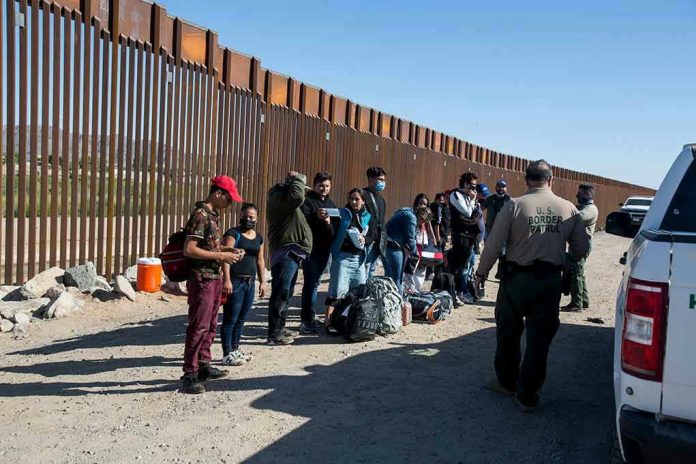
The Supreme Court just handed the Trump administration one of its biggest immigration wins ever, ruling that asylum seekers who have not physically crossed into the United States have no legal right to enter and apply for protection.
Story Snapshot
- On June 25, 2026, the Supreme Court ruled 6-3 that the government’s border turnback policy is lawful, clearing the way for officials to turn migrants away at ports of entry.
- The Court’s decision rests on a plain reading of the word “arrives” in federal immigration law, finding that migrants who have not physically entered the U.S. cannot claim asylum rights.
- A separate federal appeals court had ruled the opposite in April 2026, creating a legal clash that the Supreme Court’s decision now resolves in the administration’s favor.
- Legal advocacy groups are still fighting in court, and the full impact of the ruling on day-to-day border operations remains unsettled.
What the Supreme Court Actually Decided
The Supreme Court declined to rehear a challenge to the border turnback policy on June 25, 2026, effectively locking in the ruling that the policy is lawful. [3] The core legal question was simple but loaded: does a migrant standing at a port of entry, but not yet inside the United States, have a right to apply for asylum? The Court said no. The majority read the Immigration and Nationality Act’s use of the word “arrives” to mean physical entry into U.S. soil is required before asylum protections kick in. If Congress wants a different result, the Court said, Congress can change the law.
That textualist reading is exactly how a conservative-majority court should approach a statute. The law says what it says. Advocacy groups and lower courts that tried to stretch the word “arrives” to cover people standing at the border’s edge were doing judicial rewriting, not legal interpretation. The Supreme Court put a stop to that. Whether you support or oppose the policy on humanitarian grounds, the legal reasoning here is grounded in the actual text of the law, not in what judges wish the law said.
The Lower Court Clash That Set This Up
Getting here was not clean. In April 2026, the D.C. Circuit Court of Appeals ruled that President Trump’s Day 1 proclamation shutting down asylum access was unlawful. [1] The appeals court found the proclamation improperly bypassed the removal procedures Congress set up in the Immigration and Nationality Act. That ruling briefly restored asylum access at the border. But a stay was placed on the decision, keeping it from taking full effect while the legal fight continued. The Supreme Court’s June 25 ruling now overrides that lower court decision, though the legal machinery is still grinding through the courts.
The Ninth Circuit had also ruled against the turnback policy in 2024, finding that blocking migrants from stepping across the border to request asylum violated federal law. [4] That created a direct conflict between the circuit courts, the exact kind of split the Supreme Court exists to resolve. It resolved it firmly in the administration’s favor.
Why This Fight Has Been Going On for Years
This is not the first time a president has tried to restrict asylum at the southern border, and it will not be the last. The Trump administration’s first term produced an “asylum ban” in 2018 that the Supreme Court refused to allow at the time, and a transit-country rule in 2019 that the Court did allow to proceed. The Biden administration later adopted its own restrictions tied to encounter thresholds. [2] Every administration since the modern asylum system was built in 1980 has bumped into the same wall: a statute written for a different era of migration, and courts that disagree on what it means.
The Supreme Court Says the U.S. Can Turn Away Asylum Seekers at the Border #SupremeCourt #AsylumSeekers #ImmigrationLaw https://t.co/pq3SksofMb pic.twitter.com/bMYv5M01Vc
— Meyner and Landis (@ML_LawFirmNJ) June 25, 2026
The Supreme Court has a long history of deferring to the executive branch on immigration. The “plenary power” doctrine, developed in the late 1800s, tells courts to stay out of immigration decisions made by the president and Congress. The current Court has followed that tradition more consistently than its predecessors, and the June 25, 2026 ruling fits that pattern exactly. Advocates who expected the courts to block every executive restriction on asylum have now run out of room at the top.
What Comes Next and Why It Is Not Over
The ruling does not automatically flip a switch at the border. The D.C. Circuit’s April 2026 decision, though stayed, is still technically alive in the lower courts. [2] Legal groups like the Center for Gender and Refugee Studies are pressing forward with the Mullin v. Al Otro Lado case, which challenges the turnback policy on different grounds. [4] International human rights organizations argue the policy violates the principle of non-refoulement, the global legal norm against sending people back to places where they face persecution. Those arguments will keep coming, even if they now face a much steeper climb. The Supreme Court has spoken, the law supports border enforcement, and the next move belongs to Congress if it wants a different outcome.
Sources:
[1] Web – BREAKING: Supreme Court Sides with Trump, Allows Immigration Officials …
[2] Web – [PDF] RAICES v. Noem, No. 25-5243 – United States Court of Appeals
[3] Web – Border Restrictions and Court Orders 2017-2026
[4] Web – Supreme Court Rules Defunct Border Turnback Policy Is Lawful